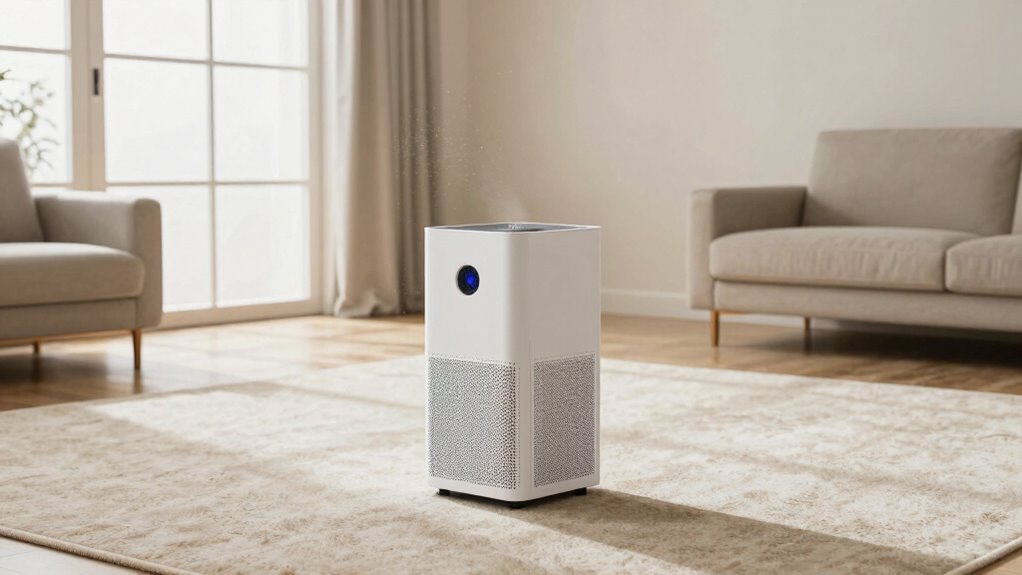
If your air purifier struggles to keep up with pollutants, allergens, or odors, it’s likely too small for your room. You’ll notice high filter replacement frequency, increased noise, and persistent dust or smells despite continuous use. An undersized unit won’t circulate enough air or improve air quality efficiently. If these signs sound familiar, your purifier may need an upgrade. Keep exploring to discover how to choose the right size for your space and guarantee healthier air.
Key Takeaways
- The purifier struggles to adequately filter pollutants, allergens, or odors in the space.
- Filters require frequent replacement due to rapid dirt accumulation.
- The device runs continuously at high speeds with noticeable noise.
- Overall air quality remains poor despite ongoing operation.
- Persistent issues persist even after maintenance, indicating insufficient capacity.
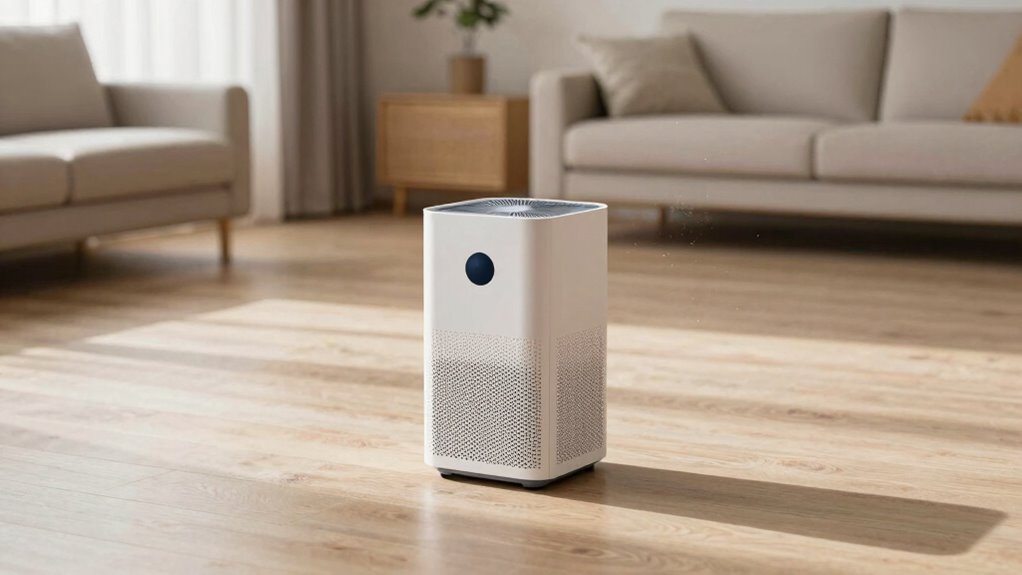
Wondering if your air purifier is powerful enough for your space? The first thing to verify is whether it’s effectively filtering the air in your room. If your purifier is too small, you’ll notice that it struggles to keep up with the pollutants, allergens, or odors you want to eliminate. When an air purifier is undersized, it simply doesn’t have the capacity to circulate enough air to clean the entire space efficiently. This means you might see persistent dust, lingering smells, or allergy symptoms that don’t improve over time. To truly gauge if your unit is suitable, check its Clean Air Delivery Rate (CADR) and compare it with the size of your room. If the recommended room size for your purifier is considerably less than your actual space, it’s a clear sign it’s too small.
Another clue is how often you need to perform filter maintenance. An undersized purifier works harder, running continuously to try to purify the air, which accelerates filter wear. If you find yourself replacing filters more frequently than suggested or notice that filters get dirty quickly, it’s a sign your device isn’t keeping pace with your room’s needs. Additionally, pay attention to noise levels. Small or underpowered units often run at higher speeds more frequently to compensate for their limited capacity, which leads to increased noise. If your purifier is loud even when set to a low or medium setting, it could be a sign it’s struggling to handle the room size. Excessive noise isn’t just annoying; it indicates the device is working harder than it should, often because it’s too small. Proper sizing can help reduce this strain and noise, ensuring more comfortable operation.
You should also observe the overall air quality and whether it improves over time. If the air feels stale, or if dust and allergens remain visible or detectable, your purifier isn’t doing enough. An undersized unit will likely run constantly without achieving the desired clean, fresh environment. It’s essential to understand air exchange rate, which is a critical factor in determining whether your purifier matches your room’s needs. Understanding the importance of capacity can help you select a device that matches your needs more effectively. If you notice these signs, it’s time to contemplate upgrading to a more appropriately sized air purifier. Remember, choosing one that matches your room size guarantees optimal filter maintenance, keeps noise levels manageable, and provides the clean air you’re after. Investing in the right size means your purifier won’t be overworked or underperforming, making your air cleaner, healthier, and more comfortable to breathe.

LEVOIT Air Purifiers for Home Large Room Up to 1875 Ft² with Washable Pre-Filter, AHAM VERIFIDE, Air Quality Monitor, HEPA Sleep Mode for Allergies, Pet Hair in Bedroom, Vital 200S-P, White
𝐖𝐇𝐘 𝐂𝐇𝐎𝐎𝐒𝐄 𝐀𝐇𝐀𝐌 𝐕𝐄𝐑𝐈𝐅𝐈𝐃𝐄 𝐏𝐑𝐎𝐃𝐔𝐂𝐓𝐒: AHAM (Association of Home Appliance Manufacturers) is an ANSI-accredited organization that sets strict…
As an affiliate, we earn on qualifying purchases.
As an affiliate, we earn on qualifying purchases.
Frequently Asked Questions
Can an Air Purifier Be Too Large for a Small Room?
Yes, an air purifier can be too large for your room. When selecting an air purifier size, consider room compatibility—an oversized unit may be louder and consume more energy than needed. It might also lead to over-filtering, which isn’t necessary and could cause maintenance issues. To guarantee peak performance, match the air purifier size with your room’s size, avoiding units that are excessively large for small spaces.
How Does Room Layout Affect Purifier Effectiveness?
Room layout greatly impacts your air purifier’s effectiveness. If airflow circulation is blocked by furniture or curtains, the purifier can’t evenly clean the air. You should place it in an open space, away from clutter, to maximize airflow and guarantee fresh air reaches all corners. Proper furniture placement helps prevent airflow obstruction, allowing your purifier to work efficiently and improve overall indoor air quality.
Do Air Purifiers Work Better in Open or Closed Spaces?
Air purifiers work better in closed spaces because ventilation strategies and air circulation patterns stay more controlled, allowing the device to effectively filter pollutants. In open areas, fresh air enters constantly, diluting the purifier’s efficiency. To optimize performance, use the purifier in a space where air circulation can be managed, and consider adding fans or vents to enhance circulation and prevent stale air from lingering.
Can Multiple Small Purifiers Outperform One Large Unit?
Imagine you’re in a large living room with multiple small purifiers placed around, each targeting specific zones. Multiple small purifiers can outperform one large unit by increasing overall air purifier efficiency and covering more area, but they might raise noise levels. Consider noise level considerations and placement for peak performance. Using several units can be effective, but guarantee they’re appropriately sized and placed to avoid unnecessary noise and maximize air cleaning.
How Often Should I Replace Filters in a Small Air Purifier?
You should replace filters in your small air purifier every 3 to 6 months, depending on usage and air quality. Check the filter lifespan recommendations from the manufacturer, as replacement frequency varies with environmental factors like dust and pet dander. If you notice reduced airflow or odors lingering, it’s a sign to replace the filter sooner. Regularly maintaining your purifier guarantees peak performance and cleaner air in your space.

KNKA Air Purifier for Home Bedroom Large Room Up to 1,695 Ft² in 1 Hr, HEPA Sleep Mode Air Cleaner with Washable Pre-Filter, AHAM VERIFIDE, AQI Display, Pet Mode for Pets, Dust, Pollen, APH4000
𝐀𝐇𝐀𝐌 𝐕𝐞𝐫𝐢𝐟𝐢𝐞𝐝 & 𝐇𝐢𝐠𝐡 𝐂𝐀𝐃𝐑 𝐕𝐚𝐥𝐮𝐞: Certified by the Association of Home Appliance Manufacturers, this air purifier provides…
As an affiliate, we earn on qualifying purchases.
As an affiliate, we earn on qualifying purchases.
Conclusion
If your air purifier struggles to clear the air, it’s like trying to put out a wildfire with a garden hose—completely overwhelmed. Don’t settle for a tiny unit that can’t handle your space’s needs; it’s a waste of money and effort. Choose an air purifier that matches your room size perfectly, so you can breathe easy knowing you’re protected. Remember, a well-sized purifier isn’t just an appliance—it’s your fortress against airborne pollutants.

GermGuardian HEPA Air Purifier – Large Room Air Purifier for Bedroom, Office, Dorm, and Home – Filters Pet Dander, Dust, Pollen, Smoke, Scents – AC4825E – 22" Tower – Gray
AIR PURIFIER FOR HOME: Circulates and filters air in a small bedroom (153 sq. ft.) every 12.5 minutes…
As an affiliate, we earn on qualifying purchases.
As an affiliate, we earn on qualifying purchases.

Air Purifiers for Home Large Room up to 2200sq.ft, MOOKA Air purifier for Home Pets with Washable Filter, PM 2.5 Display Air Quality Sensor Air Cleaner for Bedroom, Dorm room, Pets, Office PR1 (White)
MORE AIR INTAKE & HIGH-EFFICIENCY: This is the 2024 latest MOOKA PR1 HEPA air purifiers for home. To…
As an affiliate, we earn on qualifying purchases.
As an affiliate, we earn on qualifying purchases.