
TL;DR

Get cleaning gear delivered free — and shop member deals
- Fast, free delivery on millions of items
- Access to Prime Big Deal Days deals on October 6–7
- Prime Video, Amazon Music and more included
The best gas ranges for home chefs balance a powerful burner for fast boiling with a true simmer burner for sauces, plus an oven sized for the pans you use. Compare freestanding, slide-in, pro-style, and compact models by burner layout, convection, cleaning, fuel compatibility, and installation requirements before choosing.
Compare both burner extremes: standard burners commonly run 5,000–9,500 BTU, power burners 12,000–23,000 BTU, and true simmer burners about 500–800 BTU [1].
Choose oven capacity by measuring the pans and meals you cook; a larger cubic-foot figure does not guarantee a better rack layout.
Treat compact 20-inch ranges and a 48-inch dual-fuel range as distinct options with very different space, oven, and installation needs.
Check whether a product specification is confirmed; an omitted feature in a listing is not proof that the appliance lacks it.
Use a licensed professional for gas installation or approved fuel conversion, and plan ventilation for a gas cooking appliance.
Start with the cooking you do most often
The best gas ranges for home chefs match your regular meals, cookware, and kitchen space; no single feature makes a range the right choice for everyone. A household that often cooks large holiday roasts needs a different oven from a renter who mostly sautés vegetables and bakes a small tray of cookies. Start with your real weeknight routine, then decide which specifications matter.Imagine making dinner on a Tuesday: you boil pasta, warm a sauce, and roast vegetables at the same time. You need a burner that can bring a large pot to a boil, a second burner that can hold sauce at a gentle bubble, and enough oven room for the vegetables without crowding the rack. That small scenario reveals more than a long list of add-on features.
Before you compare models, write down the largest pan you use, the biggest dish you bake, and whether you cook with natural gas or propane. Then measure the opening where the range will sit, including depth and clearance around cabinets. A handsome 48-inch range will not help if your kitchen opening is built for a standard-width appliance.
- Choose the cooking surface around your most-used pans and burner combinations.
- Choose oven capacity around the roasting pan, baking sheets, and number of dishes you cook at once.
- Choose range width only after measuring the opening, walkways, and nearby doors.
This approach also keeps you from paying attention to features you may rarely use. If you bake one sheet of cookies a month, a second oven may matter less than easy-to-clean grates or a reliable low flame.
Compare the main gas range styles before you shop
Freestanding ranges are the familiar, flexible choice, slide-in models put controls at the front for a built-in look, and pro-style ranges emphasize high-output burners and larger formats. The style affects appearance, control placement, installation fit, and often the overall cost. Measure first: a slide-in range can expose gaps where an old freestanding model’s backguard once covered the counter.| Style | What you get | Works well for | Watch for |
|---|---|---|---|
| Freestanding | Finished sides and usually a rear control panel | Replacing a standard range or keeping options flexible | Backguard height and reach to rear controls |
| Slide-in | Front controls and a cleaner counter-to-range line | Kitchen remodels and cooks who prefer front access | Exact width, counter overlap, and exposed wall area |
| Pro-style | Often more burners, heavy grates, and high-output cooking | Large kitchens and cooks who use several pans at once | Wide footprint, ventilation, fuel supply, and installation |
| Compact | Narrower body and a smaller oven cavity | Small kitchens, accessory units, or tight remodels | Limited oven room and fewer burner-layout choices |
For example, replacing a freestanding range in a rental may be simplest if you keep the same layout and width. In a remodel, a front-control slide-in can give the counters a smoother line, but you’ll want the installer to check the opening and countertop edges before delivery.
Price bands vary by brand, size, and features, so treat them as rough market context rather than a promise: research commonly places freestanding models around $600–$1,500, slide-ins around $1,200–$3,000, and pro-style models around $4,000–$10,000 or more [1]. Compare current specifications and total installation needs when you shop.
Balance a power burner with a real simmer setting
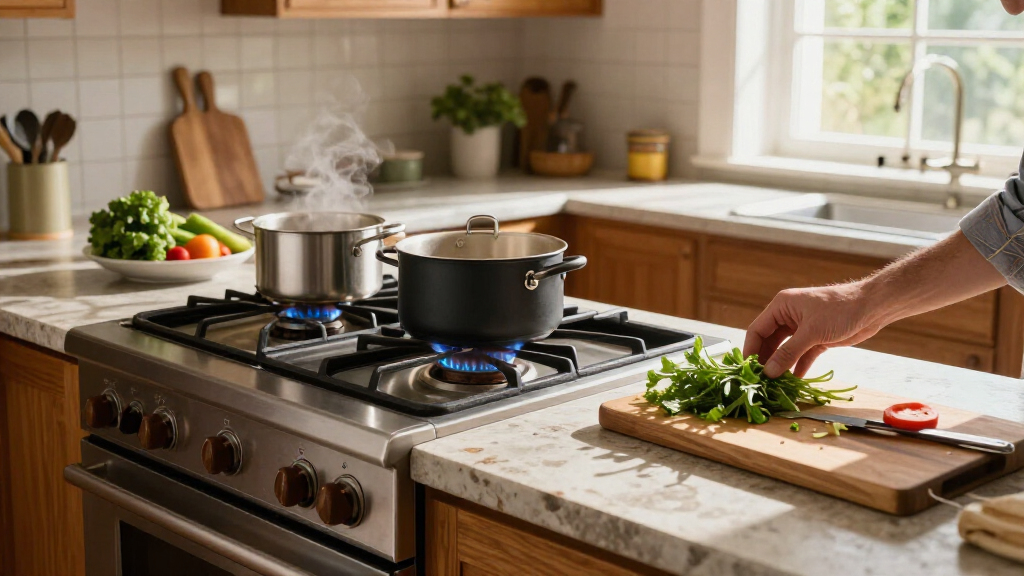
A useful cooktop gives you both fast heat and steady low heat, because searing and gentle simmering ask for opposite flame behavior. Standard burners often run at 5,000–9,500 BTU, while power burners commonly range from 12,000–23,000 BTU; some pro-style burners reach 25,000 BTU or higher [1]. True simmer burners can hold roughly 500–800 BTU, which helps keep delicate food from scorching.Think of burner settings like gears on a bicycle: a high gear gets you across flat ground quickly, while a low gear gives you control on a steep climb. A burner that only excels at maximum output may boil stock quickly but make it harder to keep a small pot of custard calm. For many cooks, low-end control matters just as much as peak BTUs.
Picture a Sunday sauce: you soften garlic on medium heat, add tomatoes, then let the pot burble while you set the table. A good simmer burner keeps the sauce moving gently without forcing you to slide the pot partly off the grate. For a weeknight stir-fry, the power burner can bring a wok or large skillet back to heat after you add cold vegetables.
- Look for at least one power burner if you often boil large pots, sear meat, or cook with a wok.
- Look for a low simmer setting if you melt chocolate, make custards, or hold sauces warm.
- Check burner placement so a stockpot does not block access to the other controls.
Four burners suit many households, while five or six burners can help when you prepare several dishes at once. A center griddle is handy for pancakes or grilled sandwiches, though it takes space that could otherwise hold a pot. A real kitchen test is to imagine your largest skillet next to your largest saucepan; if their handles collide, the burner count alone will not solve the layout.
Choose oven capacity and convection for your actual pans
Oven capacity matters most when it comfortably fits the pans and meals you cook, while convection can help hot air circulate around food. Many full-size gas ranges fall around 4.8–6.8 cubic feet [1]. A larger number can be useful for a holiday turkey or multiple trays, but rack spacing, usable width, and the shape of the cavity matter just as much.For instance, a 5.6-cubic-foot oven may suit a household that roasts a chicken and bakes one tray at a time. A 6.0-cubic-foot oven gives a little more room, but it is worth checking whether the roasting pan fits with the door closed and whether you can still reach the rack comfortably. If you regularly bake two trays, look for guidance on multi-rack convection rather than assuming that a fan alone guarantees even results.
True convection typically adds a heating element near the fan, while fan-assisted designs use a fan to move heat produced by other elements. Both can improve circulation, but cooking results depend on the oven design and the recipe. A first batch of cookies is a useful trial: note whether the back row browns faster, then rotate the tray if your oven manual recommends it.
Also check the broiler location and cleaning method. An in-oven broiler gives you direct access to the cooking cavity; a drawer broiler uses a separate space below the oven and can be awkward when you are working with a heavy pan. Pyrolytic self-cleaning uses very high heat to reduce residue to ash, while steam-clean cycles use moisture for lighter soil and generally need more manual wiping [1].
Features such as air-fry modes, temperature probes, and smart controls can be convenient, but they do not replace a good rack layout or steady oven temperatures. If you often roast a large tray of potatoes, rack position and cavity width will make more difference than a phone alert telling you the oven has preheated.
Use these replacement options as starting points
A replacement search should start with the specifications you need, then narrow by fit, fuel, and confirmed model details. The Kenmore 5.6 cu. ft. front-control gas range brief lists true convection, air fry, self-cleaning, and a storage drawer; its status may vary, so treat it as a reference point rather than assuming you can buy that exact configuration. The alternatives below have different sizes and feature detail, so compare the official product specifications before deciding.| Option from the research brief | Listed oven size | What the brief says | Best fit to explore |
|---|---|---|---|
| ZLINE 48-inch Legacy dual-fuel range | 6.0 cu. ft. plus a second electric oven | Seven gas burners, stainless steel, knob controls | Large kitchens and cooks wanting gas burners with electric ovens |
| 20-inch gas range with four burners | 68 liters | Stainless steel, rotary baking oven, double-layer glass door, NG-LPG conversion kit listed | Compact kitchens where the listed configuration fits |
| 20-inch freestanding LPG range | 50 liters | Four coil burners, stainless steel and black finish, automatic ignition listed | Small spaces already configured for LPG, subject to verified compatibility |
| Avanti 20-inch freestanding gas range | 2.1 cu. ft. | Four burners, white finish, storage drawer, broiler | Small kitchens that need a narrow range and modest oven |
The ZLINE is a very different replacement from a standard-width range: at 48 inches, it needs a large opening and a kitchen setup that can support its size. Its dual-fuel design pairs a gas cooktop with electric ovens, which may appeal to someone who wants flame control on top and electric baking below. Confirm the exact dimensions, electrical connection, gas requirements, and included features with the manufacturer.
Compact 20-inch models trade oven room for a narrower footprint. The 68-liter model and the 50-liter LPG model are not interchangeable just because both are compact; their capacities and stated fuel details differ. The Avanti’s listed 2.1-cubic-foot oven and broiler may suit a small household, but a full-size sheet pan or wide roasting dish may not fit.
Use a simple three-step check: measure the opening, verify whether your home supplies natural gas or propane, then compare the oven’s usable dimensions with your cookware. Product listings can omit control type, cleaning mode, or conversion details, so seek a current specification sheet before treating a feature as included.
Make the gas-versus-induction choice with your kitchen in mind
Gas gives you a visible flame and familiar cookware response, while induction heats compatible pans directly and avoids combustion at the cooktop. The better choice depends on your cooking habits, ventilation, cookware, utility setup, and local rules. If you already love using a flame to char peppers or see how a pan responds, gas may feel natural; if you want rapid response and easier surface cleanup, induction deserves a close look.Imagine a rainy evening and a pot of soup: with gas, you can see the blue flame beneath the pot and adjust it by eye. With induction, the cooktop surface stays comparatively cool around the pan, and a compatible pot heats quickly. The change can be easy if your cookware works with induction; a magnet that sticks firmly to a pan’s base is a quick compatibility check.
Indoor air deserves attention too. Gas combustion can add nitrogen dioxide and other pollutants indoors, and research published in 2022–2023 brought renewed attention to this issue [2]. A range hood that vents outdoors can help remove cooking pollutants, though performance depends on proper sizing and use. If anyone in your home has asthma or you cook often, discuss ventilation and appliance options with a qualified professional.
Local policies around gas hookups have shifted and faced legal challenges, so check current local building rules before planning a new gas connection. Rebates for induction or other efficient electric equipment can change by location and date; consult your utility and government program pages for current eligibility. That makes the gas-versus-induction decision partly a kitchen choice and partly a home-infrastructure choice.
Plan safe installation, ignition, and daily care
A gas range needs the correct fuel connection, clearance, ventilation, and commissioning, so have a licensed professional handle gas-line work or conversion. Gas and electrical work can create fire, shock, or carbon-monoxide hazards when done incorrectly. Keep the range manual nearby and follow its instructions for clearances, anti-tip brackets, and first use.Suppose a compact LPG range looks right for your cabin, but the cabin has a natural-gas line. A conversion kit in a product description does not mean you should swap parts yourself; the manufacturer may require a specific kit and a qualified installer. Ask the installer to confirm the fuel type, regulator, connector, shutoff valve, and local permit requirements before the appliance is connected.
- Confirm the fuel and dimensions. Check the appliance label and manufacturer’s instructions against your home supply and opening.
- Arrange licensed installation. Have a qualified professional connect gas, make any approved conversion, and follow applicable permits and codes.
- Check the safety hardware. Confirm that the anti-tip bracket is installed and the range sits level with the required clearances.
- Test each burner and the oven. The installer should check ignition and flame behavior, then explain what to do if ignition fails or you smell gas.
Electronic ignition lights the burner when you turn the control and removes the standing pilot flame used on older designs. Some ranges also include auto-reignite or flame-failure cutoff features; check the exact model specification rather than assuming all gas ranges have them. Continuous grates can make it easier to slide a pot between burners, but they are heavy, so lift them with care during cleaning.
For routine care, let grates cool before washing, wipe spills before they bake into a dark crust, and keep burner ports clear using the method in the manual. Never use a pin or tool that can enlarge an opening. If a burner flame looks unusually yellow, uneven, or unstable, stop using it and contact a qualified technician.
If you smell gas, leave the area and contact your gas utility or emergency services from a safe location. Do not operate switches or create a flame inside the affected space.
Know what a good shortlist looks like
A strong shortlist includes ranges that fit your opening, match your fuel supply, and cover both the hottest and gentlest cooking you do. It should also name the oven capacity and cleaning style you can live with, rather than leaning on vague claims such as “professional performance.” Three well-matched models are easier to compare than a dozen ranges with unrelated features.For example, a home cook who makes weeknight stir-fries and weekend bread may shortlist one standard-width range with a high-output burner and convection oven, then compare it with a slide-in version that has front controls. A cook in a studio apartment may instead compare compact 20-inch models by oven volume, fuel type, and whether a normal baking tray fits. Those are different shopping lists because the kitchens and meals differ.
- For everyday cooking: prioritize one power burner, one low simmer burner, and straightforward cleanup.
- For frequent baking: compare convection design, rack positions, temperature control, and oven width.
- For a large household: check burner spacing, number of usable racks, and whether two dishes fit together.
- For a small kitchen: verify compact dimensions and pan fit before choosing the narrowest model.
- For a remodel: compare slide-in and pro-style dimensions with cabinetry, ventilation, and utility capacity.
Keep model claims tied to a source you can verify. A product brief may list air fry or self-cleaning for one range but omit the same fields for another; a blank cell is not proof that a feature is absent. Check current manuals and manufacturer pages for configuration details, conversion rules, and installation requirements before purchase.
Answer the questions cooks ask before buying
The right gas range depends on your cooking style and home setup, but a few practical rules answer many shopping questions. You rarely need the highest BTU number available; you need an output range that handles both fast boiling and low simmering. Likewise, a range that fits your cookware and fuel supply is a better choice than one with a longer feature list.Consider the example of a cook who makes sauces, sears steaks, and bakes once a week. That person may value a 500–800 BTU simmer, a 12,000-plus BTU burner, and a convection oven more than six burners. Another cook who prepares several dishes for a large family may value burner spacing and total oven room instead.
Gas ranges are often described as lasting around 13–15 years, but lifespan varies with use, maintenance, installation, and repairability [1]. Keep the burner caps aligned, clean spills promptly, and arrange service when ignition or flame behavior changes. For gas line work, repairs, or fuel conversion, use a licensed professional.
Frequently Asked Questions
How many BTUs do I need on a gas range?
Many home cooks do well with one power burner in the 12,000–23,000 BTU range and a separate burner that can hold a low simmer [1]. Standard burners often run at 5,000–9,500 BTU, while true simmer burners can reach roughly 500–800 BTU. Choose the combination around your pans and recipes rather than chasing the highest output.
Is gas better than induction for serious cooking?
Both can support serious cooking. Gas gives you a visible flame and works with most cookware, while induction heats compatible pans directly and avoids combustion at the cooktop. Your ventilation, cookware, utility setup, and preference for flame control should guide the choice.
Can a gas range be converted from natural gas to propane?
Some models support conversion, but compatibility depends on the exact appliance and an approved conversion kit. Have a licensed professional follow the manufacturer’s instructions and local requirements. Never assume that a range can be converted just because another model in the same product family can.
Do I need professional installation for a gas range?
Use a licensed professional for gas connections, fuel conversions, and work that local code requires them to perform. The installer can check the shutoff, connector, clearances, anti-tip bracket, and burner operation. Follow the range manual and local permit requirements.
Are gas ranges being phased out or banned?
Rules vary by location and can change; some cities and states have debated or adopted restrictions on gas hookups in new construction, and some policies have faced legal challenges [1]. Check current local building rules before planning a new gas connection. Existing-appliance requirements may differ from rules for new construction.
Conclusion
Choose a range by matching its burner control, oven space, fuel, and dimensions to the meals you make most. Measure the kitchen, check the manufacturer’s specifications, and have a licensed professional handle gas work; then your next pot of sauce can simmer quietly while dinner roasts above.Fall Picks
fall essentials
As an affiliate, we earn on qualifying purchases.