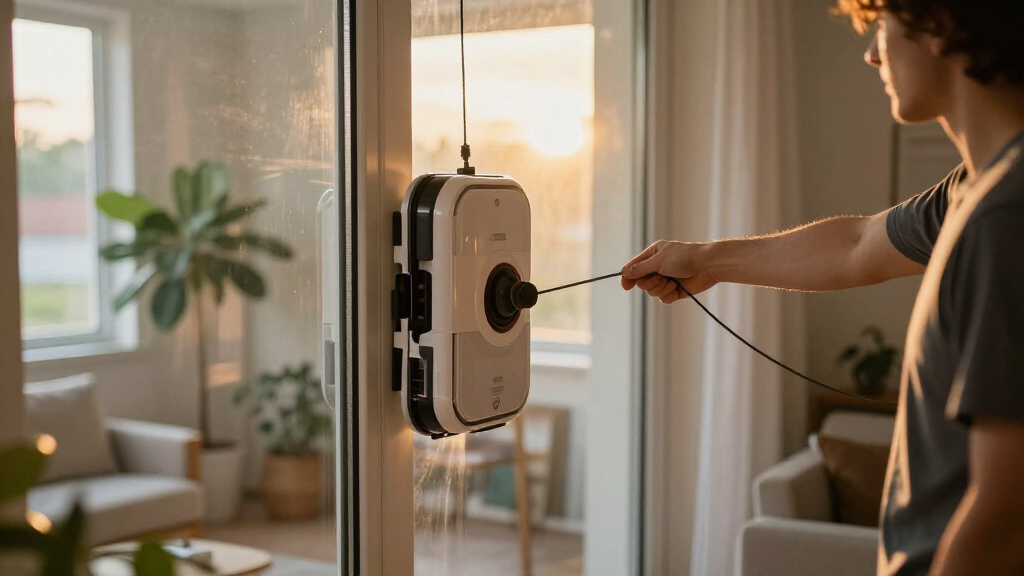

Robotic window cleaners can reduce the effort of cleaning large, hard-to-reach panes, but they differ in how they wet the glass, handle edges, and manage cables and cleaning pads. My best overall pick is the ECOVACS WINBOT W2S Omni, which pairs the robot with a 6-in-1 station; the WINBOT W3 OMNI stands out for its self-cleaning station, while the ECOVACS WINBOT Mini is a more compact choice for smaller panes. The main tradeoffs are station convenience versus simpler setups, compact access versus coverage, and advertised suction versus the complete safety and cleaning system. Read on for the full breakdown of all 15 options and a guide to choosing a cleaner that fits your windows.

Get cleaning gear delivered free with Prime
- Fast, free delivery on millions of items
- Prime Video, Amazon Music and more included
- Member-only deals all year
Complete the kit


Key Takeaways
- Station design is a major separator: ECOVACS W2S Omni, W2S PRO Omni, W2 PRO Omni, and W3 OMNI pair the cleaner with a multifunction or self-cleaning station, while many other models use a more straightforward robot-and-cable setup.
- Compactness serves a different job from broad coverage: WINBOT Mini and Mini 2 are the lineup’s small-window-oriented options; they are not automatic substitutes for a larger-format cleaner on broad panes.
- Spray systems are common, but tank details vary: Tosima X1 specifies dual-nozzle ultrasonic atomization and an 85 ml visible tank, giving buyers more concrete information about its water delivery than many listings provide.
- Suction figures alone do not settle the choice: Curalk lists 6,400 Pa, HUTT 10 Premium lists 6,500 Pa, and one WINBOT W2S Pro listing states 10,000 Pa, but buyers should compare the full safety setup and instructions rather than ranking models by this figure alone.
- Several names refer to closely related ECOVACS families: W2S Omni, W2S PRO Omni, W2S Pro, and W2 PRO Omni have different stated station or product configurations, so buyers should confirm the exact model and included accessories before choosing.
| Tosima X1 Window Cleaning Robot – Dual-Nozzle Ultrasonic Water Atomization, 85 ml Visible Water Tank, Automatic Window Cleaner for Large & Small Windows | 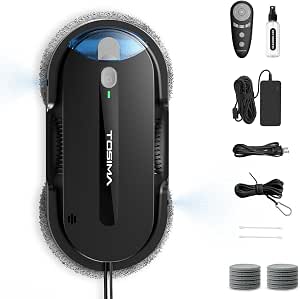 | Best for Visible Tank Monitoring | Surface recommendation: Glass | Water tank capacity: 85 ml | Cleaning path width: 8 inches | VIEW LATEST PRICE | See Our Full Breakdown |
| ECOVACS WINBOT W3 OMNI Robot Window Cleaner with Self-Cleaning Station |  | Best for Low-Handling Mop Care | Surface recommendation: Glass | Navigation: Win-SLAM 5.0 | Spray system: Triple-nozzle | VIEW LATEST PRICE | See Our Full Breakdown |
| ECOVACS WINBOT Mini Window Cleaning Robot – Compact, Smart, and Quiet |  | Best for Quiet Routine Cleaning | Surface recommendation: Glass | Water capacity: 200 ml | Spray system: Dual nozzles with ultrasonic spray | VIEW LATEST PRICE | See Our Full Breakdown |
| ECOVACS WINBOT W2S Omni Window Cleaning Robot with 6-in-1 OMNI Station |  | Best for Cordless Window Sessions | Surface recommendation: Glass | Battery life: Up to 110 minutes | Water tank capacity: 80 ml | VIEW LATEST PRICE | See Our Full Breakdown |
| ECOVACS WINBOT W2S PRO Omni Robotic Window Cleaner with Portable Station |  | Best for Edge-to-Edge Suction and Coverage | Surface recommendation: Glass | Edge cleaning: TruEdge 2.0 | Maximum suction: 10,000 Pa | VIEW LATEST PRICE | See Our Full Breakdown |
| Tosima W5 Window Cleaning Robot |  | Best for Safety Features | Maximum suction: 6,400 Pa | Cleaning path width: 6 inches | Backup battery: Up to 25 minutes | VIEW LATEST PRICE | See Our Full Breakdown |
| ECOVACS Winbot W2S Pro Window Cleaning Robot – 10,000 Pa Suction |  | Best for Large, Hard-to-Reach Windows | Maximum suction: 10,000 Pa | Cleaning system: Triple-spray wet wiping with TruEdge 2.0 edge brushes | Navigation: WIN-SLAM 4.0 smart path planning | VIEW LATEST PRICE | See Our Full Breakdown |
| Curalk Window Cleaning Robot with 6400 Pa Suction and Dual Spray |  | Best for Multi-Surface Use | Maximum suction: 6,400 Pa | Water tank capacity: 85 ml in title; 90 ml in description | Compatible surfaces: Glass, tile, and marble | VIEW LATEST PRICE | See Our Full Breakdown |
| X6 Window Cleaning Robot for High Windows |  | Best for Skylights and Broad Panes | Suction: Variable, up to 6,400 Pa | Cleaning path width: 8 inches | Water capacity: 85 ml | VIEW LATEST PRICE | See Our Full Breakdown |
| Anminto BSD16 Automatic Window Cleaning Robot with Dual Spray |  | Best for Remote-Controlled Basic Cleaning | Model: BSD16 (US-AN-06-260714-S16) | Suction force: 3,000 Pa | Water capacity: 50 ml | VIEW LATEST PRICE | See Our Full Breakdown |
| TOSIMA WA9C Pro Window Cleaning Robot with Dual Spray |  | Best for Spray Coverage | Spray nozzles: 4 | Suction force: 2600–3200 Pa | Backup battery: Up to 25 minutes | VIEW LATEST PRICE | See Our Full Breakdown |
| X6 Pro Window Cleaning Robot Dual-Spray for High Windows Inside and Outside |  | Best for Multi-Surface Use | Suction power: 6400 Pa | Spray nozzles: Dual | Recommended surfaces: Glass, tile walls, mirrors, and windows | VIEW LATEST PRICE | See Our Full Breakdown |
| ECOVACS WINBOT W2 PRO Omni Window Cleaning Robot with Multifunction Station |  | Best for Long Cleaning Sessions | Battery cleaning time: Up to 110 minutes | Battery coverage: Up to 55 square meters per charge | Spray system: Triple-nozzle | VIEW LATEST PRICE | See Our Full Breakdown |
| HUTT 10 Premium Window Cleaning Robot, 6500Pa Suction |  | Best for Edge and Corner Cleaning | Maximum suction: Up to 6500 Pa | Pressure: 55 N | Tank capacity: 80 ml | VIEW LATEST PRICE | See Our Full Breakdown |
| ECOVACS WINBOT MINI 2 Compact Window Cleaning Robot |  | Best Compact Pick | Dimensions: 8.46 × 8.46 × 2.17 inches | Minimum window size: 8.66 × 9.84 inches | Suction power: 8000 Pa | VIEW LATEST PRICE | See Our Full Breakdown |
More Details on Our Top Picks
Tosima X1 Window Cleaning Robot – Dual-Nozzle Ultrasonic Water Atomization, 85 ml Visible Water Tank, Automatic Window Cleaner for Large & Small Windows
The Tosima X1’s visible 85 ml tank makes it easier to see when a refill is due than on the ECOVACS WINBOT Mini, whose listed tank capacity is larger but lacks a viewing window in the supplied details. Its dual ultrasonic nozzles and automatic cleaning suit routine work across differently sized glass panes, while the remote lets me adjust operation without relying on an app. A safety tether and backup battery add reassurance if power is interrupted. The tradeoff is that its stated battery runtime is about 25 minutes, so large expanses may call for pauses, and 65 dB is not especially quiet. I’d choose it over the Mini for simple remote control and tank visibility, but not for extended sessions or non-glass surfaces.
Pros:- Visible 85 ml tank makes water level checks straightforward
- Dual ultrasonic nozzles support automated glass cleaning
- Remote control allows manual adjustments without a smartphone app
- Backup battery and safety tether provide added protection during power interruptions
Cons:- Approximately 25-minute battery runtime can interrupt cleaning across large windows
- 65 dB operating noise may be noticeable indoors
- Designed for glass rather than other surface materials
Best for: Buyers cleaning a mix of small and large glass windows who want to monitor water level and use a physical remote.
Not ideal for: People cleaning extensive glazing in one session or seeking a quiet robot; the listed runtime is about 25 minutes and noise level is 65 dB.
- Surface recommendation:Glass
- Water tank capacity:85 ml
- Cleaning path width:8 inches
- Spray system:Dual-nozzle ultrasonic water atomization
- Control:Remote control
- Power source:Corded electric
- Noise level:65 dB
- Warranty:2-year manufacturer warranty
Our verdict“Choose the Tosima X1 if visible water-level monitoring and remote control matter more than quiet operation or long uninterrupted sessions.”
ECOVACS WINBOT W3 OMNI Robot Window Cleaner with Self-Cleaning Station
The WINBOT W3 OMNI is the lineup’s clearest choice for reducing the chore around the chore: its station washes the mop pads after use, so I would not have to handle dirty pads as often as with the WINBOT W2S Omni. A triple-nozzle spray system, edge-cleaning scrubber, and Win-SLAM 5.0 navigation are aimed at glass doors and larger windows where coverage and corners matter. App modes add flexibility for different layouts. The station’s 1.1-liter capacity is also a different proposition from the W2S Omni’s small 80 ml onboard tank, though these figures describe different components. The main compromise is the substantial 12.22 kg listed weight, which makes moving the system less convenient; warranty details also require a customer-service inquiry.
Pros:- Station automatically washes mop pads after use
- Triple-nozzle spraying supports glass coverage
- Edge-cleaning technology targets corners
- Win-SLAM 5.0 navigation and app modes support different window layouts
Cons:- Listed 12.22 kg weight makes moving the system less convenient
- Designed for glass surfaces only
- Warranty details must be requested from customer service
Best for: Households with many large glass doors or windows that want automated pad washing and app-based cleaning modes.
Not ideal for: Buyers who need a lightweight, easy-to-carry cleaner or want clear warranty terms before purchase.
- Surface recommendation:Glass
- Navigation:Win-SLAM 5.0
- Spray system:Triple-nozzle
- Station capacity:1.1 liters
- Battery life:130 minutes
- Control:App
- Dimensions:10.63 × 2.99 × 10.63 inches
- Weight:12.22 kg
Our verdict“Pick the WINBOT W3 OMNI if automatic mop washing and coverage for large glass areas outweigh portability and warranty clarity.”
ECOVACS WINBOT Mini Window Cleaning Robot – Compact, Smart, and Quiet
For smaller indoor panes that need regular upkeep, the WINBOT Mini prioritizes compact handling and quiet operation over the station-based automation of the WINBOT W3 OMNI. Its app control and intelligent path planning make routine runs manageable, while the 9-stage protection system and anti-slipping feature address the concern of running a robot on glass. The listed 200 ml capacity is larger than the Tosima X1’s 85 ml tank, but this model is still described as best suited to light dirt; stubborn marks may need repeat cycles. It is an indoor, glass-only option, so I would skip it for outdoor jobs or a whole-home marathon. Compared with the X1, the Mini favors quieter, app-guided use rather than a physical remote and visible tank.
Pros:- Compact and lightweight design is suited to smaller windows
- Quiet operation fits frequent indoor cleaning
- App control and intelligent path planning support convenient runs
- 9-stage protection system and anti-slipping feature add safety measures
Cons:- Light-duty cleaning may require repeated cycles on heavy stains
- Limited to indoor glass use
- Corded power can restrict placement around windows
Best for: Apartment dwellers and frequent cleaners with smaller indoor glass panes who value quiet operation and smartphone control.
Not ideal for: People tackling heavy grime, outdoor windows, or long cleaning sessions across extensive glazing.
- Surface recommendation:Glass
- Water capacity:200 ml
- Spray system:Dual nozzles with ultrasonic spray
- Protection:9-stage protection system
- Control:Smartphone app
- Power source:Corded electric
- Usage:Indoor
- Power levels:3
Our verdict“Choose the WINBOT Mini for quiet, repeat cleaning of smaller indoor glass areas, not for heavy dirt or broad outdoor coverage.”
ECOVACS WINBOT W2S Omni Window Cleaning Robot with 6-in-1 OMNI Station
The WINBOT W2S Omni stands out for pairing a portable 6-in-1 station with cordless operation, giving me a more flexible setup than the corded Tosima X1. Its up-to-110-minute battery life can suit a series of windows without moving a power lead, and the station handles control, charging, storage, and cable management. For cleaning near frames, TruEdge scrubbing and frame detection help it target corners, while three wide-angle spray nozzles distribute water. The compromise is its 80 ml tank, which may need refilling during longer runs; the W2S PRO Omni lists 120 microliters, though that supplied capacity unit is not directly comparable. This model is also limited to compatible flat glass, despite support for framed, frameless, and tilted windows.
Pros:- Cordless operation supports up to 110 minutes of cleaning
- Portable station combines control, charging, storage, and cable management
- TruEdge scrubbing and frame detection target edges and corners
- Three wide-angle spray nozzles support glass cleaning
Cons:- 80 ml tank may need refilling during longer cleaning sessions
- Limited to compatible flat-glass surfaces
- Warranty details are available through customer service rather than listed here
Best for: People cleaning multiple compatible glass windows who want cordless operation and a station that stores and manages the system.
Not ideal for: Buyers who need to clean non-glass surfaces or want to avoid refilling during long sessions.
- Surface recommendation:Glass
- Battery life:Up to 110 minutes
- Water tank capacity:80 ml
- Maximum suction:8,000 Pa
- Spray nozzles:3
- Edge scrubber speed:Up to 200 RPM
- Control:App
- Power modes:Battery and AC
Our verdict“Choose the WINBOT W2S Omni for cordless flexibility and an all-in-one station, provided its small tank suits your cleaning routine.”
ECOVACS WINBOT W2S PRO Omni Robotic Window Cleaner with Portable Station
The W2S PRO Omni puts its emphasis on edge-to-edge cleaning and strong glass attachment, with TruEdge 2.0 and listed suction of 10,000 Pa. That makes it a more edge-focused alternative to the WINBOT Mini, which is positioned for quiet, light-duty indoor upkeep rather than broad coverage. Multiple cleaning modes and a portable OMNI station add flexibility, and the supplied description says one fill can cover up to 807 sq. ft. The capacity listing, however, says 120 microliters; because that unit conflicts with the broad coverage claim, I would verify the tank capacity before buying. It is also listed as corded electric and weighs 7.37 kg, so the station does not make it a lightweight, untethered option.
Pros:- TruEdge 2.0 is designed for edge-to-edge cleaning
- Listed 10,000 Pa suction supports secure attachment to glass
- Multiple cleaning modes offer flexibility for different jobs
- Portable OMNI station supports operation and storage
Cons:- Listed weight of 7.37 kg may make handling cumbersome
- Corded-electric power limits portability
- Capacity is listed as 120 microliters despite a claim of coverage up to 807 sq. ft.
Best for: Buyers prioritizing edge cleaning and strong attachment for large areas of compatible glass, who are willing to confirm tank details before purchase.
Not ideal for: People wanting a lightweight or fully cordless cleaner, or buyers who need unambiguous water-capacity specifications.
- Surface recommendation:Glass
- Edge cleaning:TruEdge 2.0
- Maximum suction:10,000 Pa
- Listed capacity:120 microliters
- Battery life:110 minutes
- Power source:Corded electric
- Control:App
- Weight:7.37 kg
Our verdict“Consider the W2S PRO Omni for edge-focused cleaning and strong suction, but confirm its water capacity and accept the corded, heavy setup.”
Tosima W5 Window Cleaning Robot
The Tosima W5 earns its place for buyers who want multiple fall-protection measures without stepping up to the more elaborate ECOVACS Winbot W2S Pro. Its adaptive suction reaches 6,400 Pa, while edge detection, a safety rope rated for up to 220 kg, and a backup battery that can run for up to 25 minutes add layers of protection during cleaning. Remote control and automatic navigation reduce the need to reach awkward windows once the robot is attached. The tradeoff is that the W5 is designed for glass and needs a power connection during normal operation, so it is not a cordless, multi-surface choice. Its 6-inch cleaning path is also narrower than the X6’s listed 8-inch path, which may mean more time on broad panes. I’d shortlist it for glass-focused cleaning where safety provisions matter more than speed.
Pros:- Adaptive suction reaches up to 6,400 Pa
- Backup battery provides up to 25 minutes during a power outage
- Safety rope is rated for up to 220 kg
- Remote control, automatic navigation, and edge detection
Cons:- Requires a power connection during normal operation
- Recommended for glass, limiting its use on other surfaces
- 6-inch cleaning path is narrower than the X6’s listed 8-inch path
Best for: People cleaning glass windows who want remote operation, a strong safety rope, and backup power during outages.
Not ideal for: Buyers who need a cordless cleaner or want one robot for tile, marble, and other surfaces beyond glass.
- Maximum suction:6,400 Pa
- Cleaning path width:6 inches
- Backup battery:Up to 25 minutes
- Battery type and voltage:Lithium-ion, 14.8 V
- Safety rope capacity:Up to 220 kg
- Controls:Button control and remote control
- Recommended surface:Glass windows
- Warranty:1 year
Our verdict“Choose the Tosima W5 if you want a glass-focused robot with substantial fall protection and can accept corded operation.”
ECOVACS Winbot W2S Pro Window Cleaning Robot – 10,000 Pa Suction
For large or elevated glass, the Winbot W2S Pro is the most feature-rich option in this group. Its 10,000 Pa suction exceeds the 6,400 Pa figures listed for the Tosima W5 and X6, while triple-spray wet wiping and TruEdge 2.0 brushes are aimed at lifting grime near edges rather than simply traversing the pane. WIN-SLAM 4.0 path planning and multiple cleaning modes help it cover broad windows with less manual repositioning. That capability comes with practical limits: it remains corded during normal use, requires a safety tether, and its listed 30-minute battery life may constrain cleaning if backup power is needed. It also relies on app control, unlike the remote-controlled W5 and Anminto BSD16. I’d favor this model when coverage and edge treatment matter more than simple controls or untethered convenience.
Pros:- 10,000 Pa suction is the highest listed among these five products
- Triple-spray wet wiping targets dust, fingerprints, and pet marks
- TruEdge 2.0 brushes are designed to reach edges and frames
- WIN-SLAM 4.0 offers smart path planning and multiple modes
Cons:- Requires corded power and a safety tether during operation
- Listed battery life is 30 minutes
- App control may be less direct than the remote controls on the Tosima W5 and Anminto BSD16
Best for: Owners of large or hard-to-reach glass windows who want app-based path planning and dedicated edge-cleaning features.
Not ideal for: Buyers who prefer a handheld remote, need long outage operation, or want a cordless window-cleaning robot.
- Maximum suction:10,000 Pa
- Cleaning system:Triple-spray wet wiping with TruEdge 2.0 edge brushes
- Navigation:WIN-SLAM 4.0 smart path planning
- Control:App control
- Battery life:30 minutes
- Power source:Corded electric
- Water capacity:4.1 fluid ounces
- Recommended surface:Glass
Our verdict“Pick the Winbot W2S Pro for large, difficult-to-reach glass where strong suction and edge-focused cleaning outweigh cord and app dependence.”
Curalk Window Cleaning Robot with 6400 Pa Suction and Dual Spray
The Curalk stands apart from the glass-focused Tosima W5 by listing glass, tile, and marble as compatible surfaces, making it the more flexible pick for homes with smooth walls or stone as well as windows. Its 6,400 Pa suction, automatic dual spray, edge detection, and three cleaning modes cover the core tasks without the W2S Pro’s higher suction and more advanced edge-brush system. The package also includes 10 washable microfiber mop replacements, a useful supply for regular cleaning. There are two preparation details to accept: the pads need pre-wetting and the glass needs cleaning solution, so operation is not entirely hands-off. Capacity is also unclear in the supplied product information, which lists both 85 ml and 90 ml. I’d choose Curalk for surface versatility and included pads, not for buyers who want unambiguous specifications or minimal setup.
Pros:- Listed for glass, tile, and marble surfaces
- Automatic dual spray and three cleaning modes
- Edge and corner detection supports coverage around window boundaries
- Includes 10 microfiber mop replacements
Cons:- Pads require pre-wetting and the glass requires cleaning solution
- Water capacity is inconsistent in the product information: 85 ml in the title and 90 ml in the description
- Suction is listed at 6,400 Pa, below the Winbot W2S Pro’s 10,000 Pa
Best for: Households cleaning glass, tile, and marble that want multiple modes and a supply of replacement microfiber pads.
Not ideal for: Buyers who want a glass-only robot with clearly stated tank capacity or minimal preparation before each run.
- Maximum suction:6,400 Pa
- Water tank capacity:85 ml in title; 90 ml in description
- Compatible surfaces:Glass, tile, and marble
- Cleaning modes:Quick, deep, and spot
- Spray system:Automatic dual spray
- Safety rope length:178 inches
- Included mop replacements:10
- Safety features:Backup battery, air pressure sensor, and safety rope
Our verdict“Choose the Curalk if you want one robot for several smooth surfaces and are comfortable preparing the pads and checking the tank details.”
X6 Window Cleaning Robot for High Windows
The X6 is a practical fit for homes with skylights or a mix of windows, mirrors, and tile walls. Unlike the glass-only Tosima W5, it lists several smooth surface types, and its 8-inch cleaning path is wider than the W5’s 6-inch path. Variable 6,400 Pa suction, dual spray, edge detection, and smart navigation pair with a safety cable and a 30-minute backup hold during power loss. The manufacturer says it can clean a 3.3 m² window in about seven minutes, though very dirty glass may need a second pass and the glass should not be made too wet to avoid smears. The listed battery-life figure of 450 minutes sits alongside the 30-minute outage hold, so those figures describe different stated claims and should not be treated as interchangeable. I’d prioritize it for surface range and wider coverage, rather than the W2S Pro’s stronger suction and edge brushes.
Pros:- Listed for glass, tile walls, and mirrors
- 8-inch cleaning path is wider than the Tosima W5’s 6-inch path
- Dual spray, smart navigation, and edge detection
- Safety cable and up to 30 minutes of backup hold during power loss
Cons:- Very dirty windows may need two cleaning passes
- Over-wetting the glass can cause smears
- Product data lists both 450 minutes of battery life and a 30-minute backup hold, which may be confusing
Best for: Homeowners with skylights, broad panes, or a mix of glass, mirrors, and tile walls who want a wider cleaning path.
Not ideal for: People who need a clearly explained battery runtime or expect one pass to handle heavily soiled windows.
- Suction:Variable, up to 6,400 Pa
- Cleaning path width:8 inches
- Water capacity:85 ml
- Power source:Corded electric
- Backup hold during power loss:30 minutes
- Listed battery life:450 minutes
- Noise level:63 dB
- Recommended surfaces:Glass, tile wall, and mirror
- Warranty:1 year
Our verdict“Pick the X6 for wider coverage across windows, skylights, mirrors, and tile, provided you can work around its cleaning and runtime caveats.”
Anminto BSD16 Automatic Window Cleaning Robot with Dual Spray
The Anminto BSD16 is the simpler, lower-suction alternative for buyers who value direct controls over advanced spray or navigation systems. It pairs AI path planning and edge detection with three automatic modes, manual control, and an infrared remote, so adjustments do not depend on an app like the ECOVACS Winbot W2S Pro. Dual nozzles and microfiber pads handle routine smudges on windows, mirrors, and glass doors, while a safety rope and UPS backup rated for up to 30 minutes add protection during use. Its 3,000 Pa suction is notably below the 6,400 Pa listed for the Tosima W5 and X6, so buyers seeking the strongest stated grip should compare those models. The 50 ml tank may also call for refills on longer sessions. I’d choose it for straightforward indoor glass cleaning, not for a high-suction or large-capacity setup.
Pros:- Infrared remote supports three automatic modes and manual control
- AI path planning and edge detection guide coverage
- Dual spray nozzles and microfiber pads target everyday smudges
- UPS backup is rated for up to 30 minutes and a safety rope is included
Cons:- 3,000 Pa suction is lower than the Tosima W5 and X6’s listed 6,400 Pa
- 50 ml water capacity may require refills during longer sessions
- Recommended for indoor use on glass surfaces
Best for: Indoor users who want a remote-controlled robot for routine cleaning of windows, mirrors, and glass doors.
Not ideal for: People cleaning large or demanding windows who prioritize higher stated suction or a larger water tank.
- Model:BSD16 (US-AN-06-260714-S16)
- Suction force:3,000 Pa
- Water capacity:50 ml
- Controls:Infrared remote control
- Cleaning modes:3 automatic modes and manual control
- Power backup:UPS backup up to 30 minutes
- Recommended uses:Windows, mirrors, and glass doors
- Usage:Indoor
Our verdict“Choose the Anminto BSD16 for routine indoor glass cleaning with simple remote controls, but opt for a higher-suction model for larger or more demanding jobs.”
TOSIMA WA9C Pro Window Cleaning Robot with Dual Spray
The TOSIMA WA9C Pro is a good fit for buyers who want broad mist coverage and straightforward control on glass windows. Its four spray nozzles cover more of the cleaning path than the dual-nozzle setup on the X6 Pro, while automatic N- and Z-shaped routes handle routine passes without constant steering. A remote also lets you direct it manually when a section needs extra attention. For elevated glass, anti-fall sensors, a safety rope, and backup attachment for up to 25 minutes add useful safeguards during a power interruption. That backup window is shorter than the HUTT 10 Premium’s 30 minutes, and this model is limited to glass rather than the X6 Pro’s listed tile and mirror options. I’d choose it for spray coverage, not broader surface use.
Pros:- Four nozzles spread spray across the cleaning path.
- Automatic N- and Z-shaped routes reduce manual direction changes.
- Remote control supports targeted cleaning.
- Safety rope, anti-fall sensors, and backup battery add protection on elevated glass.
Cons:- Backup attachment lasts up to 25 minutes during a power interruption.
- Recommended for glass windows, limiting its use on other surfaces.
- The 8-inch cleaning path may mean more passes on broad panes.
Best for: Homeowners cleaning large glass windows who want multiple spray points, automatic routes, and remote-directed touch-ups.
Not ideal for: Buyers who need one robot for tile or mirrors, or who want more than 25 minutes of backup attachment during a power outage.
- Spray nozzles:4
- Suction force:2600–3200 Pa
- Backup battery:Up to 25 minutes
- Cleaning path width:8 inches
- Navigation:Automatic N- and Z-shaped paths
- Control:Remote control
- Recommended surface:Glass windows
- Included accessories:4 cleaning mops, unclogging needle kit, water bottle, replacement nozzles, AC power cable and adapter
Our verdict“Choose the WA9C Pro if spray coverage and remote control matter more to you than multi-surface use or a longer backup window.”
X6 Pro Window Cleaning Robot Dual-Spray for High Windows Inside and Outside
The X6 Pro stands apart from glass-only picks such as the TOSIMA WA9C Pro because its listed surfaces include glass, tile walls, and mirrors. Its 6400Pa suction is the highest specified here, giving buyers a strong stated grip for vertical cleaning, while smart navigation and app control offer more ways to manage a run than the WA9C Pro’s remote-only control. Dual spray nozzles and edge detection round out the setup for high or hard-to-reach areas. The tradeoff is that its battery is listed for just 30 minutes, so larger jobs may need more than one session; the ECOVACS WINBOT W2 PRO Omni, by comparison, lists up to 110 minutes of battery cleaning. The X6 Pro also needs regular pad and water maintenance, so it suits varied surfaces better than buyers seeking a low-maintenance glass-only routine.
Pros:- Listed for glass, tile walls, and mirrors.
- 6400Pa suction is the highest stated suction figure among these five picks.
- App, remote, and button controls provide flexible operation.
- Dual spray, smart navigation, edge detection, and anti-fall protection support high-window cleaning.
Cons:- Listed battery life is 30 minutes, which may not cover a large cleaning job in one session.
- Pads and water need attention for effective cleaning.
- Its multiple control and safety features may be more than needed for simple, accessible windows.
Best for: People with high glass windows, mirrors, and tile walls who want app, remote, and button controls in one cleaner.
Not ideal for: Owners of large window expanses who want a long battery cleaning session, or buyers who prefer minimal pad and water upkeep.
- Suction power:6400 Pa
- Spray nozzles:Dual
- Recommended surfaces:Glass, tile walls, mirrors, and windows
- Control methods:Button, remote, and app control
- Battery life:30 minutes
- Water capacity:85 ml
- Power source:Corded electric
- Additional features:Smart navigation, edge detection, anti-fall protection, and storage bag
Our verdict“Pick the X6 Pro if you need a high-suction robot for several vertical surface types and can work around shorter battery sessions.”
ECOVACS WINBOT W2 PRO Omni Window Cleaning Robot with Multifunction Station
For buyers facing a large run of glass, the WINBOT W2 PRO Omni is the most session-friendly option in this group: it lists up to 110 minutes of battery cleaning and coverage of up to 55 square meters per charge. That makes it a stronger match for extended cleaning than the X6 Pro, whose listed battery life is 30 minutes, or the TOSIMA WA9C Pro, which lists 25 minutes of backup attachment during an outage. The multifunction station brings controls, charging, and storage together, while triple-nozzle spray and WIN-SLAM 4.0 planning support a more guided route. Its limits are clear: it is specified for indoor glass, and battery mode still has a finite runtime. I’d favor it for broad indoor glass jobs over buyers needing a multi-surface robot like the X6 Pro.
Pros:- Up to 110 minutes of battery cleaning per charge.
- Listed coverage reaches up to 55 square meters per charge.
- Multifunction station combines controls, charging, and storage.
- Triple-nozzle spray, WIN-SLAM 4.0 planning, and 12-stage protection support guided cleaning.
Cons:- Specified for glass and indoor use, unlike the X6 Pro’s broader listed surfaces.
- Battery mode has a finite runtime and requires recharging between longer jobs.
- The station adds equipment to store compared with simpler robot-and-accessory setups.
Best for: People with extensive indoor glass who want longer battery cleaning sessions, organized storage, and app control.
Not ideal for: Buyers who need a robot for tile or mirrors, or who primarily clean outdoor windows and want a model explicitly suited to that use.
- Battery cleaning time:Up to 110 minutes
- Battery coverage:Up to 55 square meters per charge
- Spray system:Triple-nozzle
- Navigation:WIN-SLAM 4.0 path planning
- Safety:12-stage protection including anti-fall
- Control:App control
- Recommended surface and use:Indoor glass
- Special features:Multifunction station, washable filter, and 5 power levels
Our verdict“Choose the WINBOT W2 PRO Omni for long indoor glass-cleaning sessions and a station-based setup, not for multi-surface jobs.”
HUTT 10 Premium Window Cleaning Robot, 6500Pa Suction
The HUTT 10 Premium puts edge and corner access ahead of extras such as the WINBOT W2 PRO Omni’s station and long battery cleaning mode. Its round and square pads, dual ultrasonic spray, and smart mapping are designed to reach glass areas that can be awkward for a single pad shape; 14 sensors also support route planning and edge detection. A stated 6500Pa maximum suction and 55N pressure give buyers useful grip specifications to compare with the X6 Pro’s 6400Pa suction, though the figures alone do not establish cleaning results. The HUTT lists a 30-minute backup battery, five minutes longer than the WA9C Pro’s stated outage backup. On the downside, cleaning liquid is not included, and dusty or wet tracks and over-wet pads can reduce traction. It is a focused glass pick, not a multi-surface machine.
Pros:- Round and square pads are designed to reach edges and corners.
- Dual ultrasonic spray and smart mapping support planned glass cleaning.
- Fourteen sensors provide route-planning and edge-detection support.
- Backup battery lasts up to 30 minutes, with a safety rope included.
Cons:- Cleaning liquid is not included.
- Dust or moisture on tracks and overly wet pads can reduce traction.
- Recommended for glass, so it is less versatile than the X6 Pro’s listed surface range.
Best for: Glass-window owners who want attention to edges and corners, multiple cleaning modes, and a safety rope for elevated panes.
Not ideal for: Buyers who need mirror or tile cleaning, or those unwilling to manage track cleanliness and pad moisture.
- Maximum suction:Up to 6500 Pa
- Pressure:55 N
- Tank capacity:80 ml
- Coverage per refill:Up to 60 square meters
- Backup battery:30 minutes
- Sensors:14
- Weight and noise:1.3 kg; 65 dB
- Included accessories:Remote control, safety rope, spray bottle, 6 nozzles, and 3 pairs of cleaning pads
Our verdict“Choose the HUTT 10 Premium if corner access and glass-specific cleaning matter more than broad surface compatibility or station-based storage.”
ECOVACS WINBOT MINI 2 Compact Window Cleaning Robot
The WINBOT MINI 2 is the most space-conscious choice here, with an 8.46-inch square footprint and a listed minimum window size of 8.66 by 9.84 inches. That makes it a better candidate for narrow panes than the larger-format HUTT 10 Premium, while its edge brushes and side wings help it clean close to frames. Five modes, including Spot and Edge Clean, let users match a run to light dust or a particular problem area; the ECOVACS WINBOT W2 PRO Omni is a better fit for extended cleaning across large indoor glass, with up to 110 minutes per charge. MINI 2 instead lists 200 minutes of battery life and over 30 minutes of backup attachment, though heavily soiled glass may need repeated cycles or fresh pads. It is still a glass-only cleaner, not a replacement for the X6 Pro on tile or mirrors.
Pros:- Compact dimensions suit narrow panes and tighter storage spaces.
- Minimum listed window size is 8.66 by 9.84 inches.
- Edge brushes and side wings clean close to frames, with up to 90% edge coverage listed.
- Five cleaning modes and app control support routine, edge, and spot cleaning.
Cons:- Heavily soiled glass may require repeated cycles or a clean pad.
- Recommended for glass, unlike the X6 Pro’s listed tile and mirror use.
- A compact cleaning footprint may be less suited to covering broad windows quickly.
Best for: People with narrow windows, mirrors, or glass doors who want a compact robot and mode choices for routine cleaning or spot work.
Not ideal for: Buyers with heavily soiled glass who expect a single pass, or households needing one robot for tile and other non-glass surfaces.
- Dimensions:8.46 × 8.46 × 2.17 inches
- Minimum window size:8.66 × 9.84 inches
- Suction power:8000 Pa
- Edge coverage:Up to 90%
- Cleaning modes:Fast, Thorough, Deep, Spot, and Edge Clean
- Battery life:200 minutes
- Backup attachment duration:Over 30 minutes
- Control and connection:App control with Bluetooth directional control
- Recommended surface:Glass
Our verdict“Pick the WINBOT MINI 2 for narrow glass and frame-adjacent cleaning, but choose a larger or more versatile model for broad, dirty, or non-glass surfaces.”
How We Picked
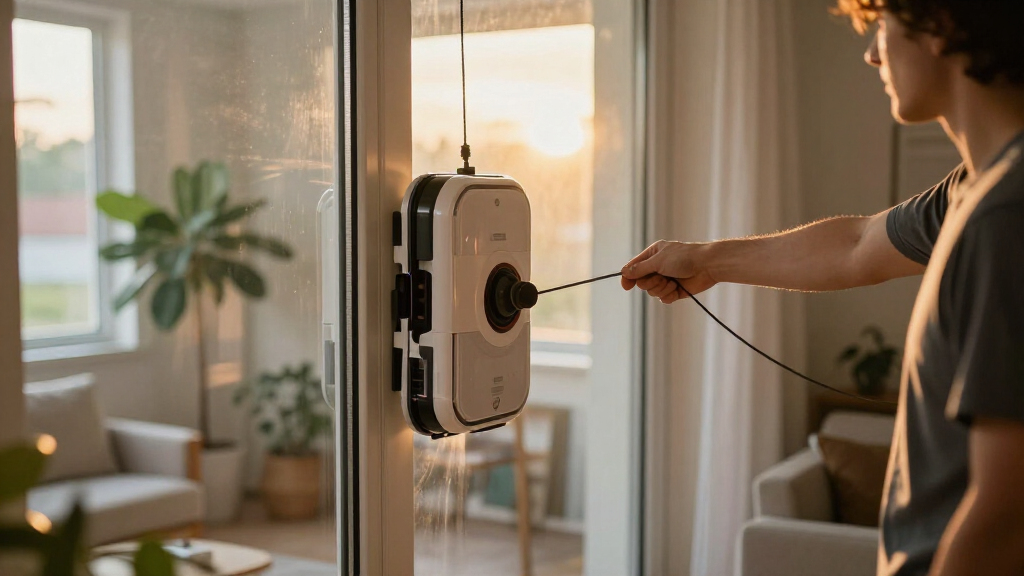
I compared these 15 cleaners around the decisions that affect ownership: the stated spray method, tank information, suction claims, station or portable setup, compactness, and how clearly the listing identifies the intended use. I gave more weight to a coherent cleaning and handling package than to a single headline specification. A station can simplify water management or pad care, while a compact body can make more sense for smaller panes; neither benefit matters equally to every household.
The order favors options with a clearly differentiated setup and useful information for matching the machine to a home, then places more specialized or less fully specified models later. Close ECOVACS model names are judged by their stated configuration rather than treated as interchangeable, and suction numbers are not treated as direct proof of better cleaning. Because listing details do not provide a consistent basis for comparing measured cleaning performance, I avoid claiming lab results and recommend confirming window compatibility, included parts, and operating instructions before purchase.
Factors to Consider When Choosing Robotic Window Cleaners
Choosing a robotic window cleaner is less about finding the biggest number on a product page and more about matching the machine to your panes, cleaning routine, and tolerance for setup. I would start with the window layout, then compare how the robot handles water, power, safety, and maintenance.
Match the robot’s shape and size to your panes
Measure the smallest pane you expect the robot to clean, not just the largest window in the room. Frames, handles, muntins, and narrow gaps can limit where a cleaner can move even when its overall footprint appears compact. A Mini-style model may suit smaller sections, but compactness does not automatically mean it covers a large window faster. For broad panes, check the manufacturer’s supported window dimensions and edge behavior before buying. A common mistake is choosing for the most impressive window and then finding the robot cannot work comfortably on the smaller panes that need frequent cleaning. If your home has a mix of sizes, prioritize the strictest fit constraint and accept that one device may not be ideal for every pane.
Read spray and tank details as maintenance clues
A spray system affects how often you may need to refill and whether you must manage water during a cleaning session. Dual spray can help distribute cleaning fluid, while an atomizing system such as the Tosima X1’s stated ultrasonic nozzles describes a different delivery approach. Tank capacity is only useful when paired with an idea of how much fluid the robot uses; a visible tank makes checking the remaining liquid easier, but it does not by itself prove longer coverage. Confirm which cleaning solution is permitted, whether the tank is refillable, and how the nozzles should be kept clear. Avoid assuming that more spray or more water always produces cleaner glass, since excess liquid can leave residue or complicate pad performance.
Compare the whole safety and power arrangement
For exterior or elevated windows, examine the complete attachment and power instructions, not only the suction rating. Check what safety tether is supplied, how it attaches, whether the unit needs a continuous power connection, and what the manual says about usable glass and weather conditions. A high suction figure is a stated specification, not a substitute for correct setup or a guarantee that every surface is supported. Cable routing matters too: a cord that catches on a frame can interrupt a cleaning path or create extra handling. If you cannot safely reach the window to attach the robot and tether, the device may not remove the need for access equipment. Choose a model only when its stated use matches your glass and your ability to follow its safety procedure.
Decide whether a station earns its space
Multifunction and self-cleaning stations can reduce some hands-on upkeep, but they add a separate component to store, connect, and set up. Their value depends on how often you clean and whether the station’s stated tasks solve a real chore in your routine. A portable station may appeal if you move between rooms or windows, while a simpler configuration can be easier to store when cleaning is occasional. Check exactly what the station does and which accessories are included; similarly named models may not share the same kit. Do not pay for a station feature based only on its label if you will still need to wash or replace pads by hand. Consider the room available for both the robot and its support equipment before settling on a station-based option.
Plan for pads, edges, and the finish you expect
Robotic cleaners still rely on clean pads and suitable glass preparation, so maintenance does not disappear. Look up how pads attach, how they are washed, whether replacements are available, and whether the manufacturer specifies different care for dusty or greasy glass. Edge detection and frame compatibility can affect how much of the perimeter is cleaned, leaving some corners or borders for a manual touch-up. If your windows have dried-on grime, construction dust, or heavy deposits, a robot may need pre-cleaning rather than a single routine pass. Buyers sometimes expect automation to mean zero supervision; instead, plan for setup, pad checks, and periodic cleaning of the machine itself. The best fit is the model whose upkeep you are willing to repeat, not simply the one with the longest feature list.
Check exact model names and included accessories
This lineup includes several similar ECOVACS names, including W2S Omni, W2S PRO Omni, W2S Pro, and W2 PRO Omni, alongside WINBOT Mini and Mini 2. Similar wording does not establish that they include the same station, accessories, or operating features. Compare the full model identifier and the seller’s included-items list against the manufacturer’s instructions before ordering. This is especially helpful when a title emphasizes a specific suction figure or station but omits details about the power setup or replacement pads. A concise specification sheet can save frustration if it clearly identifies what arrives in the box and what must be purchased separately. Treat the exact configuration as part of the product choice, not as a minor detail.
Frequently Asked Questions
Can a robotic window cleaner handle both interior and exterior glass?
Some listings describe use on both sides, but that does not mean every model suits every window or exterior setup. Check the exact manual for compatible glass, frame conditions, power requirements, and safety-tether instructions. Exterior use on elevated panes requires particular care because the robot still needs to be attached and prepared safely. If you cannot reach the starting point or secure the tether as directed, do not rely on the robot to solve that access problem. Choose based on the specific window and setup rather than a general claim of indoor-and-outdoor use.
Is a higher suction rating enough reason to choose one model?
No. Suction ratings such as 6,400 Pa, 6,500 Pa, or 10,000 Pa are useful specifications to compare, but they do not describe the entire cleaning or safety system. The listing may not explain how the number was measured or how performance changes across different surfaces. Also compare the tether, power arrangement, window compatibility, spray system, and instructions. A model with a more modest stated figure may fit your panes and routine better than one selected on suction alone.
Should I choose a model with a self-cleaning or multifunction station?
A station makes the most sense when its stated functions reduce work you would otherwise do often, such as managing cleaning or storage tasks. It also takes up space and may add setup steps, so occasional users may prefer a simpler arrangement. Compare the exact station functions across model names rather than assuming every OMNI version includes the same setup. Check which accessories and supplies are included, and what still requires manual cleaning. The right choice depends on how frequently you clean and whether the station’s specific features fit your routine.
Will a compact window cleaner work on large windows too?
Compact models are attractive for narrow or smaller panes, but size alone does not show how quickly or effectively a cleaner handles a broad window. Check the manufacturer’s supported dimensions and any restrictions on frames or glass before using it on a large pane. A smaller machine can require more passes, while a larger design may be awkward on divided windows. If your home has both small and wide glass, compare the full range of compatible sizes rather than choosing based on one window. The Mini and Mini 2 names signal compact positioning, but you should verify each model’s specifications separately.
Do I still need to clean or replace the pads?
Yes. Robotic operation does not remove the need to keep pads clean, since accumulated dust and residue can affect the finish and may spread grime across the glass. Follow the care instructions for washing and drying pads, and check whether replacements are sold for the exact model. A station may handle some tasks, but do not assume it eliminates pad maintenance unless the product instructions say so. Heavily soiled glass may need a manual first pass before routine robot cleaning. Include pad care and replacement availability in your ownership decision.
Conclusion
For most buyers, I would start with the ECOVACS WINBOT W2S Omni, whose 6-in-1 station gives it a clear all-round role in this lineup. For a more hands-on maintenance setup, the WINBOT W3 OMNI is the premium pick to investigate because it is listed with a self-cleaning station; confirm the exact station functions before choosing. Best for beginners is the ECOVACS WINBOT Mini, a straightforward compact direction for smaller panes, while the Tosima X1 is my best value-oriented feature pick for buyers who want stated dual-nozzle atomization and a visible 85 ml tank without making station features the priority. For specific needs, consider Mini 2 for compact-window use or compare the listed high-window X6 variants against your exact glass and safety setup. Before ordering, verify the full model name, compatible window dimensions, tether and power instructions, and what comes in the box.
Halloween Picks
halloween
As an affiliate, we earn on qualifying purchases.