TL;DR

Get cleaning gear delivered free with Prime
- Fast, free delivery on millions of items
- Prime Video, Amazon Music and more included
- Member-only deals all year
Ryobi says its PCL750B 18V One+ Window Vacuum will launch at Home Depot in November 2026 for $69.97 as a bare tool. It uses an 11-inch squeegee and a separate spray bottle with microfiber pad; a Pro Tool Reviews writer has not yet tested Ryobi’s model, so its cleaning performance remains unverified.
Ryobi has announced the PCL750B 18V One+ Window Vacuum, which is scheduled to go on sale at Home Depot in November 2026 for $69.97 as a bare tool. The product is designed to collect cleaning liquid from smooth glass and other flat surfaces, and its compatibility with Ryobi’s existing 18V One+ battery platform may appeal to owners who already have those packs.
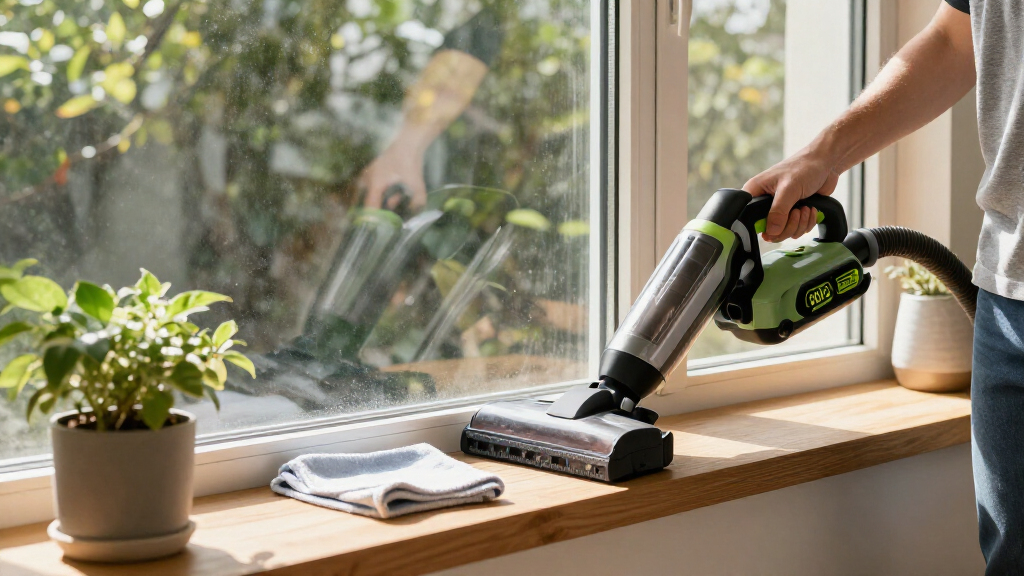
The vacuum has an 11-inch squeegee that directs liquid toward vents, where suction draws it into a holding container. Ryobi’s system also includes a separate spray bottle and microfiber cleaning pad: users spray the surface, loosen dirt with the pad, then pass the vacuum over the wet glass. The collected liquid can be emptied into a sink, and the container rinsed.
Unlike a model with a built-in battery, the Ryobi unit uses 18V One+ battery packs. The source report says it can use packs up to 6.0Ah, allowing users to swap batteries rather than pause for a recharge. The battery sits behind an IPX4-rated door intended to shield it from water or cleaning solution. Ryobi lists a two-year warranty.
The announced price is $69.97, with the vacuum sold as a bare tool, meaning the battery is not included in the listed package. Ryobi plans to offer it online and in select local Home Depot stores. The source report does not provide independent test results for the PCL750B.
A Battery Platform for Glass Cleaning
For households already invested in Ryobi’s 18V One+ system, using a compatible battery may make the vacuum a more convenient addition than buying a separate battery-powered cleaning appliance. The option to swap packs could also help when cleaning many windows or other glass surfaces, although actual runtime will depend on the battery used and the work being done.
The tool’s likely value depends on the surfaces being cleaned. The source report identifies mirrors, shower doors, glass stovetops, countertops, and tile as possible uses, provided they are smooth, flat, and accessible. It may be less suited to vehicle glass, curved surfaces, deep corners, or heavily soiled exterior windows. Those limits matter because the product is not a replacement for every kind of window-cleaning method.
At $69.97 before the cost of a battery, the launch gives One+ users a stated entry price for a dedicated window vacuum. Whether the tool saves time or leaves fewer streaks than other cleaning approaches will need to be judged through hands-on testing, not inferred from its design alone.
Products Worth Considering

eufy C28 Robot Vacuum Cleaner and Mop for Pet Hair, 15,000 Pa

Shark AI Ultra Robot Vacuum, Black/Silver, AV2511AE

Dyson Ball Animal 3 Upright Vacuum
As an affiliate, we earn on qualifying purchases.
How the Two-Step Cleaning System Works
A window vacuum is used after the surface has been wetted and cleaned, rather than as a standalone dry vacuum. Ryobi’s described process pairs the microfiber pad and spray bottle for loosening dirt with the vacuum’s squeegee for collecting the remaining liquid. Emptying the tank and rinsing it are part of the cleanup.
Pro Tool Reviews compared the design with a Karcher window vacuum its writer already uses. The writer said that, in their experience with that other model, window-vacuum cleaning solutions remain wet longer than a fast-evaporating spray, allowing the squeegee to remove liquid in a final pass. That observation is the writer’s experience with another product, not a test of Ryobi’s PCL750B.
The report advises against using a window vacuum on vehicle glass, where curved panes and areas around a rearview mirror can be difficult to reach. It also cautions that home exterior windows may carry heavier dirt and buildup than regularly cleaned indoor glass. The author instead described using a Ryobi extendable power scrubber and rinsing for those exterior jobs.
“The final action of the squeegee wiping cleanly and the vacuum removing the liquid really does make for a streak-free finish.”
— Pro Tool Reviews writer
Performance Awaiting Hands-On Tests
Ryobi’s cleaning performance has not been independently established in the supplied report. Its writer reviewed the product information and images but had not used the PCL750B, so the predicted streak-free result is an expectation based on experience with another brand’s window vacuum, not a confirmed result for Ryobi’s tool.
The available material does not state the vacuum’s runtime, suction figures, tank capacity, weight, included battery status beyond its bare-tool listing, or how it performs on different types of glass. It also does not provide a full package inventory beyond the described cleaning components. Availability is described as planned for November 2026, but the source does not give a specific day or confirm whether all stores will stock it.
Home Depot Launch Set for November
Ryobi’s announced next milestone is the November 2026 Home Depot launch, online and in select local stores, at a listed bare-tool price of $69.97. The product is backed by a two-year warranty, according to the source material. No specific release date within November is provided.
Hands-on reviews after the vacuum becomes available should help establish whether its squeegee and suction deliver the expected finish, how long it runs on different 18V packs, and how well the tank and pad work in routine cleaning. Until then, buyers can compare the announced features and price with their own cleaning needs, while treating performance claims as untested.
Key Questions
When will Ryobi’s 18V One+ Window Vacuum be available?
Ryobi’s PCL750B is scheduled to launch at Home Depot in November 2026, online and in select local stores. The source does not give a specific day.
How much does the PCL750B cost, and is a battery included?
The listed price is $69.97 as a bare tool. The source does not describe a battery as included; buyers should check the package listing before purchase.
How is the window vacuum intended to be used?
Spray the surface and loosen dirt with the microfiber pad, then run the vacuum’s 11-inch squeegee across the wet surface to collect liquid in its holding container.
Has Ryobi’s model been confirmed to leave streak-free glass?
No. The Pro Tool Reviews writer had not tested Ryobi’s model. The report’s positive comments about streak reduction are based on the writer’s experience with another brand’s window vacuum.
What surfaces may be a poor fit for the tool?
The report cautions against vehicle glass and heavily soiled home exterior windows. Curves, deep corners, and heavy outdoor buildup may make the vacuum less effective than it is on smooth, flat, accessible surfaces.
Source: protoolreviews.com