
TL;DR

Get cleaning gear delivered free — and shop member deals
- Fast, free delivery on millions of items
- Access to Prime Big Deal Days deals on October 6–7
- Prime Video, Amazon Music and more included
Toro says its 60V 900 CFM handheld blower is designed for year-round cleanup, not just fall leaves. The company describes its airflow, ergonomics and cold-weather materials as choices intended to balance performance, battery runtime and comfort; independent test results and a complete set of seasonal performance figures are not provided in the source report.
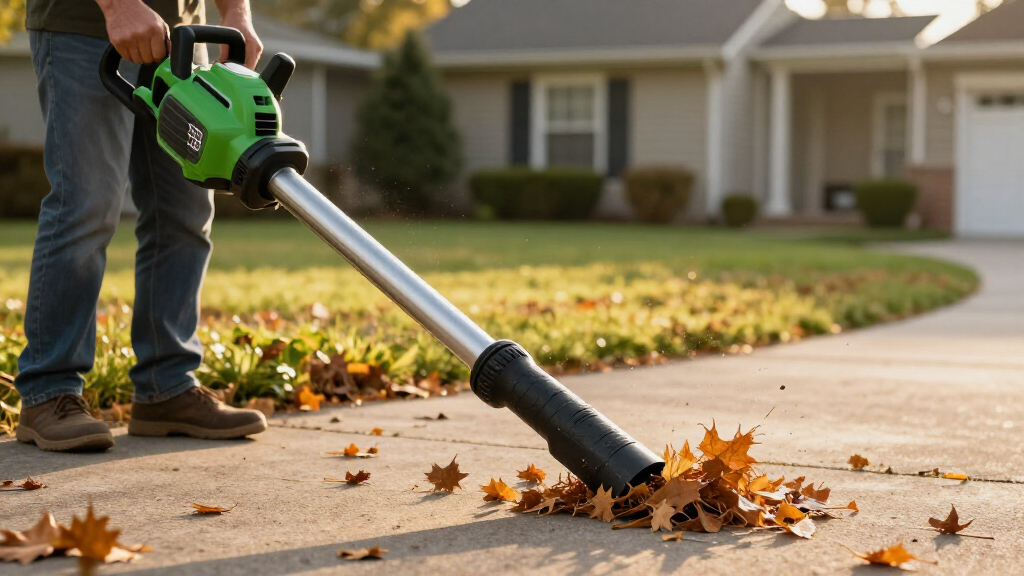
Toro’s 60V 900 CFM handheld battery-powered leaf blower is the company’s highest-performing handheld battery model, and Toro says it was designed for cleanup in every season, not only autumn. In a report based on an interview with Ben Waldera, Toro’s product marketing manager, Pro Tool Reviews describes the company’s approach to airflow, handling and cold-weather use; the source does not provide independent test results or a full seasonal performance comparison.
Toro’s central design choice is to prioritize high airflow, measured in cubic feet per minute (CFM), rather than maximizing air speed alone. Waldera told Pro Tool Reviews that the company aims for the blower to deliver useful force at full throttle without requiring users to hold the Turbo button continuously. Toro’s stated aim is to help users complete work while preserving battery runtime, but the report gives no quantified runtime figures or test conditions to verify that benefit.
The report explains that CFM, air speed in miles per hour (MPH), and Newton force describe different aspects of blower performance. Newton force measures the force coming through the nozzle, while higher airflow can help move leaves across a wider area. Higher air speed, by contrast, can be useful for dislodging debris from tight spots. Toro says it favors airflow for this model’s broader range of cleanup tasks. The source does not give the blower’s precise MPH or Newton rating.
Handling was another stated design concern. Toro places the battery near the user’s wrist to reduce the feeling of weight when rotating the blower, and includes a front handle for two-handed control. The report says the handle can help when directing strong airflow or working around obstacles, though most users may choose to operate the tool one-handed. These are design explanations attributed to Toro, not findings from a comparative ergonomics test.
A Battery Blower Beyond Fall Cleanup
The all-season positioning matters to homeowners and grounds crews weighing whether a battery blower can serve as a regular outdoor cleanup tool rather than a seasonal purchase. The uses described include moving leaves and debris after winter, clearing petals and yard waste, and handling cleanup in cold conditions. A single tool used across more of the year could be more useful than a blower selected only for autumn leaf piles, though the report does not establish how often owners would use it or compare ownership costs.
Performance trade-offs also matter to buyers comparing advertised specifications. A high CFM number does not by itself establish that a blower is best for every task: the report says broader airflow may suit moving leaves over a lawn, while concentrated air speed can help with stuck debris. Toro’s emphasis on airflow reflects its view of an all-purpose balance, not a universal ranking over competing models. Buyers would need comparable measurements, runtime tests and task-specific results to judge how the blower performs against alternatives.
The claimed cold-weather design also addresses a practical issue for battery-tool owners: equipment may be used when temperatures are low, but batteries need appropriate care. Toro advises users to charge and store batteries indoors during winter so they perform at their best when taken outside. The source offers that guidance but does not specify an operating-temperature range or battery storage limits.
battery powered leaf blower 900 CFM
As an affiliate, we earn on qualifying purchases.
As an affiliate, we earn on qualifying purchases.
How Toro Defines All-Season Use
The report frames “all-season” around tasks that extend beyond autumn. In spring, Toro points to leaves left in landscaping over winter, debris packed into gutters and leaves that can be difficult to dislodge from grass. It also identifies fallen flower petals and other yard debris as cleanup needs. The supplied source ends partway through its spring discussion and does not provide the report’s full breakdown of summer, fall and winter applications.
Waldera told Pro Tool Reviews that Toro’s product teams observe people working and speak with users when developing tools. He described the 900 CFM model as a product shaped by those needs rather than by a desire to chase higher specification numbers. The report also says Toro used materials associated with its winter equipment in the blower’s construction and incorporated static-dissipative resin to reduce static buildup in cold, dry air. Those descriptions come from Toro through the interview, not from a materials test in the article.
Performance Data Still Missing
The source report does not provide a price, release date, battery capacity, estimated runtime, charging time, precise air-speed or Newton-force figures, or the conditions used to measure the 900 CFM rating. It also does not include independent testing, direct comparisons with competitors, or user feedback beyond Toro’s account of its design process. Those gaps mean the report explains the company’s intentions but does not establish how the blower performs across all tasks in real-world use.
The supplied material also stops during its spring-use discussion. Although Toro’s all-season claim includes winter, it does not detail the full summer and fall applications in the text provided, nor specify how long the blower can operate in freezing temperatures. The report describes cold-weather materials and recommends indoor battery storage, but gives no temperature limits or warranty details.
What Buyers Should Check
Readers considering the blower should consult Toro’s current product listing for price, included battery and charger, operating specifications and warranty terms, none of which are stated in the supplied report. For a performance comparison, the most useful next information would be standardized tests covering airflow, air speed, force, runtime under different settings and handling with the recommended battery.
Until those details or independent results are available, the confirmed development is the report’s account of Toro’s design goals and the company’s positioning of the 60V 900 CFM model as a year-round tool. Toro’s advice in the report is to keep batteries indoors during winter charging and storage; the source gives no further timing for product updates or testing.
Key Questions
What is the Toro 900 CFM blower?
It is Toro’s 60V handheld battery-powered leaf blower, described in the report as the company’s highest-performing handheld battery model. Toro positions it for cleanup throughout the year.
Why does Toro emphasize CFM?
Toro says higher airflow, measured in CFM, can help users move leaves across a wider area. Air speed can be more useful for dislodging debris in tight spots, so the best specification depends on the task.
Is the blower’s all-season performance independently verified?
Not in the source material. The Pro Tool Reviews report presents Toro’s design explanations and product positioning, but provides no independent performance tests or full runtime figures.
How should users care for the battery in winter?
Toro advises users to charge and store batteries indoors during winter so they can perform at their best when used outdoors in cold conditions. The report does not state specific temperature limits.
Source: rss
Fall Picks
fall essentials
As an affiliate, we earn on qualifying purchases.