TL;DR

Get cleaning gear delivered free with Prime
- Fast, free delivery on millions of items
- Prime Video, Amazon Music and more included
- Member-only deals all year
A House Beautiful report describes storage expert Max Wilson’s “three homes rule,” which assigns each belonging to an everyday, seasonal or exit category. The approach offers a practical way to decide where kept items belong and to move unwanted belongings toward donation or disposal, though the report provides no research showing how effective the method is.
House Beautiful has outlined a decluttering method called the “three homes rule,” in which storage expert Max Wilson recommends assigning each item to one of three places: an accessible spot for regular use, storage for seasonal belongings, or a defined route out of the home. The method focuses on both deciding what to keep and giving kept items a practical location.
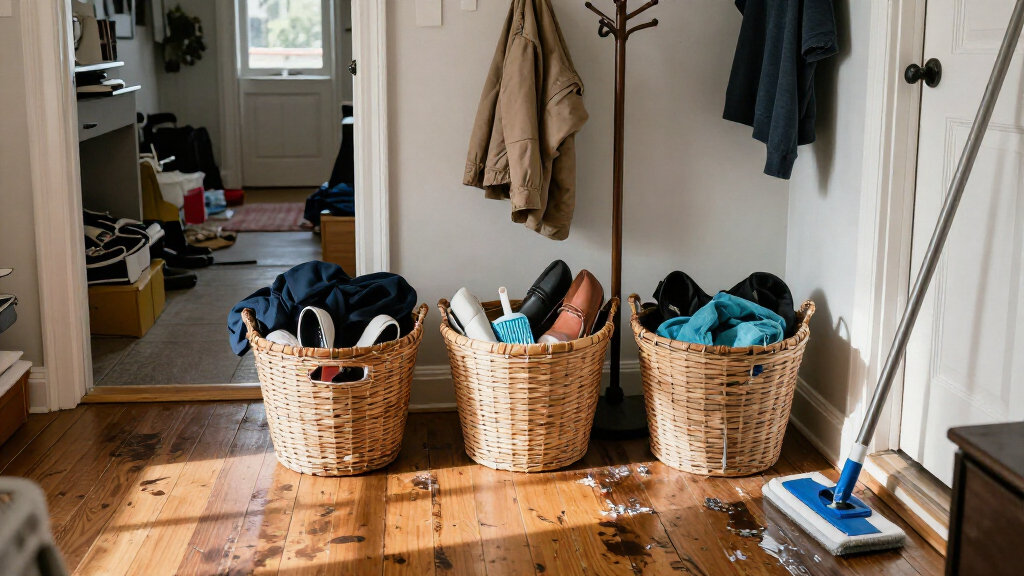
Wilson, CEO and co-founder of Pocket Storage, says the categories are an “everyday home,” a “seasonal home” and an “exit home.” The first is for items used frequently, such as school bags, mail, gym clothes or kitchen staples. Wilson’s advice, as reported by House Beautiful, is to keep everyday belongings near where they are used and easy to put away.
The second category is for items needed only at certain times of year or for occasional activities. Wilson recommends storing related belongings together—for example, keeping a tent, sleeping bags and other camping equipment in one place—so they can be found together when needed. He also says storage should suit the items: hiking gear may be kept in a garage, while clothing should be stored somewhere dry and protected.
The “exit home” is a designated place for things the household no longer wants. Wilson advises keeping that area limited and acting promptly on decisions to donate or otherwise remove items. House Beautiful’s report does not prescribe a single destination for every item; the appropriate next step can depend on whether it is suitable for donation, sale, recycling or disposal.
Three Destinations, Fewer Decisions
The method addresses two separate sources of friction in decluttering: deciding whether to keep something and determining where it should go. By giving each item a category, the approach can make the sorting process more concrete than leaving belongings in an unsorted pile. That is the practical value presented in the report, rather than a claim that the system has been tested in a study.
For items that remain, the rule ties storage to how often they are used. Keeping everyday belongings accessible may make them easier to return to their places, while moving occasional items out of high-use storage areas can free those spaces for things used more often. The exit category also highlights a common gap between deciding to give something away and actually removing it from the home.
The rule is a suggested organizing framework, not a requirement to discard belongings or a guarantee of a clutter-free home. Readers still need to make individual decisions about what they use, what they have room to store and what can be passed on responsibly.
As an affiliate, we earn on qualifying purchases.
How the Rule Sorts Belongings
House Beautiful presents Wilson’s advice as a response to a problem that comes after the initial keep-or-discard decision: where each kept item should live, and how to prevent unwanted items from lingering. The framework uses three destinations rather than a long list of detailed categories.
For the everyday category, Wilson’s example is a hairdryer that is difficult to put away because it is behind a basket, lid and other cables. If returning something to its place takes too many steps, he says, it may be left out. The suggested remedy is a clear, accessible location near where the item is used, such as coat hooks by the entrance or a bread bin in the kitchen.
For seasonal belongings, the distinction is between keeping an item and keeping it within easy reach. Wilson cautions against discarding equipment that will be needed again, while recommending that it be stored together and outside the most frequently used cupboards. For unwanted items, the report stresses follow-through: a donation bag does not free up space while it remains by the door.
“Something you use most mornings shouldn’t require a small excavation.”
— Max Wilson, CEO and co-founder of Pocket Storage, as quoted by House Beautiful
What the Report Does Not Establish
The House Beautiful article presents Wilson’s recommendations but does not cite research comparing the three homes rule with other organizing methods or measuring its effects on household clutter. Its description should be read as practical advice attributed to a storage expert, not as evidence that the approach works for every home.
The report also does not set a standard size or location for each “home,” define how long an item can remain in the exit area, or give a universal rule for deciding whether something should be donated, sold or discarded. Those choices depend on the belongings, available storage and local reuse or disposal options. No launch, policy change or broader industry development is reported.
Putting the Three Homes Into Practice
For readers trying the approach, the next step is to sort one manageable group of belongings at a time and decide which of the three destinations fits each item. Everyday items can be placed near their point of use; seasonal items can be grouped and stored in a suitable location; and items assigned to the exit category can be given a specific next action.
Wilson’s advice, as reported by House Beautiful, is to make that last step concrete—for example, keep donations together and schedule a drop-off. The source does not report a formal follow-up or research into the method, so whether it helps a household will depend on how well the chosen locations and removal routine fit its needs.
Key Questions
What is the three homes rule?
It is a decluttering method described by House Beautiful in which each belonging is assigned an everyday home, seasonal home or exit home.
What belongs in an everyday home?
Items used regularly, such as a coat, school bag or kitchen staple, belong in an accessible place near where they are used. Wilson recommends making them easy to put away and retrieve.
How should seasonal items be stored?
Group related belongings together and store them somewhere suitable for their condition and frequency of use. For example, camping equipment can be kept together rather than split across several boxes or locations.
What is an exit home for?
It is a clearly defined, temporary place for belongings the household no longer wants. The method advises deciding what to do with those items and moving them out, rather than letting the exit area become another storage spot.
Does the report show that the rule is proven to work?
No. The report attributes the approach to storage expert Max Wilson but does not cite research testing its effectiveness. It presents the rule as practical organizing advice.
Source: rss
Halloween Picks
halloween
As an affiliate, we earn on qualifying purchases.