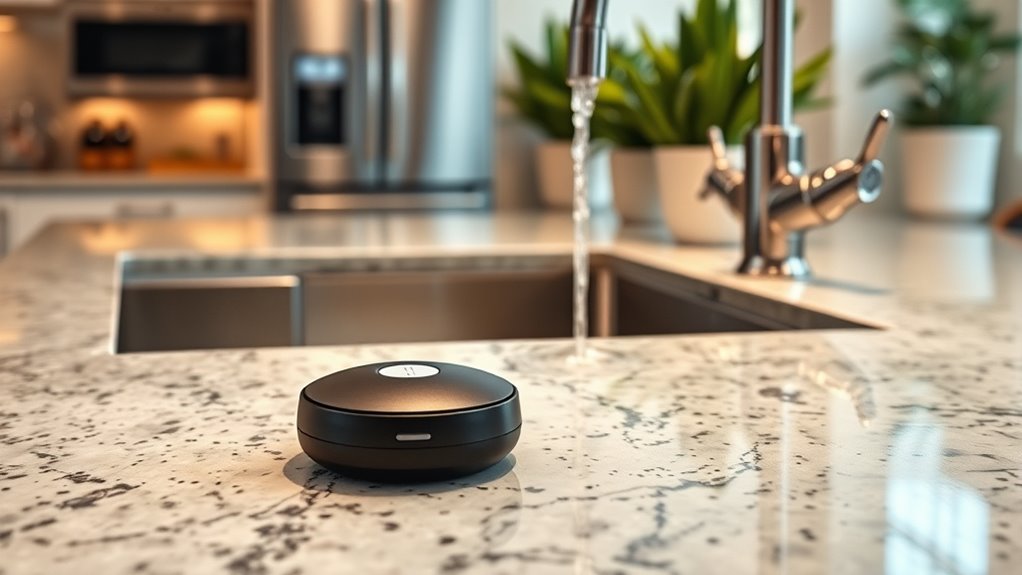

For most homes, I’d start with the YoLink Water Leak Sensor 4-Pack with Hub: its included hub and loud local alarm make it a practical choice for monitoring several trouble spots. The GoveeLife sensor with a 4.92-foot cable suits tight spaces where water may pool out of reach, while Moen Flo’s Wi-Fi-enabled three-pack is a straightforward option for people who want app alerts without choosing a separate hub. The main tradeoffs are how sensors connect, how far their probes reach, and whether alerts still work when the internet is down. A bigger pack can cover more locations, but only if its hub, app, and sensor design fit your home. Read on for my comparison of all 15 options and guidance on choosing the right setup.

Get cleaning gear delivered free with Prime
- Fast, free delivery on millions of items
- Prime Video, Amazon Music and more included
- Member-only deals all year
Complete the kit


Key Takeaways
- YoLink’s hub kits stand out for multi-room coverage, but buyers should choose between the four-sensor and six-sensor bundles based on actual placement needs.
- GoveeLife’s cable model addresses a placement problem that standard puck sensors cannot: reaching beneath or behind appliances where water collects.
- X-Sense offers two different priorities: an ultra-slim four-sensor kit for discreet placement and a 120 dB kit for a particularly loud local alarm.
- Hub requirements vary across the lineup. Tapo and Aqara depend on compatible hubs, while Wi-Fi-based choices may be simpler for households without an existing smart-home hub.
- Pack size alone does not determine value. The best fit depends on sensor placement, connectivity, alarm audibility, and whether the included hub covers the locations that matter.
| GoveeLife Smart Water Leak Detector, 2-Pack |  | Best Compact Starter Kit | Pack size: 2 detectors | Wireless technology: Sub-1G | Connectivity range: Up to 1,804 feet | VIEW ON AMAZON | See Our Full Breakdown |
| YoLink Water Leak Sensor 4-Pack with Hub, 105 dB Alarm |  | Best for Offline Resilience | Included: 1 YoLink Hub and 4 leak sensors | Sensor technology: LoRa | Wireless range: Up to 2,034 feet (1/4 mile) open air | VIEW ON AMAZON | See Our Full Breakdown |
| GoveeLife Smart Water Leak Detector 2, 4-Pack |  | Best for Voice Assistant Flexibility | Pack size: 4 detectors | Maximum range: Up to 1,968.5 feet | Sensor connectivity: LoRa | VIEW ON AMAZON | See Our Full Breakdown |
| GoveeLife Smart Water Leak Detector with 4.92 ft Cable |  | Best for Sump Pits and Hidden Leaks | Cable length: 4.92 feet | Wireless range: Up to 550 meters | Sensor technology: 915 MHz | VIEW ON AMAZON | See Our Full Breakdown |
| GoveeLife Upgraded Smart Water Leak Detector with High Alarm, 6 Pack |  | Best for Large Homes | Quantity: 6 detectors | Wireless technology: Sub-1G | Connectivity range: Up to 1,804 feet through up to 5 walls | VIEW ON AMAZON | See Our Full Breakdown |
| GoveeLife Upgraded Smart Water Leak Detector 1s, 4 Pack |  | Best for Long-Range Coverage | Quantity: 4 detectors | Wireless technology: Sub-1G | Connectivity range: Up to 1,804 ft through 5 walls | VIEW ON AMAZON | See Our Full Breakdown |
| Moen Flo Detector – WiFi-Enabled Water & Moisture Sensor (3-Pack) |  | Best for Moen Smart Water Homes | Model: 920-005 | Quantity: 3 detectors | Connectivity: 2.4 GHz Wi-Fi | VIEW ON AMAZON | See Our Full Breakdown |
| Tapo Smart Water Leak Detector (T300) – Requires Tapo Hub |  | Best for Fast, Dual-Side Detection | Detection time: As little as 1 second | Sensor probes: 6, with dual-side sensing | Alarm: 90 dB, adjustable | VIEW ON AMAZON | See Our Full Breakdown |
| X-Sense Ultra-Slim Wi-Fi Water Leak Detector with 4 Sensors and Base Station |  | Best for Tight Spaces | Included: 4 detectors and base station | Probe layout: 2 top probes and 4 bottom probes per sensor | Minimum water depth: 0.4 mm | VIEW ON AMAZON | See Our Full Breakdown |
| X-Sense Wi-Fi Water Leak Detector Kit, 120 dB, 3 Sensors + Base (SWS54) | 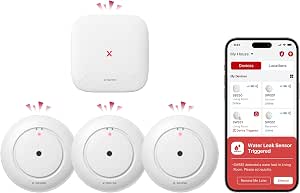 | Best for Shared Household Alerts | Model: SWS54 | Number of sensors: 3 | Probes: 6 per sensor: 2 upper and 4 lower | VIEW ON AMAZON | See Our Full Breakdown |
| Govee Life Smart Water Leak Detector 2 – 1968 ft Ultra-Long Range (6-Pack) |  | Best for Long-Range Coverage | Pack size: 6 sensors | Wireless technology: LoRa | Maximum range: Up to 1,968 ft | VIEW ON AMAZON | See Our Full Breakdown |
| YoLink Water Leak Sensor 4 Kit – 6-Pack with Hub, 105 dB Alarm |  | Best for Local Alerts During Internet Outages | Pack contents: 1 hub and 6 Leak Sensor 4 units | Wireless technology: LoRa | Maximum range: Up to 2,034 ft open-air | VIEW ON AMAZON | See Our Full Breakdown |
| GoveeLife Upgraded Smart Water Leak Detector 1s with High Alarm, 5 Pack |  | Best for Adjustable Local Alarms | Pack size: 5 sensors | Wireless range: Up to 1,804 ft (550 meters) | Wireless technology: Sub-1G | VIEW ON AMAZON | See Our Full Breakdown |
| Aqara Zigbee Water Leak Sensor, 3 Pack |  | Best Compact Pick for Aqara Setups | Pack size: 3 sensors | Connectivity: Zigbee | Minimum water detection: 0.5 mm (0.02 in) | VIEW ON AMAZON | See Our Full Breakdown |
| YoLink Water Leak Sensor Kit, 6 Sensors with Hub |  | Best for Expanding Multi-Room Coverage | Pack contents: 1 YoLink Hub and 6 Leak Sensor 1 units | Connectivity: LoRa | Maximum range: Up to 2,034 ft open-air | VIEW ON AMAZON | See Our Full Breakdown |
| smart home leak sensor | Water resistance |
|---|---|
| GoveeLife Smart Water Leak Det | IP67 |
| YoLink Water Leak Sensor 4-Pac | IP67 |
| GoveeLife Smart Water Leak Det | IP66 |
| GoveeLife Smart Water Leak Det | IP66 in one listing detail; IP67 in another |
| GoveeLife Upgraded Smart Water | IP67 |
| GoveeLife Upgraded Smart Water | IP67 |
| Moen Flo Detector | — |
| Tapo Smart Water Leak Detector | — |
| X-Sense Ultra-Slim Wi-Fi Water | — |
| X-Sense Wi-Fi Water Leak Detec | — |
| Govee Life Smart Water Leak De | IP66 |
| YoLink Water Leak Sensor 4 Kit | — |
| GoveeLife Upgraded Smart Water | IP67 |
| Aqara Zigbee Water Leak Sensor | IP67 |
| YoLink Water Leak Sensor Kit | — |
More Details on Our Top Picks
GoveeLife Smart Water Leak Detector, 2-Pack
For a few high-risk spots, this two-pack pairs long-range Sub-1G connectivity with app, SMS, and email alerts, so a leak can reach you even when you are away from home. Its range is listed at up to 1,804 feet, and the 105 dB adjustable alarm adds a local warning. Compared with the four-sensor YoLink Water Leak Sensor 4-Pack with Hub, this kit covers fewer locations but keeps the setup focused on two GoveeLife sensors. The IP67 rating suits damp locations, while the stated five-year battery life limits routine changes. The main constraint is its closed compatibility: the gateway supports only H5059/H5830 sensors, and it requires 2.4 GHz Wi-Fi. Choose it for targeted coverage; skip it if you want to build around mixed brands or protect many rooms at once.
Pros:- Sub-1G connection is specified for up to 1,804 feet, including through walls
- App, SMS, and email alerts provide several ways to hear about a leak
- Adjustable alarm reaches 105 dB and can be silenced from the app
- IP67 rating and stated five-year battery life suit long-term placement
Cons:- Two sensors cover fewer locations than the YoLink four-sensor kit
- Gateway requires 2.4 GHz Wi-Fi
- Compatible only with GoveeLife H5059/H5830 sensors
Best for: Homeowners who want to monitor two leak-prone areas with remote alerts and a loud local alarm
Not ideal for: Buyers protecting several floors or seeking a hub that supports sensors from multiple brands
- Pack size:2 detectors
- Wireless technology:Sub-1G
- Connectivity range:Up to 1,804 feet
- Alarm volume:Up to 105 dB; four adjustable levels
- Battery life:Up to 5 years
- Notifications:App, SMS, and email
- Water resistance:IP67
- Gateway Wi-Fi:2.4 GHz
- Compatible sensors:GoveeLife H5059/H5830
Our verdict“Pick this two-sensor kit for targeted, long-range leak alerts; choose a larger bundle if you need coverage in more rooms.”
YoLink Water Leak Sensor 4-Pack with Hub, 105 dB Alarm
The standout reason to choose this kit is device-to-device control during internet outages: its sensors can trigger compatible YoLink sirens or shutoff valves even when the connection to the internet is down. Four sensors and a hub make it a more substantial starter system than the two-sensor GoveeLife Smart Water Leak Detector, 2-Pack, while LoRa range up to a quarter mile in open air suits properties where ordinary Wi-Fi coverage is unreliable. Each sensor also has a 105 dB alarm and can send app, email, and SMS alerts. The tradeoff is setup: the hub is required, and sensors use replaceable AAA batteries. Alexa support and capacity for over 300 YoLink devices give it room to grow, but that ecosystem commitment may be more than someone needs for a single sink or appliance.
Pros:- LoRa wireless range is listed up to 1/4 mile in open air
- Sensors can trigger compatible YoLink devices during internet outages
- Four sensors each include a 105 dB alarm and IP67 rating
- Hub supports more than 300 YoLink devices
Cons:- Requires a separate hub for the sensors to operate as a smart kit
- Eight included AAA batteries will need manual replacement over time
- The hub and ecosystem add setup overhead compared with a two-sensor kit
Best for: Homeowners with weak Wi-Fi coverage who want leak sensors to trigger compatible YoLink devices during internet outages
Not ideal for: Renters or buyers seeking the simplest one-room setup without a separate hub or manual battery changes
- Included:1 YoLink Hub and 4 leak sensors
- Sensor technology:LoRa
- Wireless range:Up to 2,034 feet (1/4 mile) open air
- Alarm volume:105 dB
- Battery:8 AAA batteries; 2 per sensor
- Battery life:Up to 5 years
- Water resistance:IP67
- Hub capacity:More than 300 YoLink devices
- Voice assistant compatibility:Alexa
Our verdict“Choose this kit when outage resilience and broad YoLink expansion matter more than keeping setup minimal.”
GoveeLife Smart Water Leak Detector 2, 4-Pack
This four-pack combines LoRa sensor links with a 2.4 GHz Wi-Fi gateway, giving you coverage across multiple rooms while routing alerts through app, SMS, or email. Its listed range of up to 1,968.5 feet and support for Alexa, Google Assistant, and IFTTT make it more appealing to voice-assistant households than the GoveeLife Smart Water Leak Detector with 4.92 ft Cable, which instead focuses on reaching hidden or below-floor water. Each sensor has a 100 dB alarm and an IP66 rating, and the supplied AAA batteries are claimed to last over five years under normal use. That alarm is slightly lower than the 105 dB alarms on the YoLink four-pack and GoveeLife cable-probe model. Battery life also depends on use, and the gateway needs 2.4 GHz Wi-Fi.
Pros:- Four sensors cover several leak-prone areas in one kit
- Listed LoRa range reaches up to 1,968.5 feet
- Supports Alexa, Google Assistant, and IFTTT
- App, SMS, email, and audible alarms provide multiple alert paths
Cons:- 100 dB alarm is lower than the 105 dB alarms on some alternatives
- Gateway supports only 2.4 GHz Wi-Fi
- Battery life varies with usage
Best for: Smart-home households that want four sensors with voice assistant and IFTTT compatibility
Not ideal for: Buyers who need a cable probe for a sump pit or want the stronger listed 105 dB alarm
- Pack size:4 detectors
- Maximum range:Up to 1,968.5 feet
- Sensor connectivity:LoRa
- Gateway Wi-Fi:2.4 GHz
- Alarm volume:Up to 100 dB
- Battery:8 AAA batteries included
- Battery life:Over 5 years under normal use
- Water resistance:IP66
- Compatible devices:Alexa, Google Assistant, and IFTTT
Our verdict“Choose this four-pack for broad voice-assistant compatibility and multiroom coverage, provided a cable probe is not needed.”
GoveeLife Smart Water Leak Detector with 4.92 ft Cable
The 4.92-foot cable probe is the reason this detector earns a distinct place in a leak-sensor roundup: it can reach into a sump pit or behind an appliance where a floor-contact puck may not fit. Selectable leak alarm and water-level modes also make it more useful for monitoring a rising level than the GoveeLife Smart Water Leak Detector 2, 4-Pack, which is designed for general placement around a home. This model adds a 105 dB alarm, app, SMS, and email alerts, plus a stated battery life of up to five years. Its 2.4 GHz gateway requirement and compatibility limits narrow its fit, and product details conflict on whether the sensor is IP66 or IP67. Buyers should check the rating for their intended location rather than assume the higher figure.
Pros:- 4.92-foot cable probe reaches areas a floor sensor may not
- Selectable leak alarm and water-level detection modes
- 105 dB audible alarm plus app, SMS, and email notifications
- Listed battery life is up to five years
Cons:- Requires a compatible GoveeLife gateway and 2.4 GHz Wi-Fi
- Product details conflict between IP66 and IP67 ratings
- A cable probe is less convenient than a compact puck for open floor areas
Best for: Homeowners monitoring a sump pit, utility area, or appliance where a cable probe can reach concealed water
Not ideal for: Buyers who only need simple floor sensors or require a clearly consistent water-resistance specification
- Cable length:4.92 feet
- Wireless range:Up to 550 meters
- Sensor technology:915 MHz
- Alarm volume:105 dB
- Battery:6 AAA batteries included
- Stated battery life:Up to 5 years
- Gateway Wi-Fi:2.4 GHz
- Detection modes:Leak alarm and water level
- Water resistance:IP66 in one listing detail; IP67 in another
Our verdict“Pick this model for a sump pit or concealed leak point where its cable probe and water-level mode solve a placement problem.”
GoveeLife Upgraded Smart Water Leak Detector with High Alarm, 6 Pack
With six sensors in one kit, this is the most direct choice here for covering many leak-prone locations, from bathrooms and laundry areas to a basement. Its Sub-1G connection is specified to reach 1,804 feet through up to five walls, while app, SMS, email, flashing light, and an adjustable 105 dB alarm give leaks several ways to get noticed. Compared with the YoLink Water Leak Sensor 4-Pack with Hub, this bundle supplies more detectors and does not list internet-outage device-to-device control as a feature. The stated five-year battery life and IP67 rating support long-term placement, but the system still depends on a 2.4 GHz gateway and accepts only GoveeLife H5059/H5830 sensors. That makes it a strong coverage pick for a GoveeLife setup, less so for buyers building a mixed-brand system.
Pros:- Six detectors provide the broadest included coverage among these five products
- Sub-1G range is listed at 1,804 feet through up to five walls
- App, SMS, email, flashing light, and adjustable audible alarm offer multiple alerts
- IP67 rating and five-year battery life support long-term placement
Cons:- Gateway requires 2.4 GHz Wi-Fi
- Compatible only with GoveeLife H5059/H5830 sensors
- Does not list the internet-outage device-to-device control offered by the YoLink kit
Best for: Owners of larger homes who want six sensors and remote alerts across many leak-prone rooms
Not ideal for: Buyers who need outage-triggered shutoff control or plan to mix sensors from different brands
- Quantity:6 detectors
- Wireless technology:Sub-1G
- Connectivity range:Up to 1,804 feet through up to 5 walls
- Alarm volume:Up to 105 dB; 4 adjustable levels
- Battery life:5 years
- Alert methods:SMS, app push, email, flashing light, and audible alarm
- Water resistance:IP67
- Gateway Wi-Fi:2.4 GHz
- Compatible sensors:GoveeLife H5059/H5830
Our verdict“Choose this six-pack for broad coverage in a large home if you are comfortable with GoveeLife’s sensor compatibility limits.”
GoveeLife Upgraded Smart Water Leak Detector 1s, 4 Pack
Long-range coverage is the reason I’d choose this four-pack for a home where the laundry room, basement, or utility spaces sit far from the gateway. Its Sub-1G connection is rated for up to 1,804 feet through five walls, and the five-year battery life limits routine upkeep across several locations. SMS, app, and email alerts offer more ways to hear about a leak than the app-only notification setup described for the Moen Flo Detector. The local alarm also reaches 105 dB, with adjustable volume and app silencing. The tradeoff is a dedicated gateway that needs 2.4 GHz Wi-Fi, plus compatibility limited to specified GoveeLife sensors. I’d favor X-Sense’s SWS54 if shared access for a larger household matters more; this GoveeLife set prioritizes reach and multiple alert channels.
Pros:- Sub-1G wireless range rated up to 1,804 feet through five walls
- SMS, app, and email alerts provide several ways to receive leak notices
- IP67 housing is reusable after drying
- Five-year battery life and adjustable 105 dB alarm
Cons:- Gateway requires a 2.4 GHz Wi-Fi network
- Compatible only with GoveeLife H5059 and H5830 sensors
Best for: Homeowners placing sensors in distant basements, garages, or utility rooms who want several alert channels and long battery life
Not ideal for: Buyers who want sensors to connect directly to Wi-Fi or work across brands, since this setup needs a 2.4 GHz gateway and supports limited sensor compatibility
- Quantity:4 detectors
- Wireless technology:Sub-1G
- Connectivity range:Up to 1,804 ft through 5 walls
- Alarm:Up to 105 dB, 4 adjustable levels
- Battery life:Up to 5 years
- Notifications:SMS, app push, and email
- Wi-Fi requirement:2.4 GHz gateway
- Water resistance:IP67
- Compatible sensors:GoveeLife H5059 and H5830
Our verdict“Choose this four-pack for far-flung leak-prone areas where long wireless reach and several alert methods matter most.”
Moen Flo Detector – WiFi-Enabled Water & Moisture Sensor (3-Pack)
Moen ecosystem fit gives this three-pack a clear audience: households already using the Moen Smart Water Network or planning to add its Flo Shutoff. The detectors monitor places such as water heaters and washing machines, then send app alerts when they sense moisture. Multiple units can be linked, which makes expanding coverage straightforward within that system. Compared with the Tapo T300, which needs a separate Tapo Hub, this model uses 2.4 GHz Wi-Fi and the Moen app rather than a dedicated sensor hub. That convenience comes with a narrower path: it requires 2.4 GHz Wi-Fi, and automatic shutoff depends on a separately sold Flo Shutoff. I’d pick the GoveeLife 1s for longer stated range and SMS or email alerts; Moen is the more natural choice for buyers building around Moen devices.
Pros:- Real-time app alerts when moisture is detected
- Multiple detectors can be linked for broader home coverage
- Integrates with the Moen Smart Water Network
- Replaceable battery is securely mounted
Cons:- Requires a 2.4 GHz Wi-Fi network
- Automatic water shutoff requires a separate Moen Flo Shutoff
Best for: Homeowners with Moen Smart Water Network devices who want app-monitored coverage near appliances and water heaters
Not ideal for: Buyers seeking automatic shutoff from the detector alone, or those without a 2.4 GHz Wi-Fi network and Moen app setup
- Model:920-005
- Quantity:3 detectors
- Connectivity:2.4 GHz Wi-Fi
- Battery:Replaceable, securely mounted
- App compatibility:Moen Smart Water Network app
- Use:Standalone or paired with Moen Flo Shutoff
- Automatic shutoff:Requires separate Moen Flo Shutoff
Our verdict“Choose this pack if Moen is already your smart water system and app alerts are the main goal.”
Tapo Smart Water Leak Detector (T300) – Requires Tapo Hub
The six probes on both sides are the Tapo T300’s strongest point: they can catch drips from above as well as water reaching the sensor from below. The stated one-second detection and 90 dB alarm suit buyers who want a quick local warning near a washing machine or sink, while app alerts add a remote cue. Compared with the Moen Flo Detector, this model provides specific dual-side sensing and an adjustable audible alarm, but it depends on a Tapo Hub. Its replaceable AAA cells are simple to source, though the stated battery life is up to three years and is a lab estimate. The GoveeLife 1s offers a longer stated battery life and SMS and email alerts; Tapo makes more sense for buyers already using its hub and who value probe coverage.
Pros:- Six probes provide dual-side water sensing
- Stated detection time is as little as one second
- Adjustable 90 dB alarm and app notifications
- Replaceable AAA batteries with a stated life of up to three years
Cons:- Requires a Tapo Hub to operate
- Uses disposable AAA batteries
Best for: Tapo Hub owners who want fast leak detection with probes that sense water from above and below
Not ideal for: Households without a Tapo Hub or buyers seeking a detector that can operate independently of a hub
- Detection time:As little as 1 second
- Sensor probes:6, with dual-side sensing
- Alarm:90 dB, adjustable
- Battery type:2 replaceable AAA batteries
- Battery life:Up to 3 years (lab estimate)
- Hub requirement:Tapo Hub required
- Water and dust resistance:IP67
- Alerts:App notifications for leaks and low battery
Our verdict“Pick the T300 if you already have a Tapo Hub and want dual-side sensing with a fast local alarm.”
X-Sense Ultra-Slim Wi-Fi Water Leak Detector with 4 Sensors and Base Station
Slim sensor bodies make this X-Sense set a useful fit behind appliances or in other cramped spots where a taller detector may be awkward. Each sensor is 0.7 inches thick and uses top and bottom probes, with stated detection of water as shallow as 0.4 mm. The base station sounds an alarm while the app supplies remote alerts, alarm history, and temporary muting. Compared with the Tapo T300, this kit bundles four detectors and a base station rather than requiring the buyer to provide a Tapo Hub; Tapo, by contrast, specifies a one-second detection time. X-Sense states up to 1,700 feet in open areas, so that figure may not translate to rooms separated by walls. Its alarm-volume information also conflicts: the description says up to 100 dB, while specifications say 120 dB.
Pros:- 0.7-inch-thick sensors fit tight spaces
- Top and bottom probes detect drips and shallow pooling
- App provides alerts, alarm history, and mute controls
- Includes four detectors and a base station
Cons:- The 1,700-foot range is specified for open areas
- Alarm volume is inconsistent between product description and specifications
- Power comes from eight AAA batteries
Best for: Homeowners who need several low-profile sensors for narrow gaps behind appliances and want app history
Not ideal for: Buyers who need dependable range through walls or a clearly specified alarm volume
- Included:4 detectors and base station
- Probe layout:2 top probes and 4 bottom probes per sensor
- Minimum water depth:0.4 mm
- Sensor thickness:0.7 in (17 mm)
- Sensor diameter:3 in (77 mm)
- Wireless range:Up to 1,700 ft (500 m) in open areas
- Alarm volume:Description: up to 100 dB; specifications: 120 dB
- Power:8 AAA batteries, included
- Connectivity and alerts:Wi-Fi with app alerts
Our verdict“Choose this kit for low-clearance sensor placement and app history, provided its range and alarm-volume limits suit your home.”
X-Sense Wi-Fi Water Leak Detector Kit, 120 dB, 3 Sensors + Base (SWS54)
Shared access for up to 12 users sets this X-Sense kit apart for households where more than one person needs to respond to a leak. Its three sensors use six probes each, including upper probes for drips and lower probes for pooled water, with a stated detection depth of 0.4 mm. Both sensors and base can sound a 120 dB alarm, while 2.4 GHz Wi-Fi sends phone alerts. Compared with the GoveeLife 1s, this kit specifies access for a larger group and a louder alarm, but the GoveeLife has more alert channels and a five-year battery claim. X-Sense’s range reaches up to 1,804 feet, though placement still depends on the home layout. Its main constraint is network compatibility: it supports 2.4 GHz only, with no 5 GHz support.
Pros:- Up to 12 users can share access
- 120 dB alarm from sensors and base
- Six probes per sensor detect drips and water as shallow as 0.4 mm
- Wireless range rated up to 1,804 feet
Cons:- Supports 2.4 GHz Wi-Fi only
- Three sensors provide less included coverage than four-sensor kits
Best for: Households with several people responsible for leak response who want shared phone access and a loud base alarm
Not ideal for: Buyers whose Wi-Fi operates only on 5 GHz or who need sensors that do not depend on a Wi-Fi base setup
- Model:SWS54
- Number of sensors:3
- Probes:6 per sensor: 2 upper and 4 lower
- Probe detection depth:0.4 mm
- Alarm sound level:120 dB
- Wireless range:Up to 1,804 ft (550 m)
- Wi-Fi band:2.4 GHz only
- User access:Up to 12 users
Our verdict“Choose the SWS54 if multiple household members need alerts and your network supports 2.4 GHz Wi-Fi.”
Govee Life Smart Water Leak Detector 2 – 1968 ft Ultra-Long Range (6-Pack)
The 1,968 ft LoRa range makes this six-sensor set a strong fit for large homes where a utility room, basement, or detached building sits far from the gateway. Like the YoLink Water Leak Sensor 4 Kit, it uses long-range LoRa rather than relying on each sensor’s direct Wi-Fi connection; the Govee set adds Alexa, Google Assistant, and IFTTT compatibility. Multiple alert channels and a 100 dB alarm help cover both away-from-home monitoring and nearby leaks. Its tradeoff is the battery setup: the pack uses 12 AAA batteries, which means more replacements to manage than the YoLink kit’s two AAA batteries per sensor. The gateway also requires 2.4 GHz Wi-Fi, so buyers should check their network setup before choosing it.
Pros:- Long-range LoRa connectivity rated up to 1,968 ft
- SMS, app, and email alerts, with Alexa, Google Assistant, and IFTTT support
- Six probes and a 100 dB alarm for detecting and announcing leaks
- IP66 rating and stated battery life of over five years
Cons:- The six-pack uses 12 AAA batteries, adding replacements to manage
- Gateway supports 2.4 GHz Wi-Fi only
- The 100 dB alarm is quieter than the 105 dB alarm in the YoLink Water Leak Sensor 4 Kit
Best for: Owners of large homes or detached spaces who want six leak points covered with long-range alerts and voice-assistant compatibility
Not ideal for: Buyers who want fewer batteries to track or whose router setup cannot support a 2.4 GHz gateway
- Pack size:6 sensors
- Wireless technology:LoRa
- Maximum range:Up to 1,968 ft
- Alarm:100 dB
- Battery setup:12 AAA batteries included
- Stated battery life:Over five years
- Water resistance:IP66
- Compatible devices:Alexa, Google Assistant, IFTTT
- Wi-Fi requirement:2.4 GHz only
Our verdict“Choose this Govee set if you need long-range coverage across six locations and value broad alert integrations.”
YoLink Water Leak Sensor 4 Kit – 6-Pack with Hub, 105 dB Alarm
The 105 dB alarm in each sensor gives this YoLink kit an advantage when a leak happens within earshot, while its Control-D2D feature can provide local device-to-device protection without internet. That makes it a more self-contained choice for basements or utility areas than the YoLink Water Leak Sensor Kit with Leak Sensor 1 units, whose sensors have no built-in siren. Both kits include a hub and six sensors, use long-range LoRa, and support app, email, and text alerts. Each Leak Sensor 4 runs on two AAA batteries with a stated life of up to five years. The tradeoff is that smart features depend on the included YoLink hub, and the 2,034 ft range is an open-air rating rather than a promise for every house.
Pros:- Includes one hub and six sensors in a ready-to-set-up kit
- Built-in 105 dB alarm on each sensor
- Control-D2D enables local actions without internet
- Two AAA batteries per sensor with up to five years of stated battery life
Cons:- Requires the included YoLink hub for smart features
- The stated 2,034 ft range is open-air and may be reduced by walls and building layout
- The package has seven pieces total: one hub and six sensors
Best for: Households that want audible alerts at each sensor and local device-to-device actions that can keep working during an internet outage
Not ideal for: Buyers who already use another smart-home hub and want leak sensors that connect directly to it
- Pack contents:1 hub and 6 Leak Sensor 4 units
- Wireless technology:LoRa
- Maximum range:Up to 2,034 ft open-air
- Alarm:105 dB per sensor
- Batteries per sensor:2 AAA
- Stated battery life:Up to 5 years
- Offline control:Control-D2D device-to-device
- Hub capacity:300+ YoLink devices
Our verdict“Pick the Leak Sensor 4 kit if you want a loud local alarm at every sensor and offline device-to-device protection.”
GoveeLife Upgraded Smart Water Leak Detector 1s with High Alarm, 5 Pack
With a 105 dB alarm and four adjustable volume levels, this five-pack lets buyers tune the sound to the room rather than accept a fixed alarm. Its Sub-1G wireless connection is rated for up to 1,804 ft through dense walls, which makes it a practical choice when a leak sensor must reach across a large home. Compared with the Govee Life Smart Water Leak Detector 2 six-pack, this version has one fewer sensor and a higher stated alarm level, but its listed compatibility is narrower: it works with GoveeLife H5059/H5830 sensors and requires a 2.4 GHz gateway. App, SMS, and email alerts add remote notice, while IP67 protection suits damp locations. The tradeoff is a total of 10 AAA batteries across the pack, and buyers should confirm their existing Govee devices are compatible.
Pros:- 105 dB alarm with four adjustable volume levels
- Sub-1G range rated up to 1,804 ft through dense walls
- App, SMS, and email alerts
- IP67 protection and stated battery life up to five years
Cons:- Uses 10 AAA batteries across the five sensors
- Gateway requires 2.4 GHz Wi-Fi
- Compatibility is limited to GoveeLife H5059/H5830 sensors
Best for: GoveeLife households that want to adjust alarm volume and place sensors across a large or wall-heavy home
Not ideal for: Buyers seeking broad smart-home compatibility or a kit with fewer batteries to maintain
- Pack size:5 sensors
- Wireless range:Up to 1,804 ft (550 meters)
- Wireless technology:Sub-1G
- Alarm:105 dB with 4 volume levels
- Battery setup:10 AAA batteries included
- Stated battery life:Up to 5 years
- Water resistance:IP67
- Connectivity:2.4 GHz Wi-Fi gateway
- Compatible sensors:GoveeLife H5059/H5830
Our verdict“Choose this five-pack if adjustable loud alarms and long-range coverage matter more than broad device compatibility.”
Aqara Zigbee Water Leak Sensor, 3 Pack
This compact three-pack is aimed at buyers already building around Aqara: each sensor detects water as shallow as 0.5 mm and can send phone alerts while triggering an alarm on a compatible Aqara Hub. The shallow detection threshold can help catch a small leak before water spreads, and the IP67 housing suits placement near sinks or appliances. Unlike the YoLink Water Leak Sensor 4 Kit, Aqara uses Zigbee and needs a compatible hub sold separately; it does not offer the same stated long-range coverage. Its recommended sensor-to-hub distance is just 10 m, so placement and hub location matter. This is a neat fit for a compact, hub-centered smart home, but less appealing for buyers who need to cover distant rooms or want a complete kit in one box.
Pros:- Detects water at levels as low as 0.5 mm
- Compact wireless design requires no wiring or screws
- IP67-rated housing
- Can send phone alerts and trigger an alarm on a compatible Aqara Hub
Cons:- Compatible Aqara Hub is required and sold separately
- Recommended sensor-to-hub range is limited to 10 m
- Third-party hubs and Zigbee USB dongles are not officially supported
Best for: Aqara users adding compact leak sensors near sinks, appliances, or other spots within 10 m of their hub
Not ideal for: Buyers without a compatible Aqara Hub or those needing long-range coverage across a large home
- Pack size:3 sensors
- Connectivity:Zigbee
- Minimum water detection:0.5 mm (0.02 in)
- Water resistance:IP67
- Hub requirement:Compatible Aqara Hub required; sold separately
- Recommended sensor-to-hub range:Within 10 m (33 ft)
Our verdict“Choose the Aqara three-pack if you already own a compatible hub and need compact sensors for nearby leak-prone spots.”
YoLink Water Leak Sensor Kit, 6 Sensors with Hub
This kit covers six leak-prone areas with a hub and Leak Sensor 1 units, using LoRa to reach places where direct Wi-Fi coverage may be unreliable. It shares the YoLink platform and a stated open-air range of up to 2,034 ft with the YoLink Water Leak Sensor 4 Kit, and both can send app, email, and text alerts. The key difference is at the sensor: this model has no built-in siren, while the Sensor 4 kit includes a 105 dB alarm in each unit. Control-D2D can still trigger compatible sirens or shutoff valves locally during internet outages, which suits buyers building a broader leak response system. Factor in the cost and setup of those extra devices if you need audible alerts, since they are not included.
Pros:- Includes one YoLink Hub and six sensors for multi-area coverage
- LoRa connectivity with a stated open-air range up to 2,034 ft
- App, email, and SMS/text alerts
- Control-D2D can trigger compatible devices locally during internet outages
Cons:- Sensors have no built-in siren
- Audible or spoken alerts require a compatible siren or SpeakerHub
- Requires the included YoLink hub for smart features
Best for: Homeowners covering several utility areas who plan to connect sensors to YoLink sirens or shutoff valves for local leak response
Not ideal for: Buyers who need each sensor to sound an audible alarm without adding a compatible siren or SpeakerHub
- Pack contents:1 YoLink Hub and 6 Leak Sensor 1 units
- Connectivity:LoRa
- Maximum range:Up to 2,034 ft open-air
- Alert methods:App, email, and SMS/text
- Offline local control:YoLink Control-D2D
- Hub capacity:300+ YoLink devices
- Built-in siren:No
Our verdict“Choose this kit if you want six LoRa sensors for a YoLink setup and are prepared to add sirens or shutoff devices as needed.”
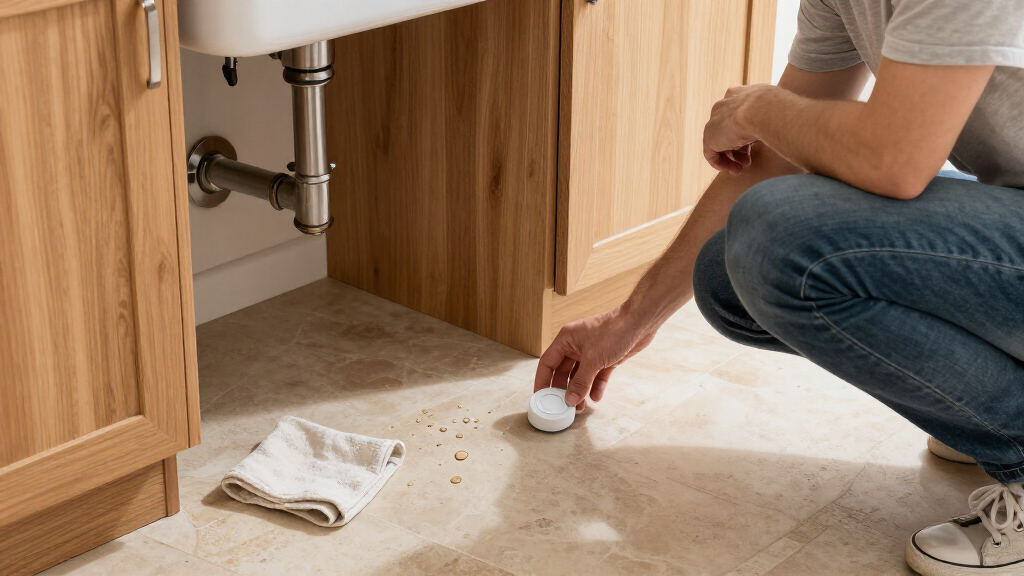
How We Picked
I compared these sensors on the factors that affect how quickly a household can detect a leak and respond: connection type, hub requirements, local alarm design, probe or sensor shape, pack size, and the likely effort of setup and maintenance. I gave more weight to practical coverage and a clear alert path than to a large bundle by itself. A sensor that can reach a hidden leak or sound an alarm nearby can be more useful than an extra sensor that is awkward to place.
The ranking reflects distinct use cases across this lineup. I put the YoLink four-pack with hub near the top for its balanced combination of included hub, multiple sensors, and 105 dB alarm; specialized picks follow where they solve a narrower problem, such as cable placement or a very loud alarm. I also account for the tradeoff of hub-dependent systems, the convenience of Wi-Fi options, and the different needs of buyers who already use Zigbee or a specific smart-home ecosystem. Product names and listed features inform this comparison; buyers should confirm current compatibility and setup requirements before choosing.
| smart home leak sensor | Water resistance |
|---|---|
| GoveeLife Smart Water Leak Det | IP67 |
| YoLink Water Leak Sensor 4-Pac | IP67 |
| GoveeLife Smart Water Leak Det | IP66 |
| GoveeLife Smart Water Leak Det | IP66 in one listing detail; IP67 in another |
| GoveeLife Upgraded Smart Water | IP67 |
| GoveeLife Upgraded Smart Water | IP67 |
| Moen Flo Detector | — |
| Tapo Smart Water Leak Detector | — |
| X-Sense Ultra-Slim Wi-Fi Water | — |
| X-Sense Wi-Fi Water Leak Detec | — |
| Govee Life Smart Water Leak De | IP66 |
| YoLink Water Leak Sensor 4 Kit | — |
| GoveeLife Upgraded Smart Water | IP67 |
| Aqara Zigbee Water Leak Sensor | IP67 |
| YoLink Water Leak Sensor Kit | — |
Factors to Consider When Choosing Smart Home Leak Sensors
I’d choose a leak sensor by starting with the leak locations and the alert path, then matching a product to those needs. The questions below can prevent a common mistake: buying a large pack before checking whether the sensors can connect and fit where they need to go.
Map Leak Locations Before Choosing a Pack
Start with likely leak sources such as under sinks, beside washing machines, near water heaters, and around toilets. Count locations that need monitoring, but also check their shape: a sensor must sit where water will reach it, and a cable probe can sometimes cover a narrow gap that a flat unit cannot. A multi-pack may leave you with spare units if your key appliances are close together, while a smaller pack may fall short across several floors. Think about whether you need coverage in a detached area or a basement where the hub may be far away. I’d prioritize putting sensors at high-consequence leak points before adding coverage to lower-risk areas.
Check the Alert Path, Not Just the Connection Label
Wi-Fi, Zigbee, and long-range systems depend on different network arrangements, so the sensor’s connection name alone does not tell you how alerts will reach you. Check whether a hub is included, whether it must connect to your router, and whether your phone receives notifications through an app account or a local system. A hub can simplify communication among several sensors, but it adds another device and another point to configure. If your home internet or power fails, remote phone alerts may stop even when a sensor can still sound its own alarm. Decide whether an audible alert at home is enough or whether you need a resilient path to someone who can act while you are away.
Plan for Alarm Audibility and Household Response
A loud alarm only helps if someone can hear it and knows what to do next. Consider whether the sensor will sit behind a machine, in a closed cabinet, or on another floor from bedrooms; those locations can muffle a siren. Phone notifications may help when nobody is home, but they depend on connectivity and notification settings. Before relying on alerts, identify who can shut off the water and where the relevant valve is. If a household includes people who may not notice app alerts, favor a setup with a clear local sound and place sensors where that sound can be heard.
Match Sensor Shape to the Space
Standard contact sensors work well on accessible floors, but an appliance’s underside or a cramped cabinet can make placement difficult. A cable sensor can put its detection point deeper into a gap while leaving the main unit easier to reach. Slim designs may fit neatly beneath fixtures, though buyers should still check how much clearance the unit needs and whether it can sit flat. Avoid placing a sensor where routine splashes, cleaning water, or condensation could trigger nuisance alerts. The right shape is the one that can stay in the best detection spot without obstructing maintenance or normal use.
Check Ecosystem Fit Before Mixing Brands
A sensor that requires a particular hub may not join a system you already own, even if both products use a familiar wireless standard. Verify the exact hub model, app, and smart-home platform support before combining brands. A standalone app setup can be easier for a household that wants a focused leak alert, while an ecosystem-linked sensor may fit better if automations are a priority. Consider what you want an alert to trigger, such as a light or a water shutoff, and confirm that the chosen system supports that action. Buying compatible devices as a group can save setup effort, but it can also tie future replacements to one platform.
Account for Battery Access and Ongoing Upkeep
Leak sensors can sit undisturbed for long stretches, which makes battery checks easy to forget. Before buying, find out how the sensor reports low battery and whether its placement will make battery changes awkward. Test the alert path after setup and repeat a simple check periodically, especially after changing routers or smart-home hubs. Keep sensor contacts free of dust and residue, since grime or poor placement can interfere with detection. If you have many sensors, a consistent naming and placement system makes it easier to identify the unit that needs attention when an alert arrives.
Frequently Asked Questions
Should I choose a kit with a hub or a Wi-Fi sensor?
I’d choose based on your existing network and where the sensors will sit. A hub-based kit can coordinate several sensors and may suit a spread-out setup, but it requires another device and a compatible app or ecosystem. Wi-Fi options may reduce hub setup, though they still rely on a stable wireless connection and the manufacturer’s alert service. Check whether the alarm works locally if the router loses internet access. Also confirm that the signal reaches the planned spots before installing sensors throughout the home.
Can a leak sensor alert me when I’m away from home?
Many connected models can send app notifications remotely, but the sensor needs to communicate with its hub or network and the alert service must be available. Phone settings can also mute notifications, so allow the app to send alerts and verify that alerts arrive on the devices you carry. A local siren is useful when someone is home, but it cannot notify you across town by itself. If remote response matters, decide who else should receive alerts and how they can access the water shutoff. Test the full path after setup rather than assuming that a successful pairing guarantees a useful notification.
Where should I put sensors first if I only have a few?
I’d begin at places where a small leak could go unnoticed or cause damage: beneath sinks, near a water heater, beside a washing machine, and near a refrigerator with a water line. Prioritize locations with hidden connections or flooring that could be damaged before adding sensors to easy-to-inspect spots. Place each unit where water would reach its contacts early, while avoiding routine splashes. If a sensor cannot fit in the likely pooling area, a cable-style detector may solve that placement issue. Expand coverage based on your home’s plumbing layout, not simply on room count.
Will these sensors shut off the water automatically?
A leak sensor detects water and sends or sounds an alert; that function alone does not close a supply valve. Automatic shutoff requires a compatible shutoff valve or a broader leak-protection system, plus support for the specific sensor and hub combination. Check compatibility at the system level before buying separate parts, since similar brand names do not guarantee that devices work together. If you want automatic action, consider what happens if the hub loses power or a valve cannot move. A sensor-only setup still provides useful warning, but someone must respond to it.
Can I use a sensor from one brand with a hub from another?
Do not assume that two products will work together because they share a wireless standard or appear in the same smart-home app. Some manufacturers require their own hub, while others support only selected platforms or device models. Check the exact sensor and hub compatibility list, then confirm which functions carry over; basic detection may work even when automations or notifications do not. If dependable leak alerts are your main goal, a matched kit can reduce uncertainty during setup. Mixed-brand systems make more sense when you already have a compatible hub and have confirmed the needed features.
Conclusion
For a balanced multi-room setup, I’d choose the YoLink Water Leak Sensor 4-Pack with Hub as my best overall pick; the six-sensor YoLink kits make more sense when you have additional locations to cover. For best value in coverage, compare those larger YoLink bundles with GoveeLife’s multi-packs and buy according to where sensors can actually be placed. The cable-equipped GoveeLife is my pick for awkward appliance gaps, while X-Sense SWS54 suits buyers who put a particularly loud local alarm first. Beginners who want to avoid a separate hub can look at the Moen Flo Wi-Fi-enabled three-pack, after checking app and network requirements. If you already use a compatible Zigbee setup, consider Aqara; if you prefer a discreet profile, the X-Sense ultra-slim kit offers a more tailored fit. Choose the system that matches your home’s connections and likely leak points, then test its alerts where the sensors will live.
Columbus Day / Indigenous Peoples' Day Picks
long weekend sales
As an affiliate, we earn on qualifying purchases.