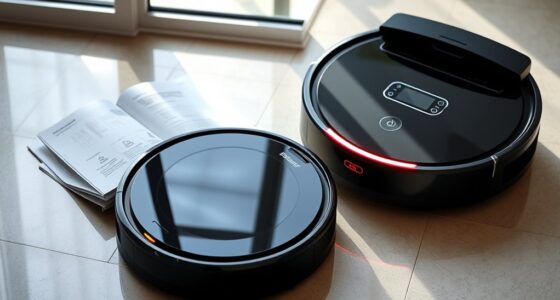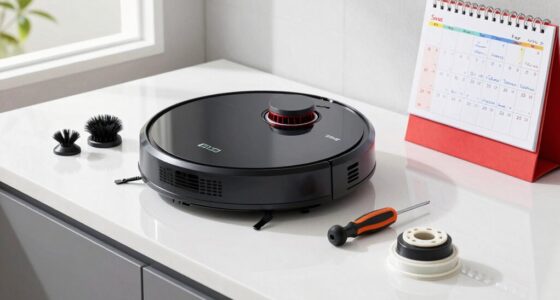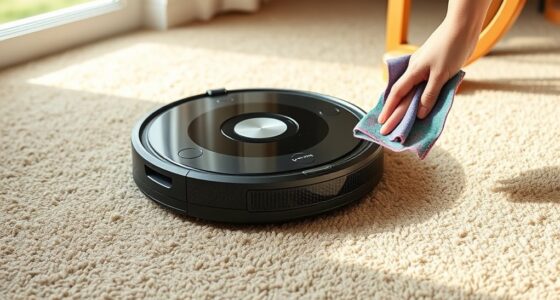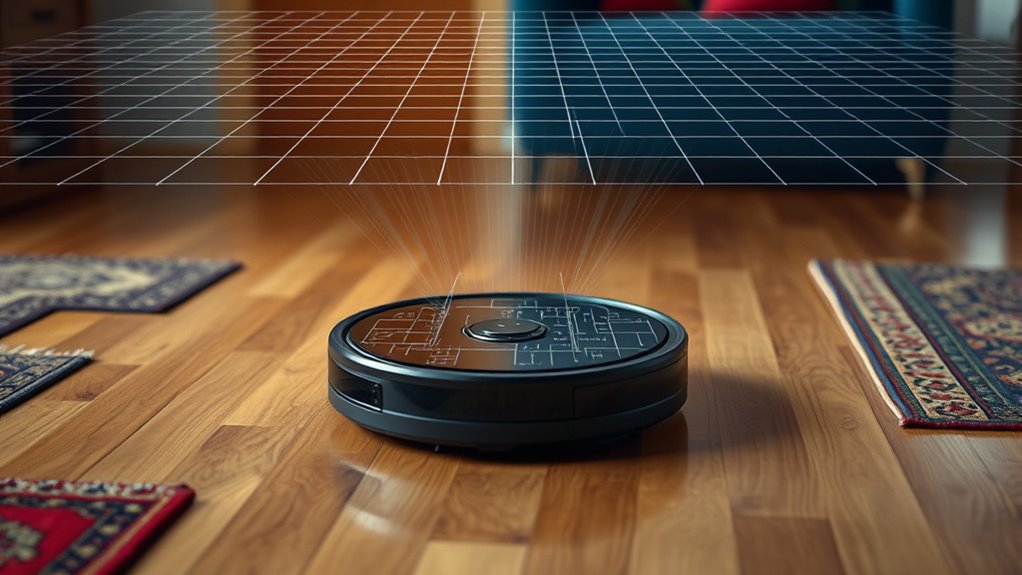

Robot vacuums navigate using a combination of advanced mapping, sensors, LIDAR, and SLAM algorithms to efficiently cover your home. LIDAR uses laser beams to create real-time 3D maps, while sensors detect obstacles, edges, and surface changes. SLAM refines the environment understanding and tracks the vacuum’s position, preventing missed spots or unnecessary repeats. Together, these technologies enable precise and adaptable navigation. Keep exploring to see how these features work together to clean your space thoroughly.
Key Takeaways
- Robot vacuums use sensors and LIDAR to detect obstacles, edges, and surface changes in real-time.
- LIDAR creates detailed 3D maps of the environment, improving navigation accuracy.
- SLAM algorithms continuously update the map while tracking the vacuum’s position.
- Advanced navigation combines sensors, LIDAR, and SLAM for efficient, adaptive cleaning routes.
- Machine learning enhances predictiveness and reliability in complex or cluttered home environments.

Robot vacuums have revolutionized how we keep our homes clean by maneuvering efficiently around obstacles and different floor types. At the core of this capability are advanced mapping algorithms that allow the vacuum to understand and remember the layout of your space. These algorithms process data from various sensors to create a detailed map, enabling the device to plan ideal cleaning routes. Instead of blindly wandering, your robot vacuum now navigates with purpose, systematically covering every inch of your home and avoiding missed spots or repeated passes. This precise mapping not only improves cleaning efficiency but also helps prevent the vacuum from getting stuck or bumping into furniture unnecessarily. Additionally, recent developments in algorithms continue to enhance predictive capabilities, making navigation even smarter.
Sensor integration plays an essential role in how these vacuums perceive their environment. The vacuum’s sensors detect obstacles, edges, and changes in floor surfaces in real-time, feeding this information back to the device’s processor. For example, cliff sensors prevent the vacuum from falling down stairs, while obstacle sensors help it sidestep furniture or toys. The seamless integration of sensors ensures continuous awareness of surroundings, allowing the vacuum to adapt instantly to unexpected objects or alterations in the environment. This dynamic responsiveness is what makes robot vacuums so reliable, even in cluttered or complex spaces.
LIDAR (Light Detection and Ranging) technology further enhances navigation by scanning the environment with laser beams. This creates a detailed, real-time 3D map of your home, allowing the vacuum to quickly identify and differentiate between objects, walls, and open spaces. LIDAR-equipped models use this data in conjunction with advanced mapping algorithms to update their maps as they clean, ensuring thorough coverage. The combination of sensor integration and LIDAR results in a highly accurate and efficient navigation system that adapts to changes, such as moving furniture or new obstacles.
Simultaneously, SLAM (Simultaneous Localization and Mapping) algorithms work to continuously refine the vacuum’s understanding of its environment. As the robot moves, it builds a map and tracks its position within that map, allowing it to recalibrate if it gets displaced or encounters new obstacles. This constant process of localization and mapping guarantees that your robot vacuum won’t waste time retracing already cleaned areas and can quickly find its way back to its charging station when needed. Furthermore, ongoing advancements in machine learning algorithms are helping these systems become even more adaptive and predictive. Together, these technologies—mapping algorithms, sensor integration, LIDAR, and SLAM—create a navigation system that’s precise, adaptable, and efficient. With such advanced navigation, your vacuum ensures a cleaner home with minimal effort on your part.

Lefant LiDAR Robot Vacuum and Mop, Smart Mapping and Obstacle Avoidance, Tangle-Free Pet Hair, 2.4G/5G WiFi App Control, Slim Design for Wider Coverage, Carpet Detection, M330 Pro
【dToF Navigation & Multi-Floor Mapping】With advanced dToF navigation, the Lefant M330 Pro lidar robot vacuum efficiently scans up…
As an affiliate, we earn on qualifying purchases.
As an affiliate, we earn on qualifying purchases.
Frequently Asked Questions
How Do Robot Vacuums Handle Moving Obstacles?
You’ll find that robot vacuums handle moving obstacles through dynamic obstacle detection and real-time mapping. They use sensors like infrared or ultrasonic to spot and track moving objects, adjusting their path instantly. This allows the vacuum to navigate around people, pets, or furniture that shifts position. By continuously updating their maps, they guarantee efficient cleaning without collisions, making sure your floors stay clean even with constant movement in the environment.
Can Robot Vacuums Learn and Remember Multiple Floor Plans?
Think of your robot vacuum as a diligent explorer with a photographic memory. It can learn and remember multiple floor plans through advanced memory mapping and floor plan recognition, allowing it to switch seamlessly between different homes or floors. This smart navigation guarantees efficient cleaning without re-mapping each time. With this ability, it truly becomes your home’s faithful assistant, adapting effortlessly to your changing spaces and keeping every corner spotless.
What Maintenance Is Required for Their Sensors and Navigation Systems?
You should regularly perform sensor calibration and keep your robot vacuum’s software updated to guarantee ideal navigation. Check the sensors for dust, dirt, or debris that could affect their accuracy, and clean them gently with a soft cloth. Installing software updates promptly can improve navigation algorithms and fix bugs. These simple maintenance steps help your robot vacuum navigate efficiently and avoid obstacles, keeping your floors cleaner with less hassle.
How Do Robot Vacuums Avoid Getting Stuck Under Furniture?
You can help your robot vacuum avoid getting stuck under furniture by guaranteeing it has effective obstacle detection and furniture recognition features. These systems use sensors like IR and ultrasonic to identify obstacles and recognize furniture, prompting the vacuum to change direction. Regularly cleaning sensors and updating the firmware ensures peak performance. Keep furniture’s clearance adequate, and the vacuum will navigate smoothly without getting trapped underneath.
Are There Differences in Navigation Between Budget and High-End Models?
Think of high-end robot vacuums as eagle-eyed scouts, offering superior navigation accuracy compared to budget models. They use advanced sensors and LIDAR to detect obstacles with precision, avoiding missed spots and collisions. Budget models, like less experienced explorers, might stumble or miss areas. You’ll notice high-end models adapt better to complex layouts, ensuring thorough cleaning and fewer mishaps, all thanks to their enhanced obstacle detection and smarter navigation systems.
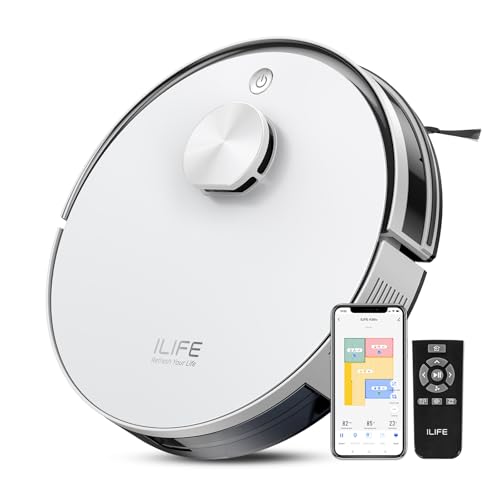
ILIFE A30s Robot Vacuum Cleaner, 10000Pa Max Suction Power with Lidar Navigation, Home Mapping, No-Go Zone, 150 Mins Max, 2.4G WiFi/App/Alexa/Remote Control, for Hard Floor, Carpet and Pet Hair
10,000Pa Max Suction Power: Experience deep cleaning with up to 10,000Pa ultra-strong suction in Spot Mode. The A30s…
As an affiliate, we earn on qualifying purchases.
As an affiliate, we earn on qualifying purchases.
Conclusion
Now that you understand how robot vacuums navigate using lidar, SLAM, and sensors, you can appreciate their efficiency. For example, imagine a robot vacuum in a busy household, avoiding furniture and pets while optimizing cleaning paths. By combining these technologies, it adapts to changes and guarantees thorough cleaning. Next time you see a robot vacuum effortlessly move around obstacles, you’ll know it’s leveraging advanced navigation systems to work smarter, not harder.

Goodsby Replacement Cliff Drop Infrared Side Sensors for Shark IQ Robot Vacuums RV1001AE RV912S RV913S RV1000S QR1000SG AV1002AE AV1010AE AV911S QR1000SB UR1000SR UR1005AE RV1101ARUS UR1105ARUS
✅ !!! CHECK YOUR VACUUM MODEL BEFORE ORDERING !!! ✅
As an affiliate, we earn on qualifying purchases.
As an affiliate, we earn on qualifying purchases.

eufy C10 Robot Vacuum Self Emptying, 8 Weeks Hands Free, Advanced Smart Mapping with LiDAR Navigation, 2.85-Inch Slim Design, Powerful Suction, Edge Expansion Brush for Pet Hair, Carpet Detection
【Self-Empty Station】:Robotic vacuum C10's dust bin is automatically emptied into the station's 3L dust bag. Thanks to its…
As an affiliate, we earn on qualifying purchases.
As an affiliate, we earn on qualifying purchases.