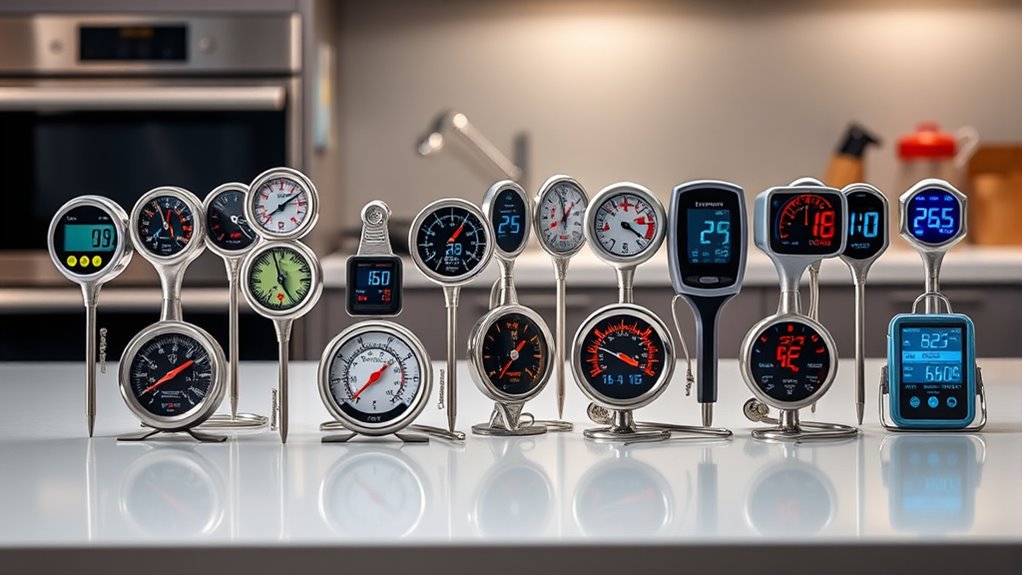

An oven thermometer shows whether your oven’s displayed setting matches the heat inside, which can help explain uneven baking or roast times that run long. My best overall pick is the OXO Good Grips Oven Thermometer for its established kitchen-focused design, while the Rubbermaid Commercial Stainless Steel Monitoring Thermometer stands out for its broad temperature range. For an easy-to-scan dial, the Efeng Large 3.5-inch Oven Thermometer is another strong option. The main tradeoffs are dial size, temperature range, mounting flexibility, and whether a single unit or multipack better suits your oven. Read on for how all 15 options compare and which one fits your cooking habits.

Get cleaning gear delivered free with Prime
- Fast, free delivery on millions of items
- Prime Video, Amazon Music and more included
- Member-only deals all year
Complete the kit


Key Takeaways
- OXO Good Grips is my best overall choice for shoppers who want a familiar, kitchen-oriented design without making a multipack the deciding factor.
- The Rubbermaid Commercial model has the widest stated range in this lineup, from 60°F to 580°F, making it a flexible pick for cooks who use both low and high oven settings.
- Large-dial options such as the Efeng 3.5-inch model prioritize at-a-glance readability, while compact 2.75- and 3-inch designs take up less visual space.
- Several models offer dual Fahrenheit and Celsius scales; this helps when following recipes in either unit, though dial size and scale layout affect how quickly a reading is read.
- Multipacks from Taylor and other brands make it possible to compare heat in different oven zones, but a second thermometer only helps if there is room to place and read both.


| oven thermometer | Temperature range |
|---|---|
| Rubbermaid Commercial Stainles | 60°F–580°F (20°C–300°C) |
| Oven Thermometer Extra Large 3 | 150°F–600°F |
| OXO Good Grips Oven Thermomete | — |
| Taylor Analog Oven Thermometer | 100°F–600°F (50°C–300°C) |
| Oven Thermometer for Gas & Ele | 100°F–600°F |
| Oven Thermometer 2.75" Dual Sc | — |
| AcuRite 00620A2 Stainless Stee | — |
| Oven Thermometer | — |
| Stainless Steel Oven Thermomet | — |
| KitchenAid 3‑in Dial Oven Ther | — |
| Efeng Large Dial Oven Thermome | 150°F–600°F |
| 2-Pack Oven Thermometers | 100°F–600°F |
| PECULA Stainless Steel Oven Th | 100°F–600°F / 50°C–300°C |
| Taylor Oven Thermometer | 100°F–600°F |
| Efeng Large 3.5" Oven Thermome | 100°F–600°F |
More Details on Our Top Picks
Rubbermaid Commercial Stainless Steel Monitoring Thermometer, 60‑580°F Range
The Rubbermaid Commercial’s 60°F starting point makes it more useful for checking lower-temperature oven settings than several options here, including the Taylor Analog Oven Thermometer, which starts at 100°F. Its upper limit of 580°F is slightly lower than the 600°F ceiling on the Taylor and the 3-inch Extra Large dial model, but still covers a broad range for ovens, grills, and smokers. Battery-free mechanical operation keeps it simple to leave in place, while the shatter-proof lens and NSF certification suit kitchens where durability and food-safety credentials matter. It can hang or stand, so placement is flexible. The tradeoff is the smaller stated temperature range at the hot end, and its mechanical readout may not offer the fine-grained precision of a digital thermometer.
Pros:- Measures from 60°F, below the 100°F starting point of several alternatives
- Battery-free mechanical operation
- Stainless steel body with a shatter-proof lens
- NSF certified and usable hanging or standing
Cons:- Maximum reading of 580°F is below the 600°F range of several competitors
- Mechanical display may be less precise than a digital readout
Best for: Cooks who want a durable, battery-free thermometer for ovens, grills, or smokers, including lower-temperature settings.
Not ideal for: Bakers who need readings above 580°F or a digital display for fine temperature adjustments.
- Temperature range:60°F–580°F (20°C–300°C)
- Material:Stainless steel
- Power:Battery-free mechanical
- Certification:NSF certified
- Lens:Shatter-proof
- Placement:Hanging or standing
Our verdict“Choose the Rubbermaid if you want a rugged, battery-free gauge that can read lower temperatures; choose a 600°F model if you need more headroom at high heat.”
Oven Thermometer Extra Large 3″ with Easy-Read Dial – 150‑600°F Pro Accurate Temp Gauge for Kitchen, Baking, Grill & Meat
A 3-inch dial gives this model a readability advantage over the OXO Good Grips Oven Thermometer, whose description highlights large numerals but does not specify an oversized dial. The broad 150°F–600°F span covers common baking and roasting temperatures through high-heat grilling, though its 150°F lower limit excludes cooler settings that the Rubbermaid Commercial can measure from 60°F. Stainless steel construction and a toughened glass lens suit repeated oven use, and the option to hang it or stand it on a shelf lets cooks adjust the sightline. This is the clearest pick for quick glances through an oven window, especially if small markings are hard to read. The compromise is that it remains an analog gauge, with no digital readout or memory function for tracking changes.
Pros:- Specified 3-inch dial for easier viewing
- Measures up to 600°F for high-heat cooking
- Stainless steel body with a toughened glass lens
- Can hang or stand for flexible positioning
Cons:- 150°F minimum omits lower-temperature settings available on the Rubbermaid Commercial
- Analog display has no digital readout or memory function
Best for: Home cooks who want a large dial they can read at a glance through the oven door or while grilling.
Not ideal for: Cooks monitoring low oven temperatures below 150°F or anyone who needs digital readings or stored temperature history.
- Temperature range:150°F–600°F
- Display:Analog
- Dial size:3 inches
- Material:Stainless steel
- Lens:Toughened glass
- Power:Battery powered
- Usage:Indoor and outdoor; ovens, grills, and smokers
- Model number:TT8833
Our verdict“Pick this model when a large, glanceable dial matters more than low-temperature coverage or digital features.”
OXO Good Grips Oven Thermometer
The OXO’s wide, angled base and two-point hook address a practical problem that the other listed models describe less specifically: keeping a thermometer steady on different rack-wire thicknesses. That makes it a strong fit for cooks who move the gauge between ovens or rack positions. Its large numerals and Fahrenheit-and-Celsius scales make routine checks easier for households that use both units. By comparison, the Taylor Analog Oven Thermometer supplies a stated 100°F–600°F range and color-coded cooking zones, while the OXO product data does not give a temperature range; buyers who need a confirmed upper limit should favor a model with that specification. Its main tradeoff is physical size: the stable base can take up too much room in a compact oven.
Pros:- Two-point hook fits thin or thick oven rack wires
- Wide, angled base supports stable placement
- Large numerals aid quick reading
- Displays both Fahrenheit and Celsius
Cons:- May be too bulky for very small ovens
- Product data does not specify a temperature range
Best for: Cooks who use different oven racks or switch between Fahrenheit and Celsius and want a thermometer that sits securely.
Not ideal for: Owners of very small ovens or buyers who need a clearly stated temperature range before choosing.
- Temperature scales:Fahrenheit and Celsius
- Mounting:Two-point hook for thin or thick rack wires
- Base:Wide and angled
- Display:Large numbers
Our verdict“Choose the OXO for secure placement and dual-scale reading, provided its size suits your oven and an unspecified range is acceptable.”
Taylor Analog Oven Thermometer – 3 Inch
Color-coded cooking zones help make this Taylor easier to interpret at a glance than the plain dial described for the Rubbermaid Commercial. Its 3-inch face and 100°F–600°F range cover standard oven work through higher-heat cooking, while stainless steel construction and NSF listing add practical credentials. Like the 3-inch Extra Large Oven Thermometer, it can hang or stand, but the Taylor’s marked zones give it a more guided visual cue for cooks who prefer not to parse the needle against scale markings alone. The limitation is still the analog format: neither exact digital readings nor recorded temperature changes are available, and the stated minimum of 100°F leaves out lower settings covered by the Rubbermaid. It suits straightforward oven monitoring better than precision tracking.
Pros:- 3-inch dial with color-coded cooking zones
- 100°F–600°F range suits many oven and grill tasks
- Stainless steel construction
- NSF listed and can hang or stand
Cons:- Analog readout may be less precise than digital models
- 100°F minimum is higher than the Rubbermaid Commercial’s 60°F start
Best for: Cooks who want a clear, color-guided analog dial for routine baking, roasting, and grilling.
Not ideal for: Users who need digital precision, temperature logging, or readings below 100°F.
- Temperature range:100°F–600°F (50°C–300°C)
- Dial size:3 inches
- Display:Analog with color-coded zones
- Material:Stainless steel
- Placement:Hang or stand on oven rack
- Certification:NSF listed
Our verdict“Pick the Taylor for easy-to-scan cooking zones and a 600°F ceiling, but choose the Rubbermaid if lower-temperature coverage matters more.”
Oven Thermometer for Gas & Electric Ovens, 100°F-600°F
A bimetallic mechanical sensor and no-battery operation make this a straightforward leave-in gauge for gas and electric ovens. Its 100°F–600°F range matches the Taylor Analog Oven Thermometer’s stated span, while vivid blue-red zones are intended to make the dial easier to read through oven glass. The 2.4-inch length and hook-and-base setup offer flexible placement, though the product data does not specify a dial diameter, so the Taylor’s stated 3-inch face has a clearer readability advantage on paper. This model’s appeal is the simple mechanical format, not extra measurement tools: it provides no digital readout, and its analog scale may be less useful when a cook needs fine temperature distinctions. It is reusable and suited to routine oven checks.
Pros:- Bimetallic mechanical sensor operates without batteries
- 100°F–600°F range covers common oven temperatures
- Blue-red zones aid at-a-glance reading
- Hook and freestanding base allow two placement options
Cons:- Analog scale may be less precise than a digital display
- No dial diameter is specified, unlike the Taylor’s 3-inch face
Best for: Cooks with gas or electric ovens who want a reusable, battery-free thermometer with clear color zones.
Not ideal for: Bakers who prioritize a specified oversized dial or need the fine detail of a digital display.
- Temperature range:100°F–600°F
- Sensor:Bimetallic mechanical
- Display:Analog
- Material:Stainless steel
- Color zones:Blue and red
- Length:2.4 inches
- Placement:Hanging hook or freestanding base
- Reusable:Yes
Our verdict“Choose this for battery-free everyday oven monitoring with color cues, and choose the Taylor if a specified 3-inch dial is more important.”
Oven Thermometer 2.75″ Dual Scale, 50-300°C / 100-600°F, NSF Certified
Flexible placement is the KT Thermo’s clearest advantage: its hook rotates 360 degrees, and its base lets me position the dial where it is easiest to read in different oven layouts. The dual Celsius and Fahrenheit scales and color-coded zones offer quicker visual guidance than the single-scale AcuRite 00620A2. Its stainless-steel housing, tempered glass lens, and NSF certification also make it a considered choice for a thermometer that stays in the oven. The tradeoff is dial size: at 2.75 inches, it may be harder to read from across the kitchen than the KitchenAid’s 3-inch dial. I’d choose this for adaptable positioning and dual-scale reading, but skip it if a large face is the priority.
Pros:- Dual Celsius and Fahrenheit scales with bold numerals
- Color-coded zones make temperature ranges easier to scan
- Rotating hook and stable base allow flexible placement
- Stainless-steel housing, tempered glass lens, and NSF certification
Cons:- The 2.75-inch dial is smaller than the KitchenAid’s 3-inch face
- Analog display has no digital readout or alerts
Best for: Cooks who switch between Celsius and Fahrenheit and need to hang or stand a thermometer in different oven positions
Not ideal for: Anyone who needs to read the dial from across a large kitchen or prefers a digital display
Our verdict“Choose the KT Thermo if flexible mounting and dual-scale reading matter more than a large dial.”
AcuRite 00620A2 Stainless Steel Oven Thermometer
The AcuRite 00620A2 stands apart on paper with a 0.5-second response time and 1°F resolution, making it a fit for cooks who want the dial to react quickly as oven conditions change. Its 150°F starting point is higher than the 100°F lower limit on the KT Thermo and KitchenAid models, so it gives up visibility at lower cooking temperatures. The stainless-steel body, glass lens, and hanger or upright base keep the design practical, while its bi-metal mechanism needs no power. Compared with the KitchenAid, the supplied information does not specify a larger dial or dual Celsius scale; its appeal is the stated response time and simple Fahrenheit readout. It is oven and grill safe, though the wipe-clean care instructions offer less detail than a removable, washable design.
Pros:- Stated 0.5-second response time
- 1°F resolution across a 150°F–600°F range
- Hangs or stands upright for flexible positioning
- Bi-metal mechanism works without batteries or solar power
Cons:- 150°F minimum is higher than the 100°F minimum on the KitchenAid and KT Thermo
- Fahrenheit-only scale
- Care instructions specify wiping clean
Best for: Cooks who monitor typical roasting and grilling temperatures and value a quick-reading, battery-free dial
Not ideal for: Bakers working at lower oven settings or cooks who need a Celsius scale
Our verdict“Pick the AcuRite if fast response at standard roasting and grilling temperatures is your priority.”
Oven Thermometer – Stainless Steel 50‑300°C / 100‑600°F (2‑Pack)
This two-pack makes it easier to keep a thermometer in two ovens or cooking spaces, a practical distinction from the single KT Thermo and KitchenAid models. Each analog dial covers 100°F–600°F and 50°C–300°C, with 1°F/1°C resolution, so the pair can serve cooks who alternate between baking, grilling, and smoking. The 431 stainless steel construction, anti-oxidation dial, and tempered glass face are intended for repeated in-oven use; each unit can hang from a rack or sit on its base. The tradeoff is that the provided product data does not specify an accuracy tolerance or fast response time, unlike the AcuRite’s stated 0.5-second response. Two units also do not solve visibility if a small dial is difficult to read at a distance.
Pros:- Two thermometers support monitoring separate cooking spaces
- Dual Celsius and Fahrenheit scales with 1-degree resolution
- Each unit can hang on a rack or stand on its base
- 431 stainless steel construction with tempered glass faces
Cons:- Analog dials have no digital readout or alerts
- The supplied specs do not state an accuracy tolerance or response time
Best for: Home cooks who want a dedicated thermometer in a main oven and a second oven, grill, or smoker
Not ideal for: Buyers who need a documented response time or accuracy specification for each thermometer
Our verdict“Choose this pack if you need thermometers in two cooking spaces and value flexible mounting.”
Stainless Steel Oven Thermometer 50-300°C / 100-600°F Analog Instant Read Battery-Free Kitchen Cooking Thermometer with Hook & Stand Design
With a dual-zone blue and red dial, this single thermometer is aimed at cooks who want a quick visual cue without sorting through extra markings. Its 50°C–300°C (100°F–600°F) range and 1-degree increments cover a broad span, while the hook and stand provide the same basic placement flexibility as the KitchenAid. The battery-free mechanical display avoids charging or replacing cells, and the stainless-steel body with tempered glass lens suits regular oven use. Compared with the KT Thermo, the product data does not mention NSF certification or a rotating hook; compared with the AcuRite, it offers a Celsius scale and lower minimum temperature. The stated drawback is low-light readability, and its analog face cannot provide alerts or a digital readout.
Pros:- Dual Celsius and Fahrenheit scales from 50°C–300°C and 100°F–600°F
- 1°F/1°C resolution
- Hook and stand support different oven positions
- Battery-free mechanical design with stainless steel and tempered glass
Cons:- Analog dial may be difficult to read in low light
- No digital display or alerts
Best for: Cooks who want a straightforward Celsius-and-Fahrenheit dial with a hook and stand for regular oven monitoring
Not ideal for: People who often check temperatures in dim kitchens or need audible alerts and a digital display
Our verdict“Choose this model for a simple, battery-free dual-scale dial with both hanging and standing options.”
KitchenAid 3‑in Dial Oven Thermometer – 100°F to 600°F
The 3-inch dial is the KitchenAid’s strongest reason to make the list: its larger face and red pointer are easier to scan than the KT Thermo’s 2.75-inch display. A rotating clip can hang from most oven racks or let the thermometer stand, so the dial can face the cook without requiring a separate mounting method. The 100°F–600°F range covers common baking and roasting temperatures, and the supplied Celsius range extends to 320°C. Stainless steel and a shatter-resistant glass lens suit leave-in use. The compromises are a Fahrenheit-focused dial description and hand-wash-only care; the two-pack from B0D3XLVZCP is more useful when separate cooking spaces need their own gauges. I’d favor this single unit when reading the temperature quickly matters most.
Pros:- Large 3-inch dial with a red pointer
- Rotating clip supports hanging or standing placement
- Stainless-steel construction with shatter-resistant glass lens
- 500 ms response time and stated precision calibration
Cons:- Hand wash only
- Single thermometer, unlike the B0D3XLVZCP two-pack
Best for: Cooks who want a larger analog dial that is easier to read through an oven door
Not ideal for: Anyone seeking dishwasher-safe cleanup or a two-thermometer set for multiple cooking spaces
Our verdict“Choose the KitchenAid if a larger, easy-to-scan dial matters more than dishwasher-safe care or having a second unit.”
Efeng Large Dial Oven Thermometer for Gas & Electric Ovens, Grills – NSF Certified, Leave‑In Design
The Efeng’s 2.5-inch dial and large numerals make it easy to check oven temperature without leaning in for a close read. Its mechanical, battery-free display keeps the setup simple, while the hook and base give it placement options that the single-position design of some thermometers may lack. Compared with the 2-Pack Oven Thermometers, 100–600°F, this model has the same stated upper limit but starts at 150°F, so the two-pack covers lower warming temperatures. The Efeng’s stainless steel case, toughened glass lens, and NSF certification suit buyers who want a durable leave-in gauge. Its main compromise is that higher starting point, which rules it out for monitoring very low oven settings.
Pros:- Large numerals on a 2.5-inch dial are easy to scan
- Mechanical operation needs no batteries
- Can stand on a shelf or hang from a rack
- NSF certified with a stainless steel case and toughened glass lens
Cons:- 150°F minimum excludes lower-temperature cooking and warming
- Provides no digital display or temperature alert
Best for: Cooks who want a clearly visible, certified mechanical thermometer for standard baking and roasting temperatures
Not ideal for: People who monitor low-temperature warming below 150°F or need readings at gentler settings
- Temperature range:150°F–600°F
- Dial size:2.5 inches
- Power:Mechanical; no batteries
- Case material:Stainless steel
- Lens:Toughened glass
- Mounting:Stand or hang
- Certification:NSF
- Compatible use:Ovens, grills, smokers, and toaster ovens
Our verdict“Choose this Efeng for an easy-to-read, NSF-certified leave-in gauge if you do not need readings below 150°F.”
2-Pack Oven Thermometers, 100–600°F
This set’s clearest advantage is having two thermometers: a cook can compare temperatures at different rack positions or keep one in a second appliance. Both have 2.5-inch color-coded dials, mechanical operation, and hooks with stands, so placement and reading remain straightforward. Compared with the single Efeng Large Dial Oven Thermometer, this pair also starts at 100°F, which makes it more useful for checking low oven settings. The stainless steel and tempered glass construction is described as sealed for easier cleaning. The tradeoff is that the product data gives no accuracy tolerance, so buyers cannot judge its stated precision from the specifications. Like other leave-in analog gauges, it also requires placing the thermometer inside the hot appliance to get a reading.
Pros:- Two gauges allow checks at separate rack positions or in separate appliances
- 100°F–600°F range covers lower settings than the Efeng 150°F–600°F model
- Color-coded 2.5-inch dials are designed for quick reading
- Each thermometer has a hook and stand and a sealed, easy-clean construction
Cons:- No accuracy tolerance is provided in the product data
- Readings require placing the gauge inside the cooking appliance
Best for: Home bakers who want to compare temperatures on two oven racks or keep a second gauge for a grill or toaster oven
Not ideal for: Cooks who require a stated accuracy tolerance, remote readings, or an alarm without opening the oven
- Quantity:2 thermometers
- Temperature range:100°F–600°F
- Dial diameter:2.5 inches
- Materials:Stainless steel and tempered glass
- Power:Battery-free mechanical measurement
- Mounting:Hook and bottom stand
- Compatible appliances:Gas and electric ovens, toaster ovens, grills, and smokers
- Cleaning:Sealed design for easy cleaning
Our verdict“Pick this pair if checking two locations matters more to you than having a documented accuracy tolerance.”
PECULA Stainless Steel Oven Thermometer Large Dial – Instant Read, 50-300°C / 100-600°F Temperature Gauge for Baking, Grilling, Roasting & Meat
The PECULA presents temperatures in both Fahrenheit and Celsius, a useful distinction for cooks following recipes that switch between scales. Its range of 100°F–600°F (50°C–300°C) matches the lower reach of the Taylor Oven Thermometer two-pack, while the PECULA is a single gauge with a described large red-zone dial. The mechanical display avoids batteries, and its hook-and-panel arrangement supports hanging or standing at different angles. The listed 500 ms response time suggests a quick readout, though it does not replace a probe for measuring food itself. The key limitation is its stated indoor-only use: unlike the Taylor set, which is specified for outdoor grills, this PECULA should be skipped by buyers seeking a thermometer rated for outdoor cooking.
Pros:- Dual-scale markings cover Fahrenheit and Celsius
- 100°F–600°F range spans low warming through high-heat cooking
- Mechanical operation requires no batteries
- Can be hung or stood at different angles
Cons:- Specified for indoor use only, unlike the Taylor set rated for outdoor grills
- Measures appliance temperature rather than the center of food
Best for: Cooks who use recipes in both Celsius and Fahrenheit and want one mechanical gauge for indoor appliances
Not ideal for: Outdoor grill users who need a thermometer explicitly rated for outdoor use, or anyone seeking a food probe
- Temperature range:100°F–600°F / 50°C–300°C
- Dial:Large red-zone dial
- Length:3.1 inches
- Material:Stainless steel
- Power:Mechanical; no battery
- Response time:500 ms
- Mounting:Hook and panel; can hang or stand
- Use:Indoor
Our verdict“Choose the PECULA for dual-scale indoor oven readings, and skip it if outdoor grill use is a requirement.”
Taylor Oven Thermometer – 2 Pack
Taylor’s pair is built around visibility: each thermometer has a 3.25-inch colorful dial and bold red pointer, larger than the 2.5-inch faces on the Efeng and the other two-pack in this group. That extra dial area can help cooks read the gauge from farther back, while having two units makes it possible to compare rack positions. Its 100°F–600°F range covers more low-temperature use than the Efeng’s 150°F minimum, and the listing includes indoor ovens and outdoor grills. The tradeoff is an analog-only display with no digital readout or alarm, so it cannot notify you when the oven reaches a target temperature. Hand washing is also specified, adding a little care after use.
Pros:- Two thermometers support checks at separate locations
- 3.25-inch dial and bold pointer are larger than the 2.5-inch faces on competing picks here
- 100°F–600°F range includes lower settings than the Efeng 150°F–600°F model
- Stainless steel construction is NSF-listed
Cons:- Analog display has no digital readout or alarm
- Hand wash only
Best for: Cooks who want two highly visible gauges to compare oven zones or use across indoor and outdoor grills
Not ideal for: Buyers who need a digital display, an alert at a target temperature, or dishwasher-friendly care
- Quantity:2 thermometers
- Temperature range:100°F–600°F
- Dial size:3.25 inches
- Display:Analog with bold red pointer
- Material:Stainless steel
- Mounting:Hang from racks or stand independently
- Usage:Indoor ovens and toaster ovens; outdoor grills
- Care:Hand wash only
Our verdict“Choose Taylor’s set if large, easy-to-read dials and two-location checks matter more than digital alerts.”
Efeng Large 3.5″ Oven Thermometer for Gas and Electric Ovens with Super‑Large Hanger and Base
With a 3.5-inch colorful dial, this Efeng is the easiest option here to scan when a smaller face is hard to read. Its 100°F–600°F range also covers gentler oven settings than the Efeng 2.5-inch model, and the oversized hanger and base offer two ways to position it. That makes it a stronger fit for cooks who want one conspicuous gauge on a standard oven rack. The Taylor two-pack includes two smaller thermometers, so it serves cooks who need to compare separate locations better; this Efeng favors a single large display. Its size is also the main drawback: the product description notes it may be bulky in small ovens or toaster ovens. It remains analog, with no digital readout or alerts.
Pros:- 3.5-inch colorful dial is larger than the Taylor two-pack’s 3.25-inch dial
- 100°F–600°F range includes low-temperature settings
- Large hanger and base support hanging or standing
- Mechanical operation needs no batteries
Cons:- Bulky size may be awkward in smaller ovens or toaster ovens
- Analog display has no digital readout or alerts
- Maximum reading is 600°F
Best for: Cooks with standard-size ovens who want the largest dial in this group for easy at-a-glance readings
Not ideal for: Toaster oven owners or cooks with crowded, narrow interiors where its large hanger and base may take up too much room
- Dial size:3.5 inches
- Temperature range:100°F–600°F
- Housing:Stainless steel
- Lens:Tempered glass
- Power:Mechanical; battery-free
- Mounting:Large hanger and base plate
- Certification:NSF approval
- Compatible ovens:Gas and electric ovens
Our verdict“Pick this Efeng for maximum dial visibility in a roomy oven, but choose a smaller gauge for compact interiors.”

How We Picked
I compared these 15 oven thermometers on the details that shape everyday use: stated temperature range, dial readability, Fahrenheit and Celsius markings, materials, and whether each design offers a hook, base, or leave-in placement. I also considered how well the form factor suits different ovens and cooking habits. A broad range can accommodate more recipes, while a larger dial may be easier to read through an oven window; neither feature is useful if the thermometer is awkward to position.
The ranking favors a balanced fit for routine home cooking, then recognizes products with a clearer specialty. The OXO earns the overall role as a straightforward kitchen-oriented option; Rubbermaid ranks highly for its broad stated range, and the Efeng 3.5-inch model is aimed at buyers who value a larger display. Multipacks have a distinct case for checking hot and cool zones, while models with less distinguishing information rank as practical alternatives rather than category leaders. Product names and listed specifications guide this comparison; no firsthand testing is implied.
Factors to Consider When Choosing Oven Thermometer
Choosing an oven thermometer is less about collecting the most features and more about getting a reading you can trust and see in your particular oven. I would start with how you cook, where the thermometer can sit, and whether you need one reading or a comparison across oven zones.
Match the Temperature Range to Your Cooking
Check the lowest and highest temperatures you actually use, including slow roasting and high-heat baking. Many options here span 100°F to 600°F, while the Rubbermaid model lists a lower starting point of 60°F and a top end of 580°F. A wider range can help if your recipes vary, but it does not automatically mean finer or more accurate readings. Avoid choosing by the maximum number alone; a scale that is cramped around your usual baking temperatures may be harder to read. If you regularly use Celsius recipes, confirm that the dial includes a Celsius scale and that its markings remain legible. Let your cooking range guide the choice before you weigh extra features.
Readability Depends on More Than Dial Size
A large face can make a quick glance easier, especially when the oven door is closed, but bold markings and clear spacing matter too. The 3.5-inch Efeng model emphasizes a larger face, while several alternatives use 2.75- or 3-inch dials to keep their footprint modest. Before buying, think about the distance from your usual viewing position and whether the thermometer will sit behind a rack or cookware. Dual-scale dials can save recipe conversions, yet closely packed Fahrenheit and Celsius markings may take longer to interpret. A useful dial is one you can read without opening the oven repeatedly. That can matter more to a busy baker than a small difference in listed size.
Choose a Placement Style That Fits Your Oven
Oven thermometers commonly rest on a rack or hang from one, and some models provide both a hook and a base. A hanging design may keep the dial visible, while a standing base can work when a rack position or oven layout makes hanging awkward. Check the available clearance around your racks, pans, and oven walls before settling on a larger model. A thermometer tucked behind a roasting pan will not help much, even if its face is easy to read in isolation. Do not assume that every hook will suit every rack; shape and spacing vary. Placement should give the thermometer a stable position where the dial remains visible and unobstructed.
Use Multiple Thermometers for a Specific Reason
A two-pack can help you compare temperatures in different parts of an oven, which is useful when trays bake unevenly or you suspect hot spots. It is less useful if both units end up crowded together or if the oven has too little room for clear placement. First decide whether you want a spare or a side-by-side zone check; those are different reasons to buy a multipack. When comparing zones, place the thermometers at similar heights and allow readings to settle before drawing conclusions. Avoid moving them between positions too quickly, since the displayed temperature may lag behind a change in location. If you only need a reference reading in one spot, a single well-placed unit is simpler.
Treat the Reading as a Diagnostic, Not a Calibration
A dial thermometer can show how the oven’s actual temperature differs from its set point, but it does not adjust the oven. Read it after the oven has had time to preheat and stabilize, then compare the displayed temperature with the setting across more than one cycle. A brief opening of the door or a recent temperature change can affect the reading, so avoid reacting to a single glance. If a persistent gap appears, consult the oven maker’s instructions about calibration or service. Use the thermometer to learn how your oven behaves and adapt rack position or timing when appropriate. That distinction prevents a useful measuring tool from being mistaken for a repair.
Frequently Asked Questions
Where should I place an oven thermometer for a useful reading?
Place it near the center of the oven, where it is visible and not touching the walls or a pan. For baking, position it around the rack level you use most often, since temperatures can vary by height and location. If you suspect uneven heat, a two-pack can help compare separate zones at the same rack level. Give the oven time to preheat and settle before reading the dial. Keep the thermometer clear of food so it measures the oven air rather than a hot dish.
Can an oven thermometer tell me whether my oven needs repair?
It can help you spot a persistent difference between the set temperature and the heat inside, but it cannot diagnose the cause or repair the appliance. Compare readings over multiple heating cycles rather than relying on one moment, since ovens cycle on and off. A consistent gap may call for checking the oven manual for calibration guidance. If the temperature swings widely or the oven cannot hold heat, contact the manufacturer or a qualified repair service. Use the thermometer as evidence about oven behavior, not as a substitute for service advice.
Is a Fahrenheit-and-Celsius dial worth choosing?
A dual-scale dial is useful if you follow recipes from sources that use both units, since it saves mental conversion. It can also make the thermometer easier to share in a household where cooks use different measurement systems. The tradeoff is that two sets of markings share the same face, and smaller dials may feel crowded. If all your recipes use Fahrenheit, a clear single-scale display may be faster to scan. Choose dual units when you will use them, rather than treating them as an automatic upgrade.
Should I buy a two-pack to check for oven hot spots?
A two-pack makes sense if you can place the thermometers in separate oven zones without blocking airflow or crowding racks. Compare readings at the same height and let them stabilize before deciding that one area runs hotter. A spare unit alone does not reveal a hot spot unless you use both at once or repeat a careful comparison. If your oven is small or you usually cook on one rack, a single thermometer may be easier to position and read. Multipacks are most useful when uneven results are a recurring problem you want to investigate.
How should I clean and care for a dial oven thermometer?
Follow the care instructions supplied with the specific model, especially if it has markings or a finish that could be damaged by abrasive cleaning. Let the thermometer cool before handling it, since the case and metal parts can become hot in use. Wipe away food splatter when it is cool, and avoid immersing a dial thermometer unless the maker explicitly permits it. Check that the face remains legible and the hook or base is stable before placing it back in the oven. Store it where the dial will not be crushed or scratched.
Conclusion
For most home cooks, I recommend the OXO Good Grips Oven Thermometer as the best overall fit for routine oven checks. The Rubbermaid Commercial model is my best value-style pick for buyers who want a broad stated temperature range, while the Efeng Large 3.5-inch model suits shoppers who put dial visibility first. Beginners can start with a straightforward single thermometer such as the Taylor 3-inch and learn how their oven behaves before adding a second unit. For checking hot spots, choose a two-pack such as Taylor Oven Thermometer – 2 Pack; for dual-scale flexibility, consider one of the stainless steel Celsius-and-Fahrenheit models. Pick based on the range you use, the space you have, and how easily you can read the dial from outside the oven.