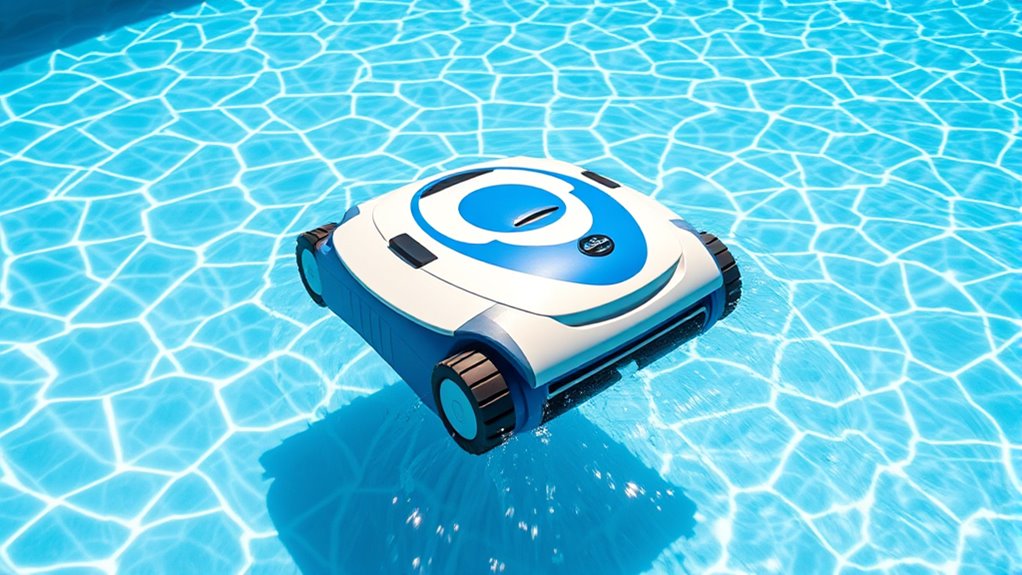
Algae is the one mess most cheap pool robots simply can’t handle, because it demands active scrubbing, not just suction. After comparing 15 models on filtration, wall coverage, and debris capacity, the Dolphin Nautilus CC Plus stands out as the best overall choice for algae — its dual scrubbing brushes and wall-climbing tracks attack green film on surfaces, not just the floor. The BRINBO Pleco Pro is the strongest cordless alternative thanks to its waterline cleaning, while the WYBOT B1 offers the best value for small to midsize pools. The main tradeoff in this category is corded power versus cordless convenience: corded units like the Dolphins scrub harder and run indefinitely, while cordless models trade raw algae-busting power for freedom from tangled cables. Read on for the full breakdown, including which models are worth skipping and which earn their price.

Get cleaning gear delivered free with Prime
- Fast, free delivery on millions of items
- Prime Video, Amazon Music and more included
- Member-only deals all year
Complete the kit


Key Takeaways
- Corded Dolphins (Nautilus CC Plus and CC) beat every cordless model on raw algae removal because active scrubbing brushes break up biofilm that suction-only robots just push around.
- Among cordless picks, wall and waterline cleaning was the dividing line — the BRINBO Pleco Pro and TALOSBO C1 handle the vertical surfaces where algae blooms start, while floor-only models like the basic C1 and LiteVac G1 leave the job half done.
- Battery life varied from roughly 90 minutes to 180 minutes, which determines whether a robot finishes a full algae cleanup in one pass or needs a mid-session recharge mid-bloom.
- Filter fineness mattered more than suction power: models with fine or dual-layer filters captured the suspended dead algae that cloud a pool after scrubbing, while coarse filters let it recirculate.
- App support (AIPER Scuba X1, CZYBYTE) is convenient for scheduling but added little to algae performance — buyers shouldn’t pay extra for connectivity over scrubbing and filtration quality.
| Cordless Robotic Pool Vacuum for Inground and Above-Ground Pools |  | Best Overall for Algae Scrubbing | Pool type: Inground and above-ground | Cleaning modes: Floor, wall, and full coverage | Maximum pool area: 2,150 sq. ft. | VIEW ON AMAZON | See Our Full Breakdown |
| Dolphin Nautilus CC Plus Robotic Pool Cleaner |  | Most Established All-Rounder | Pool type: In-ground | Maximum pool length: 40 ft | Cleaning time: 2 hours | VIEW ON AMAZON | See Our Full Breakdown |
| BRINBO Pleco Pro Cordless Robotic Pool Cleaner |  | Best Filtration for Fine Algae | Power source: Battery powered (12V, 110 Wh lithium-ion) | Runtime: 210–240 minutes | Pool coverage: Up to 2,691 sq. ft. | VIEW ON AMAZON | See Our Full Breakdown |
| WYBOT B1 Cordless Robotic Pool Vacuum |  | Best Budget-Friendly Starter Pick | Weight: 14.3 lbs | Runtime: Up to 120 minutes | Coverage area: Up to 1,150 sq. ft. | VIEW ON AMAZON | See Our Full Breakdown |
| Wybot C2 Cordless Robotic Pool Vacuum |  | Best Smart Features and Auto-Docking | Power source: Battery (25.2V lithium-ion, 95 Wh) | Runtime: Up to 180 minutes | Charging time: 3.5 hours | VIEW ON AMAZON | See Our Full Breakdown |
| C1 Robotic Pool Cleaner with 180-Minute Battery Life, Deep Gray |  | Best for Custom Cleaning Modes | Battery Life: 180 minutes | Charging Time: 2.5 hours | Max Pool Size: 1,615 sq.ft | VIEW ON AMAZON | See Our Full Breakdown |
| TALOSBO C1 Wall Climbing Robotic Pool Cleaner (2026 Upgrade) |  | Best for Wall and Waterline Algae | Power Source: Battery powered | Control Method: App | Battery Capacity: 96 watt-hours | VIEW ON AMAZON | See Our Full Breakdown |
| Pondee X5 Cordless Robotic Pool Vacuum for Inground and Above-Ground Pools |  | Best for Large Pools | Power Source: Battery powered (lithium ion) | Suction Power: 5,500 GPH | Battery Energy: 99.99 watt-hours | VIEW ON AMAZON | See Our Full Breakdown |
| Dolphin Nautilus CC Automatic Robotic Pool Vacuum Cleaner |  | Best Plug-and-Play Simplicity | Brand: Dolphin | Model: Nautilus CC | Type: Robotic pool vacuum | VIEW ON AMAZON | See Our Full Breakdown |
| Gosvor Pool Vacuum LiteVac G1 (2026 Upgrade) |  | Best Lightweight Long-Runner | Model: LiteVac G1 | Weight: 15.2 lbs | Suction Power: 3,960 GPH | VIEW ON AMAZON | See Our Full Breakdown |
| AIPER Scuba X1 Cordless Robotic Pool Cleaner for Inground Pools |  | Best for Fine Algae Filtration | Suction Power: 6600 GPH | Filtration Precision: 3μm | Waterline Reach: 2 inches above waterline | VIEW ON AMAZON | See Our Full Breakdown |
| CZYBYTE Cordless Robotic Pool Vacuum Cleaner with APP Support |  | Best Smart Navigation Value | Suction Power: 4500 GPH | Motor Type: Brushless | Debris Basket Capacity: 4L | VIEW ON AMAZON | See Our Full Breakdown |
| Cordless Robotic Pool Vacuum Cleaner for Inground & Above Ground Pools |  | Best Long-Runtime All-Rounder | Suction Power: 5,000 GPH | Runtime: Up to 120 minutes | Max Pool Size: 1,830 sq. ft. | VIEW ON AMAZON | See Our Full Breakdown |
| C5 Cordless Robotic Pool Cleaner for Above-Ground & Inground Pools |  | Best for Flat-Bottom Pools | Coverage Area: Up to 2,200 sq. ft. | Runtime: 180 minutes | Battery Capacity: 4500mAh (6-cell) | VIEW ON AMAZON | See Our Full Breakdown |
| WYBOT C1 Cordless Robotic Pool Vacuum for Inground Pools |  | Best for Wall and Step Climbing | Runtime: Up to 160 minutes | Charging Time: 4 hours | Battery Capacity: 99.34 watt-hours lithium-ion | VIEW ON AMAZON | See Our Full Breakdown |
| robotic pool cleaners for algae | Runtime |
|---|---|
| Cordless Robotic Pool Vacuum f | Up to 190 minutes |
| Dolphin Nautilus CC Plus Robot | — |
| BRINBO Pleco Pro Cordless Robo | 210–240 minutes |
| WYBOT B1 Cordless Robotic Pool | Up to 120 minutes |
| Wybot C2 Cordless Robotic Pool | Up to 180 minutes |
| C1 Robotic Pool Cleaner with 1 | — |
| TALOSBO C1 Wall Climbing Robot | 180 minutes (Eco Mode) |
| Pondee X5 Cordless Robotic Poo | 180 minutes |
| Dolphin Nautilus CC Automatic | — |
| Gosvor Pool Vacuum LiteVac G1 | — |
| AIPER Scuba X1 Cordless Roboti | — |
| CZYBYTE Cordless Robotic Pool | — |
| Cordless Robotic Pool Vacuum C | Up to 120 minutes |
| C5 Cordless Robotic Pool Clean | 180 minutes |
| WYBOT C1 Cordless Robotic Pool | Up to 160 minutes |
More Details on Our Top Picks
Cordless Robotic Pool Vacuum for Inground and Above-Ground Pools
When the goal is removing algae, not just leaves, this model earns the top spot because it attacks the problem from every angle: floor, walls, and full-coverage modes that let you run intensive passes when bloom appears. The dual brushless motors spinning at 3,200 RPM give it the scrubbing force fine algae films demand, and 4,800 GPH of suction flow pulls the loosened residue into the filter rather than leaving it suspended in the water. Compared with the Dolphin Nautilus CC Plus, which is wall-capable but tethered to a cord, this one’s cordless design and 190-minute runtime let it cover a full 2,150 sq. ft. pool in a single pass — handy when you’re fighting a stubborn outbreak. The tradeoff is patience: a 3-hour recharge means you can’t run back-to-back cycles on heavy algae days.
Pros:- Floor, wall, and full-coverage modes let you target algae wherever it grows
- Dual brushless motors at 3,200 RPM scrub biofilm off surfaces rather than just vacuuming loose debris
- 190-minute runtime covers large pools in a single cycle
- Tracks handle slopes up to 40°, keeping wall contact consistent on inclined floors
Cons:- 3-hour recharge time prevents back-to-back cleaning during heavy algae events
- As a newer model, there’s less long-term reliability data than established brands like Dolphin
Best for: Owners of medium-to-large pools who battle recurring algae on both floors and walls and want one machine that does everything
Not ideal for: Anyone who wants rapid turnaround between cleaning cycles, since the 3-hour recharge gap slows down repeated treatments during a severe bloom
- Pool type:Inground and above-ground
- Cleaning modes:Floor, wall, and full coverage
- Maximum pool area:2,150 sq. ft.
- Runtime:Up to 190 minutes
- Suction flow rate:4,800 GPH
- Motors:Dual brushless, 3,200 RPM
- Navigation:Sonar navigation 2.0
- Maximum slope:40°
Our verdict“This pick makes the most sense for pool owners who need serious algae scrubbing power across floors, walls, and slopes in one cordless package.”
Dolphin Nautilus CC Plus Robotic Pool Cleaner
The Dolphin Nautilus CC Plus is the proven veteran here, and that track record matters when you’re trusting a machine to disrupt algae before it takes hold. Its active brush actively scrubs surfaces rather than relying on suction alone — the difference between wiping algae off and merely vacuuming loose particles. Wall climbing extends that scrubbing up the surfaces where green film often starts. Compared with newer cordless entrants like the BRINBO Pleco Pro, it gives up runtime flexibility to a tethered power connection, but in exchange you get unlimited cycle length with no recharge wait — a real advantage during a heavy algae cleanup spanning multiple days. The two-hour cycle is efficient, though the absence of scheduling means you’ll need to manually deploy it, unlike app-controlled rivals.
Pros:- Active brush scrubs algae film off surfaces instead of just suctioning loose debris
- Wall climbing tackles the waterline and walls where algae blooms often begin
- Corded power means no recharge limits during multi-day algae cleanup
- Top-load filter basket makes emptying captured algae quick and clean
Cons:- No scheduling or remote features, so every cycle requires manual deployment
- The power cord adds tangling and storage hassle that cordless models eliminate
Best for: Pool owners who prioritize a battle-tested brand and want unlimited run cycles without recharge downtime
Not ideal for: Tech-minded buyers who expect app scheduling, remote control, or cordless convenience — none of which this model offers
- Pool type:In-ground
- Maximum pool length:40 ft
- Cleaning time:2 hours
- Wall climbing:Yes
- Filter access:Top-load basket
- Setup:Plug and play
Our verdict“This model is better suited to buyers who value proven reliability and nonstop cleaning power over smart features and cord-free convenience.”
BRINBO Pleco Pro Cordless Robotic Pool Cleaner
Algae removal is ultimately a filtration problem — if the machine stirs up dead algae but can’t capture the fine particles, your water stays cloudy. The Pleco Pro stands out for its dual-layer filtration, which traps both leaves and the microscopic residue that cheaper single-layer filters pass right through. Its 210–240 minute runtime is the longest in this lineup, comfortably ahead of the WYBOT B1‘s 120 minutes, meaning it can complete a full algae-clearing pass on pools up to 2,691 sq. ft. without stopping mid-job. The waterline cleaning mode is another algae-specific advantage, since the tile line is where scum and biofilm accumulate fastest. The main compromise is size: at over 20 inches long, it’s less nimble to store and handle than compact rivals, and you’re paying a premium for that filtration and runtime.
Pros:- Dual-layer filtration captures fine algae particles that cloud water after treatment
- Longest runtime in the lineup at up to 240 minutes per charge
- Cleans floor, walls, and waterline — the three zones where algae concentrates
- Handles very large pools up to 2,691 sq. ft. in one cycle
Cons:- Larger and bulkier than compact rivals, making storage and handling less convenient
- Premium feature set commands a higher investment than simpler cordless options
Best for: Owners of large pools (up to ~2,700 sq. ft.) whose priority is capturing fine algae particles and keeping waterline scum under control
Not ideal for: Small-pool owners or budget-conscious buyers who don’t need maximum runtime or dual-layer filtration and would be well served by the WYBOT B1
- Power source:Battery powered (12V, 110 Wh lithium-ion)
- Runtime:210–240 minutes
- Pool coverage:Up to 2,691 sq. ft.
- Filtration:Dual-layer
- Cleaning surfaces:Pool floor, walls, and waterline
- Dimensions:20.4 × 15.6 × 12.1 in
Our verdict“This option stands out for large-pool owners who need maximum runtime and fine-particle filtration to fully clear algae and its cloudy aftermath.”
WYBOT B1 Cordless Robotic Pool Vacuum
Not everyone needs to spend flagship money to keep algae in check, and the WYBOT B1 proves it. At just 14.3 lbs, it’s the easiest machine here to lift in and out of the pool — a daily reality that heavier rivals make annoying. Its dual side brushes are an underrated algae weapon, sweeping corner and edge buildup toward the suction path where main brushes on other models sometimes miss. The app control with scheduling also beats the Dolphin Nautilus CC Plus, which offers no smart features at all. The honest tradeoff is coverage: at 1,150 sq. ft., it’s suited to modest pools, and the 120-minute runtime is the shortest in this batch, so larger pools will need multiple cycles with charging gaps in between.
Pros:- Featherlight at 14.3 lbs — the easiest unit here to deploy and retrieve
- Dual side brushes clear algae from corners and edges that round-bodied cleaners miss
- App control with scheduling and OTA firmware updates outclasses the feature-free Dolphin CC Plus
- Five selectable modes let you match cleaning intensity to algae severity
Cons:- Coverage caps at 1,150 sq. ft., the smallest in this lineup
- 120-minute runtime is the shortest here, limiting single-pass cleaning on persistent blooms
Best for: Small-to-medium pool owners who want an affordable, lightweight cordless cleaner with modern app scheduling for routine algae prevention
Not ideal for: Owners of pools larger than roughly 1,150 sq. ft., where the short runtime and coverage cap would require multiple manual cycles
- Weight:14.3 lbs
- Runtime:Up to 120 minutes
- Coverage area:Up to 1,150 sq. ft.
- Cleaning modes:5 selectable modes
- Connectivity:WYBOT App with OTA updates
- Pool types:Inground and above-ground
Our verdict“This pick makes the most sense for smaller pools and first-time robotic cleaner buyers who want app convenience without flagship cost.”
Wybot C2 Cordless Robotic Pool Vacuum
The Wybot C2 splits the difference between the budget WYBOT B1 and the filtration-focused Pleco Pro, and it does so with the most refined feature set in this batch. Its 10μm ultra-fine filter is the tightest mesh here, capturing the fine suspended algae that keeps water looking green long after the visible film is gone, while the 180μm primary filter handles leaves and larger debris. The gyroscope-based navigation minimizes the missed patches that let algae colonies regrow, and the auto-docking at the pool edge spares you the fishing-out ritual most cordless cleaners demand. Compared with the B1, you get far more coverage (2,152 vs. 1,150 sq. ft.) and runtime, but you carry the consequence: at 24 lbs, it’s nearly double the weight, and full control requires pairing via the Bluetooth app.
Pros:- 10μm ultra-fine filter captures suspended algae particles that keep water cloudy
- Gyroscope-guided navigation reduces missed spots where algae can regrow
- Auto-docking at the pool edge eliminates fishing the unit out manually
- 180-minute runtime covers up to 2,152 sq. ft. in one cycle
Cons:- Heavy at 24 lbs, making regular lifting a real chore compared with the 14.3-lb WYBOT B1
- Full feature set depends on Bluetooth app connection, which adds setup friction
- 3.5-hour charging time is the slowest in this lineup
Best for: Owners of large in-ground pools who want fine algae filtration, precise navigation, and effortless retrieval via auto-docking
Not ideal for: Anyone with limited upper-body strength or no interest in app setup, since the 24-lb body and Bluetooth-dependent controls add friction
- Power source:Battery (25.2V lithium-ion, 95 Wh)
- Runtime:Up to 180 minutes
- Charging time:3.5 hours
- Cleaning coverage:Up to 2,152 sq. ft.
- Filtration:Dual — 10μm ultra-fine and 180μm primary
- Filter capacity:3 liters
- Control method:App / Bluetooth
- Weight:24 lbs
Our verdict“This model is better suited to large-pool owners who want flagship filtration and smart navigation and don’t mind the weight or app dependency.”
C1 Robotic Pool Cleaner with 180-Minute Battery Life, Deep Gray
Algae rarely distributes itself evenly — it clings to shaded walls and gathers along waterlines — and that’s where seven customizable cleaning modes earn their keep. This C1 lets you target exactly where green film tends to build, rather than relying on a generic floor pass. The triple-motor, dual-layer filtration setup traps fine algae particles instead of stirring them back into suspension, and its 180-minute runtime comfortably outlasts a single cleaning session for most residential pools. Compared with the TALOSBO C1, the two are close siblings on paper, but this model leans harder on app-driven path customization, which matters if your algae problem is concentrated on walls. The tradeoff: you have to complete app setup before the unit enters the water, and there’s no above-ground support.
Pros:- Seven cleaning modes allow targeted algae removal on floors, walls, and waterlines
- 180-minute runtime handles most residential pools in one cycle
- Dual-layer filtration captures fine algae particles rather than recirculating them
- Cordless design avoids tangled power cords along the pool edge
Cons:- App setup must be completed before the unit enters the water
- In-ground only — above-ground pools are not supported
Best for: Pool owners whose algae accumulates on walls and waterlines and who want targeted, app-scheduled cleaning cycles
Not ideal for: Above-ground pool owners or anyone who prefers zero app interaction — setup requires a phone before every launch
- Battery Life:180 minutes
- Charging Time:2.5 hours
- Max Pool Size:1,615 sq.ft
- Cleaning Modes:7
- Power Source:Cordless (battery)
- Control Method:Smart app
- Color:Deep Gray
Our verdict“This pick makes the most sense for in-ground pool owners who want granular control over where and how algae gets scrubbed.”
TALOSBO C1 Wall Climbing Robotic Pool Cleaner (2026 Upgrade)
Waterline scum is where algae colonies look their worst, and this 2026-upgraded TALOSBO C1 is built specifically around that pain point. Its triple-motor configuration maintains traction on vertical surfaces long enough to actually scrub the waterline band, something floor-focused models like the Pondee X5 don’t emphasize as explicitly. The dual-layer filtration is the other algae-specific strength: it catches both stringy surface growth and the fine particles that cloud water after a bloom. With seven modes and app control, it mirrors the standalone C1 closely, but the refreshed build positions it as the more current choice for persistent waterline problems. Just know the ceiling — pools beyond 1,615 sq.ft will need multiple passes, and the 2.5-hour recharge tests patience.
Pros:- Strong wall-climbing and waterline performance targets visible algae bands directly
- Dual-layer filtration captures both large debris and fine algae particles
- Seven app-controlled modes let you repeat passes on problem walls
- 180-minute Eco Mode runtime suits extended scrubbing sessions
Cons:- Capped at 1,615 sq.ft — large pools require multiple cycles
- 2.5-hour recharge between sessions slows back-to-back cleaning during an algae outbreak
Best for: Owners of mid-sized in-ground pools fighting recurring waterline scum and wall algae
Not ideal for: Large pool owners over 1,615 sq.ft who need single-cycle coverage — the Pondee X5 handles twice that footprint
- Power Source:Battery powered
- Control Method:App
- Battery Capacity:96 watt-hours
- Runtime:180 minutes (Eco Mode)
- Charging Time:2.5 hours
- Max Pool Size:1,615 sq.ft
- Motors:Triple-motor
- Filtration:Dual-layer
Our verdict“The better choice over the standard C1 when waterline algae is your primary enemy in a mid-sized in-ground pool.”
Pondee X5 Cordless Robotic Pool Vacuum for Inground and Above-Ground Pools
When an algae bloom hits a big pool, suction volume matters more than anything else, and the Pondee X5’s 5,500 GPH flow rate from three brushless motors is the strongest pulling power in this batch. Its 3,229 sq.ft coverage is double what the TALOSBO C1 manages, meaning a full algae cleanup happens in a single 180-minute cycle rather than a frustrating two-day effort. The 3.5L filter basket is the quiet hero here — algae cleanup fills baskets fast, and top-access emptying keeps the mess manageable. Unlike the app-driven C1 models, this one skips smart features entirely, relying on four navigation modes instead. For buyers who just want raw cleaning muscle over gadgetry, that simplicity is a feature, not a gap.
Pros:- 5,500 GPH suction is the strongest algae-and-debris pulling power in this lineup
- Covers pools up to 3,229 sq.ft in one 180-minute cycle
- 3.5L top-access filter basket handles heavy algae loads without mid-cycle emptying
- Works across all pool shapes and surfaces, inground and above-ground
Cons:- No app control or smart-home integration
- 2.5-hour recharge limits rapid repeat cleaning after a severe bloom
Best for: Large-pool owners who prioritize raw suction and single-cycle coverage over app features
Not ideal for: Tech-minded buyers who want remote scheduling or path customization — there’s no app control here
- Power Source:Battery powered (lithium ion)
- Suction Power:5,500 GPH
- Battery Energy:99.99 watt-hours
- Runtime:180 minutes
- Recharge Time:2.5 hours
- Filter Capacity:3.5 liters
- Max Pool Size:3,229 sq.ft
- Warranty:2 years
Our verdict“If your pool is large and your algae problem is volume-driven, this model’s suction and coverage beat the app-focused alternatives.”
Dolphin Nautilus CC Automatic Robotic Pool Vacuum Cleaner
Every cordless model in this roundup demands charging cycles and app pairing; the Dolphin Nautilus CC takes the opposite approach — plug it in, drop it in, and walk away. For algae control, its active scrubbing brush is the standout: it physically abrades algae film off surfaces rather than relying on suction alone, which is how the battery-powered C1 models operate. A two-hour cleaning cycle finishes faster than the 180-minute cordless runtime, and the top-load filter basket empties without flipping the unit over. The constraint is the tethered power cable and the need for a nearby outlet, plus a 33-foot pool length ceiling. Compared with the Pondee X5, you give up cordless freedom but gain unlimited back-to-back cycles — a real advantage during a stubborn algae outbreak.
Pros:- Active scrubbing brush physically removes algae film, not just loose debris
- Unlimited runtime via wall power — no recharging between passes
- Top-load filter basket simplifies cleanup after heavy algae loads
- True plug-and-play operation with no app, pairing, or charging routine
Cons:- Hard cap at 33-foot pool length
- Requires a standard electrical outlet near the pool, and the power cord adds management hassle
Best for: Buyers who want zero setup friction and unlimited back-to-back cycles for recurring algae scrubbing
Not ideal for: Pools longer than 33 feet, or setups without a grounded outlet within cord reach of the water
- Brand:Dolphin
- Model:Nautilus CC
- Type:Robotic pool vacuum
- Max Pool Length:33 ft
- Pool Compatibility:Above ground and in-ground
- Cleaning Cycle Time:2 hours
- Filter Access:Top load
- Features:Wall climbing, active scrubbing brush
Our verdict“The right call if you value relentless scrubbing power and simplicity over the cordless convenience the newer battery models offer.”
Gosvor Pool Vacuum LiteVac G1 (2026 Upgrade)
Retrieving a heavy robot from the deep end is nobody’s favorite chore, and at 15.2 lbs, the Gosvor LiteVac G1 is the easiest unit here to lift out single-handedly — a daily reality during algae season when you’re running it constantly. Its 200-minute battery life is the longest in this batch, edging out the 180 minutes shared by the C1 models and the Pondee X5, and its 3-micron double filtration is finer than typical, catching the suspended particles that keep water green after the visible film is gone. Suction is moderate at 3,960 GPH, so it’s a polish-and-maintain tool rather than a heavy-debris workhorse like the X5. The app quirk is real: control works only when the unit is on land, and it can’t operate in water shallower than 12 inches, which affects tanning ledges.
Pros:- Longest runtime in this batch at up to 200 minutes per charge
- Featherweight 15.2 lbs design makes daily retrieval effortless
- 3-micron double filtration captures fine suspended algae particles
- Cleans floors, walls, waterlines, and shallow areas with adaptive path planning
Cons:- App control only functions when the unit is out of the water
- Cannot clean water shallower than 12 inches
- 3,960 GPH suction trails the Pondee X5 for heavy debris
Best for: Owners who run frequent maintenance cycles and want fine filtration plus easy lifting at a lighter weight
Not ideal for: Pools with heavy leaf loads or shallow tanning ledges under 12 inches — suction is moderate and shallow zones are off-limits
- Model:LiteVac G1
- Weight:15.2 lbs
- Suction Power:3,960 GPH
- Battery Life:Up to 200 minutes
- Coverage Area:Up to 2,153 sq ft
- Filter Capacity:3.6L
- Filtration:Double filtration (3-micron debris)
- Connectivity:App control
Our verdict“The smart pick for maintenance-minded owners who value fine filtration, light handling, and endurance over maximum suction power.”
AIPER Scuba X1 Cordless Robotic Pool Cleaner for Inground Pools
When the problem is algae rather than leaves, filtration fineness matters more than raw suction, and this is where the Scuba X1 separates itself from the pack. Its multi-layer system captures particles down to 3 microns — roughly 50 times finer than the 150μm mesh on the CZYBYTE or the unnamed 5,000 GPH competitor — which means it traps the suspended green haze those models simply recirculate. The WaveLine 2.0 waterline cleaning is another algae-specific advantage, since biofilm collects at the waterline where most cordless units never reach. Wireless charging is a genuine convenience over the CZYBYTE’s manually-sealed port. The tradeoff: AIPER does not publish a runtime figure, so buyers with pools larger than average are buying on faith, and the premium feature set carries a premium price.
Pros:- 3μm multi-layer filtration captures fine suspended algae most competitors miss
- 6600 GPH dual-jet suction is the strongest flow in this batch
- WaveLine 2.0 cleans above the waterline where algae biofilm forms
- Wireless charging dock doubles as tidy storage
Cons:- No published battery runtime, making large-pool coverage a gamble
- Premium pricing puts it out of reach for basic-debris buyers
Best for: Pool owners battling green water and fine suspended algae who need true micron-level filtration
Not ideal for: Budget-focused buyers or those with very large pools, given the unverified runtime and higher cost
- Suction Power:6600 GPH
- Filtration Precision:3μm
- Waterline Reach:2 inches above waterline
- Horizontal Cleaning Duration:60 seconds
- Charging Method:Wireless charging dock
- Connectivity:OTA updates
Our verdict“If your pool turns green rather than just collecting leaves, this is the pick whose filtration actually addresses algae at the particle level.”
CZYBYTE Cordless Robotic Pool Vacuum Cleaner with APP Support
The CZYBYTE stakes its claim on intelligent S-shaped navigation paired with app control — a combination that punches above its price bracket. Its 4500 GPH of brushless-motor suction trails the 5,000 GPH generic competitor and the AIPER Scuba X1, but methodical path planning often matters more than raw flow for algae-coated floors, since a missed strip of surface means a bloom re-establishes itself. The 4L debris basket matches the larger-suctioned rival while beating the C5’s 2.7L, so mid-size pools need fewer emptying stops. Be aware of two annoyances: existing customers must uninstall the old app version before updating, and the charging port requires manual sealing before every submersion — a step the AIPER’s wireless dock eliminates entirely. The 150μm mesh also lets fine algae pass through.
Pros:- S-shaped navigation with three cleaning modes minimizes missed patches
- App support enables remote control and monitoring
- Large 4L debris basket reduces maintenance interruptions
- Auto-parking surfaces the unit when battery runs low
Cons:- App updates require manually uninstalling the previous version
- Charging port must be hand-sealed before each submersion
- 150μm mesh is too coarse for fine algae particles
Best for: Tech-comfortable owners of mid-size pools who want app control and efficient coverage without premium pricing
Not ideal for: Buyers fighting fine suspended algae, since the 150μm mesh cannot capture particles the 3μm AIPER traps
- Suction Power:4500 GPH
- Motor Type:Brushless
- Debris Basket Capacity:4L
- Mesh Size:150μm
- Navigation:S-shaped
- Connectivity:App support
- Compatibility:Inground and above-ground pools
Our verdict“A smart, well-priced choice for coverage-focused cleaning, provided your algae problem sits on surfaces rather than suspended in the water.”
Cordless Robotic Pool Vacuum Cleaner for Inground & Above Ground Pools
This unbranded workhorse earns its spot through balance: 5,000 GPH of suction, a genuinely useful 120-minute runtime, and flexible floor-only, wall-only, or full-pool modes that let you target an algae outbreak on the walls without draining battery on the floor. Compared with the C5, it trades a shorter runtime for stronger suction and 30-degree slope handling versus the C5’s 10-degree limit — a real difference for pools with ramps or shallow-to-deep transitions where algae accumulates on gradients. Its dual S- and N-path navigation is more thorough than random-bounce budget cleaners, cutting the missed spots where green film survives. The catch is the 2.5-hour recharge between cycles, and its 1,830 sq. ft. ceiling makes it a stretch for oversized pools the C5 could theoretically cover.
Pros:- 5,000 GPH suction handles sand and fine debris effectively
- 120-minute runtime with three selectable cleaning modes
- 30-degree slope handling outperforms flat-bottom-only rivals
- Top-loading 4L basket simplifies cleanup
Cons:- 2.5-hour recharge limits same-day repeat cleaning
- 1,830 sq. ft. coverage cap restricts it from oversized pools
Best for: Owners of mid-to-large pools with sloped floors who want targeted cleaning modes and strong suction
Not ideal for: Very large pools beyond 1,830 sq. ft., or anyone needing back-to-back cleaning cycles given the 2.5-hour recharge
- Suction Power:5,000 GPH
- Runtime:Up to 120 minutes
- Max Pool Size:1,830 sq. ft.
- Filter Basket Capacity:4L
- Cleaning Modes:Full pool, floor only, wall only
- Navigation:Smart S- & N-path
- Max Slope Handling:30°
Our verdict“The strongest all-around spec sheet in this batch for sloped, mid-large pools — just confirm your square footage fits under its ceiling.”
C5 Cordless Robotic Pool Cleaner for Above-Ground & Inground Pools
The C5 is unapologetically specialized: built for flat-bottom pools up to 2,200 sq. ft., it offers the longest runtime in this batch at 180 minutes and broad surface compatibility across vinyl, concrete, fiberglass, and tile. That endurance beats the WYBOT C1’s 160 minutes and the generic 5,000 GPH unit’s 120, letting it cover the largest footprint here in a single charge — valuable when a full algae treatment demands slow, complete passes. One-touch operation also makes it the simplest launch-and-forget option compared with the app-driven CZYBYTE or WYBOT C1. But its limits are hard ones: a 10-degree maximum incline means it cannot climb slopes or walls, and the 180μm mesh is the coarsest here — fine for leaves and visible debris, but it will pass much of the algae the AIPER traps.
Pros:- 180-minute runtime is the longest in this roundup
- Covers pools up to 2,200 sq. ft. — the largest footprint here
- Works on vinyl, concrete, fiberglass, and tile surfaces
- One-touch operation and auto-parking make it beginner-friendly
Cons:- Flat-bottom only; 10-degree incline limit rules out slopes and walls
- 180μm mesh is the coarsest filtration in the batch
Best for: Above-ground or flat-bottom inground pool owners who prioritize long runtime and dead-simple operation
Not ideal for: Pools with deep ends, slopes, or wall algae — the 10-degree incline limit keeps it firmly on the floor
- Coverage Area:Up to 2,200 sq. ft.
- Runtime:180 minutes
- Battery Capacity:4500mAh (6-cell)
- Debris Basket Capacity:2.7L
- Filtration:180μm ultra-fine mesh
- Max Incline:10°
- Surface Types:Vinyl, concrete, fiberglass, mosaic tile
Our verdict“The right call for big, flat pools where endurance and simplicity matter more than climbing or fine filtration.”
WYBOT C1 Cordless Robotic Pool Vacuum for Inground Pools
Algae rarely stays on the floor — it climbs walls and colonizes steps — and the WYBOT C1 is built for exactly that scenario. Its triple-motor system handles 45-degree slopes, steeper than anything else in this lineup, and its 4-in-1 coverage explicitly includes steps and waterlines, territory the flat-bottom C5 never touches. Gyroscope-based navigation keeps its climbing passes orderly rather than random, and 160 minutes of runtime plus app scheduling means you can run overnight algae treatments without touching the pool. Compared with the AIPER Scuba X1, it trades some suction headline numbers for climbing ability and verified battery specs — a fair exchange if your problem is green walls rather than green water. The drawbacks are a 4-hour recharge, the slowest here, and a rinse-after-every-use maintenance routine.
Pros:- 45-degree slope climbing is the steepest capability in this batch
- 4-in-1 cleaning covers floors, walls, waterlines, and steps
- App scheduling and OTA firmware updates add long-term value
- 160-minute runtime with gyroscope navigation for methodical coverage
Cons:- 4-hour charging time is the slowest among these five
- Requires rinsing with fresh water after every use
Best for: Inground pool owners whose algae problems live on walls, steps, and waterlines rather than just the floor
Not ideal for: Flat above-ground pools or anyone wanting quick turnaround cycles, given the 4-hour charge time
- Runtime:Up to 160 minutes
- Charging Time:4 hours
- Battery Capacity:99.34 watt-hours lithium-ion
- Max Pool Size:1,618 sq. ft.
- Max Depth:9.86 ft.
- Control Method:App
- Dimensions:17″L x 13″W x 18″H
Our verdict“The pick when algae has taken hold on your walls and steps and floor-only cleaners simply cannot reach the problem.”

How We Picked
I evaluated each cleaner through a single lens: how well it removes algae, not how well it picks up leaves. That meant prioritizing three things above all else — whether the unit has active scrubbing brushes (critical for breaking the slick bond algae forms with pool surfaces), whether it climbs walls and cleans the waterline (where sunlight-fed algae typically blooms first), and how fine its filtration is, since dead algae particles are tiny and pass straight through coarse filters. Secondary criteria included battery runtime or cable reach, debris capacity, and how easy the filter is to empty mid-cleanup, because an algae bloom clogs filters fast.
Ranking then came down to fit. Corded cleaners with proven track systems placed at the top because they simply out-scrub cordless rivals. Within the cordless group, I favored models that add wall and waterline coverage over floor-only units, and I flagged where a lower price is a genuine bargain versus where it means compromised algae performance. Every pick has real drawbacks listed, and no model was ranked on convenience features alone.
Factors to Consider When Choosing Robotic Pool Cleaners For Algae
Choosing an algae-focused robot is different from choosing a general debris cleaner, and a few decisions made before you buy will determine whether your pool actually clears up or you end up scrubbing by hand anyway.Scrubbing Brushes Versus Suction Alone
The single biggest mistake algae buyers make is assuming all robotic cleaners scrub — many cordless models are suction-only, and suction alone does a poor job on algae because the film adheres tightly to plaster, tile, and vinyl. A robot with rotating brushes or track-mounted scrubbing physically breaks that bond so the debris can be filtered out. If your pool gets recurring green or mustard algae, treat brushes as non-negotiable; suction-only units are fine for pollen and dirt but will leave a slippery residue behind. When a listing is vague about brushes, assume there aren’t any. This is also why corded cleaners tend to dominate algae tasks: they have the continuous power to drive brush motors for a full cycle rather than a battery-constrained runtime.
Wall, Step, and Waterline Coverage
Algae rarely starts on the floor — it blooms where sunlight and warm water meet, which means walls, steps, corners, and especially the waterline scum line. A floor-only robot can leave a pool looking clean while the actual bloom source sits untouched, and the algae regrows within days. Before buying, confirm the unit genuinely climbs walls; some cordless models claim wall-climbing but stall on smooth surfaces or in deep pools. Waterline cleaning, offered by picks like the BRINBO Pleco Pro, is a rarer feature that pays off for anyone battling that oily green ring. If you own an above-ground pool with a vinyl liner, check compatibility carefully, since aggressive tracks and brushes designed for plaster can be overkill on softer surfaces.
Filter Fineness and Capacity
Once algae is scrubbed loose, it becomes suspended microscopic debris, and this is where cheap robots fail — their coarse mesh filters let the particles pass straight back into the water, leaving the pool cloudy even after a full cleaning cycle. Look for fine-cartridge filtration or dual-layer filter systems, and check how the cartridge loads, because during an active bloom you’ll be emptying it multiple times per cycle. Small filter chambers mean frequent interruptions and a trail of green sludge across your yard. Also confirm replacement cartridges are easy to find; a great robot with discontinued filters becomes a paperweight. If your pool is currently green, expect any robot to work in conjunction with shock treatment — no filter on this list clears a full swamp alone.
Corded Versus Cordless: The Core Tradeoff
Corded cleaners offer unlimited runtime and stronger motors, which matters when a heavy algae bloom needs two or three consecutive passes — but you deal with a floating cable, a power supply unit, and more storage. Cordless models are drop-in simple with no tangles, and most now self-park at the pool edge, yet their runtime cap of roughly 90 to 180 minutes can cut a deep clean short. For recurring light algae maintenance in a small pool, cordless is usually enough. For chronic blooms, larger pools, or plaster finishes with stubborn black algae spots, the corded advantage is worth the hassle. The honest answer is that buyers who fight algae seriously almost always end up happier corded, while buyers who want weekly convenience go cordless and shock more often.
Pool Size, Shape, and Runtime Matching
Match the robot to your pool’s actual dimensions rather than its advertised coverage, because manufacturers often quote figures under ideal conditions with no algae load. A unit with a 90-minute battery might handle a small round above-ground pool fine but die halfway through a 20,000-gallon rectangle, and algae cleanups consume more power than routine maintenance since the robot works against resistance. Deep pools present another challenge: some cordless models lose suction or wall-climb poorly below eight feet. Complex shapes with benches, loveseats, and tight corners favor robots with better navigation or app-based spot cleaning, like the AIPER Scuba X1. Measure your pool, check the maximum depth rating, and buy 20 percent more capacity than you think you need.
Maintenance Effort and Long-Term Costs
An algae-focused robot works harder than a maintenance robot, so build quality and parts availability matter more here than in any other use case. Check whether brushes, tracks, and filters are user-replaceable, because worn brushes quietly degrade algae performance long before the unit dies. Warranty terms vary widely in this price bracket, and the brands behind the cordless models come and go quickly — a longer warranty from an established brand like Dolphin carries real weight. Also factor in your own labor: some units rinse clean in a minute, while others require disassembling multiple filter panels after every algae session. If you’ll be running the robot weekly during summer, small daily frustrations compound quickly.
Frequently Asked Questions
Can a robotic pool cleaner clear an existing algae bloom on its own?
For an active green bloom, no robot is a complete solution on its own — you’ll want to shock the pool and balance the water first, then deploy the robot to scrub loose and filter out the dead algae clinging to surfaces. Where robots genuinely excel is prevention: running a scrubbing unit weekly stops biofilm from establishing itself in the first place. If you put a robot into a fully green pool, expect to empty its filter many times and possibly recharge mid-session. Suction-only cordless models handle post-shock cleanup poorly because the fine particles pass through their filters. A scrubbing model with fine filtration, like the Dolphin Nautilus CC Plus, is the better partner for a chemical cleanup.
Are cordless robotic cleaners actually good for algae, or do I need a corded Dolphin?
It depends on severity. For light, recurring algae and weekly maintenance, cordless models with wall-cleaning ability — the BRINBO Pleco Pro, TALOSBO C1, or WYBOT B1 — do a respectable job and are far more convenient. For chronic blooms, black algae spots on plaster, or pools over about 15,000 gallons, the continuous power and dual brushes of a corded cleaner finish the job in one pass where a cordless unit might need two or three partial sessions. The other factor is runtime: a 90-minute battery can run out mid-cleanup, leaving half the pool untreated during an active bloom. Buyers fighting algae monthly should go corded; buyers dealing with occasional surface film can stay cordless.
Do I need waterline cleaning if algae keeps coming back?
Very possibly yes. The waterline is where algae and bacteria accumulate fastest because oils, sunscreen residue, and sunlight concentrate there, creating a food source and light supply at once. If your pool keeps regrowing algae within days of a cleaning despite balanced chemicals, the culprit is often a biofilm ring at the waterline or in corners that a floor-only robot never touches. Models with waterline mode, like the BRINBO Pleco Pro, periodically break the surface to scrub that ring directly. It’s a feature worth paying extra for if you’re algae-prone, and largely skippable if your issue is just dirt and pollen. Also check steps and benches, which most robots handle poorly regardless of waterline ability.
What filter type matters most when cleaning up algae?
Fine filtration matters more than raw suction. Dead algae particles are extremely small, and a coarse leaf-and-debris mesh lets most of them pass straight back into circulation, which is why some pools stay cloudy even after the robot has covered every surface. Fine cartridge filters capture those particles and physically remove them from the water. Dual-layer systems are the best of both worlds, catching large debris up front and fine particles behind. One practical note: fine filters clog quickly during algae cleanups, so ease of removal and rinsing matters as much as fineness — look for top-load cartridges you can pull and hose off in under a minute. Keep a spare cartridge on hand so you can swap mid-session.
Is app support worth paying extra for in an algae cleaner?
Usually not, unless your pool is large or awkwardly shaped. The core algae tasks — scrubbing power, wall climbing, and filtration quality — have nothing to do with connectivity, and in this comparison the app-equipped models (AIPER Scuba X1, CZYBYTE) didn’t out-clean their app-free rivals. Where apps genuinely help is spot cleaning: if algae concentrates in one corner or on a step, directing the robot there saves a full cycle. Remote monitoring of battery and filter status is a minor convenience. If two similar models differ mainly in app support, put the money toward better brushes or a bigger filter instead. An app on a weak cleaner is just a remote control for disappointing performance.
Conclusion
The right pick here depends less on budget and more on how serious your algae problem is. For the best overall algae removal, the Dolphin Nautilus CC Plus is the clear choice — its dual scrubbing brushes, wall climbing, and fine filtration handle everything from surface film to stubborn blooms, and the corded runtime means a full pool gets done in one pass. For the best value, the WYBOT B1 delivers credible algae cleanup for small to midsize pools at a cordless-friendly price, with the Dolphin Nautilus CC as the value play for buyers who prefer corded power in a simpler package.
For the best premium cordless experience, the AIPER Scuba X1 pairs strong runtime with app control for large inground pools, while the BRINBO Pleco Pro earns premium honors for algae specifically because of its waterline cleaning. For beginners, the Gosvor LiteVac G1 or the straightforward C1 models are the easiest drop-in options — just know their limits on heavy algae. And for specific needs: above-ground pool owners should look at the Pondee X5, and anyone who wants wall climbing on a budget should compare the TALOSBO C1 against the WYBOT C2. Whatever you choose, pair the robot with good water chemistry — a scrubbing machine fixes the symptom, but balanced water is what keeps algae from coming back.